The Genesis of a Viral Project

A developer named Martin Peer has created a 3D source code visualizer that has taken the developer community by storm. The project, shared on GitHub, allows users to navigate and explore massive codebases in an immersive three-dimensional space. What started as a personal exploration has quickly gone viral, captivating developers who see it as a novel way to understand complex software architectures. Peer's visualizer tackles millions of lines of code, rendering them at impressive speeds. The most striking aspect is its resource consumption: the tool demands a hefty 21GB of RAM to process and display approximately 2.5 million lines of code. Despite this significant memory footprint, it manages to maintain a fluid experience, achieving over 120 frames per second. This combination of visual fidelity, performance, and high resource requirement has sparked widespread discussion and admiration.
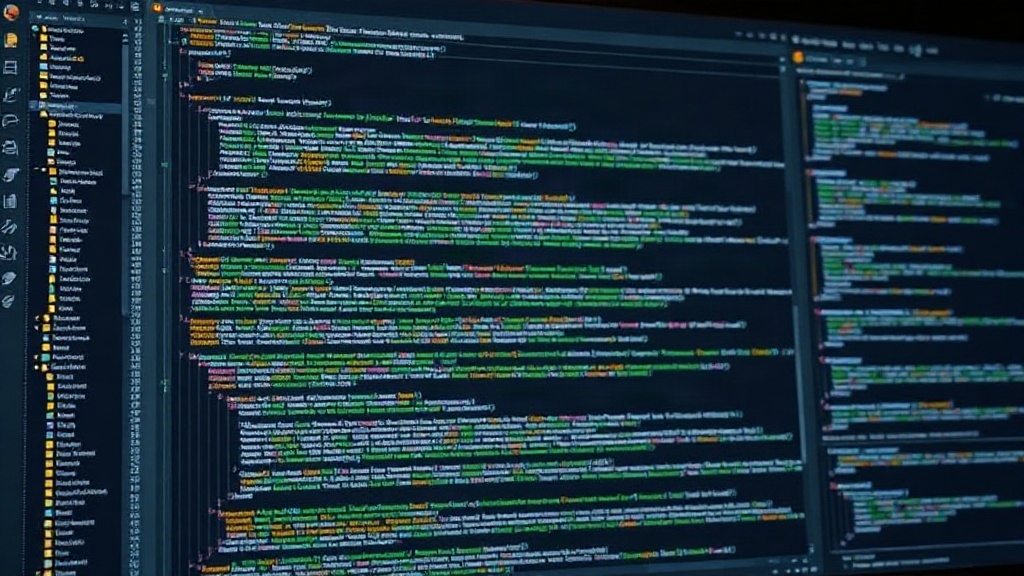
Martin Peer's 3D source code visualizer interface showing a complex software project

Technical Underpinnings and Design Choices

The visualizer's ability to handle vast amounts of code in real-time hinges on several key technical decisions. While specific implementation details are still emerging from community exploration, the core functionality involves parsing source code files, analyzing their structure and relationships, and then translating this information into a navigable 3D environment. This process likely involves sophisticated parsing techniques and efficient data structures to represent the code's hierarchy and dependencies. The sheer scale of data being processed – 2.5 million lines of code – means that the visualizer must be exceptionally efficient in its memory management and rendering pipeline. The 21GB RAM requirement suggests that the entire codebase, or at least a significant portion of its parsed representation, is held in memory for immediate access. This approach prioritizes raw performance and interactivity over minimal resource usage. For developers accustomed to lighter-weight tools, this might seem excessive, but it's a trade-off that enables the fluidity of the 3D navigation. The 120+ FPS frame rate is crucial for a smooth user experience. Achieving this with such a large dataset implies a highly optimized rendering engine, likely leveraging modern graphics APIs and hardware acceleration. Peer's choice to prioritize this level of responsiveness underscores the project's goal: to provide an intuitive and engaging way to explore code, rather than just a static representation.

The Viral Phenomenon and Developer Reaction

The project's viral spread is a testament to the latent desire within the developer community for better tools to comprehend complex software. In a world where codebases can easily grow to millions of lines, understanding the overall structure, identifying dependencies, and spotting potential issues can become a monumental task. Traditional tools often present code in a flat, linear fashion, which struggles to convey the intricate web of relationships that define large-scale software projects. Peer's visualizer offers a new paradigm. By transforming abstract code into a tangible, explorable 3D space, it provides a spatial understanding that is often missing from conventional methods. Developers can literally fly through the architecture, gaining an intuitive grasp of how different modules connect and interact. This approach can be particularly useful for onboarding new team members, debugging complex interactions, or simply for gaining a high-level overview of a system. The high RAM consumption has also become a talking point. Some developers view it as a necessary cost for such advanced visualization, while others ponder the potential for optimization. It highlights a common tension in software development: the balance between feature richness, performance, and resource efficiency. This project leans heavily towards feature richness and performance, showcasing what's possible when resource constraints are not the primary concern. What nobody has addressed yet is how this kind of visualization might evolve to integrate with collaborative development workflows. Could multiple developers navigate the same codebase in real-time 3D, annotating and discussing architectural choices? The potential for team-based code exploration is significant.

Potential Use Cases and Future Development

The implications of Peer's visualizer extend beyond mere novelty. It could serve as a powerful tool for software architecture reviews, enabling teams to identify architectural smells or areas of high complexity more easily. For educational purposes, it offers an engaging way to teach software design principles and patterns by allowing students to interact with real-world, large-scale examples. Security professionals might also find value in this tool. Visualizing code dependencies could help in identifying potential attack vectors or understanding the blast radius of a vulnerability. By seeing the interconnectedness of different code modules, security teams can gain a more comprehensive understanding of the system's security posture. As an open-source project, its future development will likely be shaped by community contributions. Potential enhancements could include support for more programming languages, finer-grained analysis of code metrics (like cyclomatic complexity), integration with IDEs, and perhaps even optimizations to reduce its substantial RAM footprint. The current iteration serves as a compelling proof-of-concept, demonstrating a new frontier in how developers can interact with and understand the software they build.