Beyond Static Links: The MCP Portfolio Server
Traditional developer portfolios, often a curated list of links with READMEs, struggle to convey the interactive nature of modern projects. Ayush Singh Tomar, a developer frustrated by this limitation, decided to transform his own portfolio. Instead of a nicer list of links, he envisioned a system where his projects could be directly queried by AI agents. This led him to build a Model Context Protocol (MCP) server that exposes his nine distinct projects as callable tools, allowing AI clients to interact with them programmatically.
MCP is a standard designed to enable AI clients, such as Claude Desktop, to directly call external tools. This moves beyond simply processing text from static descriptions. By implementing an MCP server for his portfolio, Tomar allows AI to query specific information about his work in real-time. For instance, an AI could be asked, "What has Ayush built with FastAPI?" The server then routes this query to the relevant project tool, retrieving structured data rather than relying on potentially outdated or incomplete README files.
How the MCP Server Works
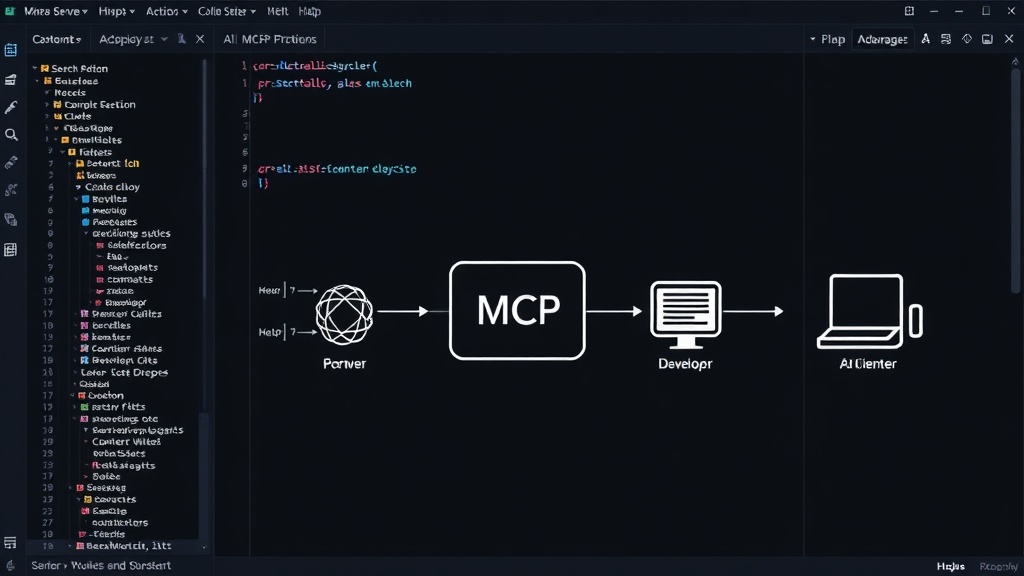
The core idea is to treat each project within the portfolio not as a passive entry, but as an active service. The MCP server acts as an intermediary, translating natural language queries or structured requests from an AI client into API calls or specific functions within each project. This requires each project to expose an interface that the MCP server can understand and interact with. For Tomar's portfolio, this means his projects, whether they are web applications, data analysis scripts, or backend services, are now presented to the AI as distinct tools with defined capabilities.
When an AI client, like Claude Desktop, connects to Tomar's MCP server, it gains access to a catalog of these project-tools. The AI can then formulate queries that leverage these tools. For example, if a user asks about projects involving machine learning, the AI can query the server, which in turn might call a specific function within a project designed for ML model analysis. This function would return structured data about the models, their performance, or the datasets used, providing a far more accurate and dynamic response than a static description could offer.
This approach fundamentally changes how a portfolio can be experienced. Instead of a developer manually curating descriptions and screenshots, the portfolio becomes an interactive demonstration of their capabilities. An AI agent can effectively 'interview' the portfolio, probing for specific skills, technologies, or project outcomes. This is particularly valuable for recruiters or collaborators who want to quickly assess a developer's expertise in niche areas without sifting through lengthy documents.
Technical Implementation and Future Potential
Building an MCP server involves defining the structure for how AI clients can discover and interact with the exposed tools. This typically includes metadata about each tool (project), its functions, and the parameters it accepts. The server then handles the routing of requests and the formatting of responses. Tomar's implementation likely involves creating specific API endpoints or function wrappers for each of his nine projects, enabling them to be called by the MCP server.
The implications of this architecture extend beyond personal portfolios. Imagine a company exposing its internal tools or datasets through an MCP server. Developers or data scientists could then use AI assistants to interact with these resources, accelerating research, debugging, or feature development. This could streamline workflows by allowing natural language queries to trigger complex operations or data retrieval processes that would otherwise require extensive documentation lookup and manual execution.
The surprising detail here is not the concept of exposing services, but the application of a specific AI interaction protocol like MCP to a developer's personal portfolio. It elevates the portfolio from a passive resume to an active, queryable knowledge base. This moves towards a future where AI agents can not only understand what developers have built but can also interact with and utilize those creations directly, fostering a more dynamic and integrated developer ecosystem.
What This Means for Developer Portfolios
This MCP-based portfolio represents a significant shift from the static, document-centric approach. It allows for a more nuanced and interactive demonstration of skills. A potential employer or collaborator can ask precise questions and receive direct, data-driven answers, bypassing the limitations of curated text descriptions. This can lead to more efficient evaluations and a deeper understanding of a developer's capabilities. If you are a developer looking to make your portfolio stand out, consider how your projects could be exposed as queryable services, not just linked resources.
The underlying technology, MCP, is designed to be a standard, suggesting that this approach could be adopted more broadly. As AI agents become more integrated into developer workflows, the ability to expose projects as tools will become increasingly valuable. This isn't just about making a portfolio look different; it's about making it more functional and accessible to the next generation of AI-powered development tools. The question remains: how many other developers will embrace this interactive model, and what new standards will emerge from this shift?