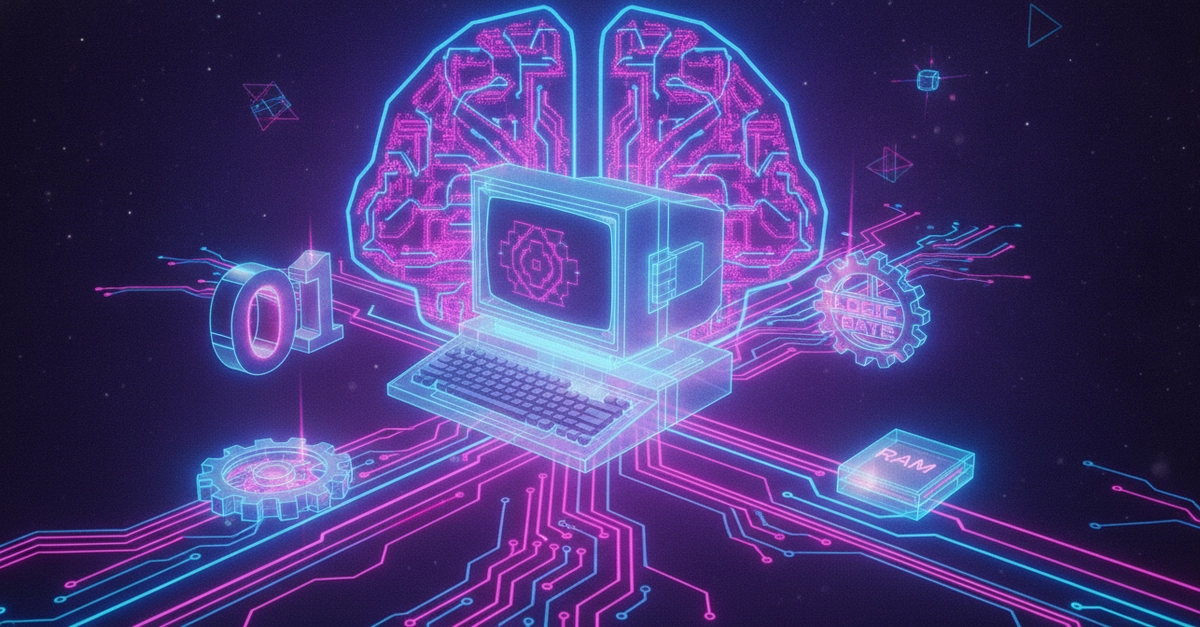
Many software engineers, after years of building applications, hit a wall. They can deploy code, manage databases, and interact with APIs, but the fundamental question— "What is the computer actually doing underneath all of this?"—reveals a surprising lack of clarity. This isn't a formal course, but rather a personal journey to rebuild and solidify foundational computer knowledge.
Why This Matters: Beyond the Abstraction Layer
The software development landscape often encourages focusing on higher-level abstractions. Frameworks, libraries, and cloud services abstract away the intricate details of hardware, operating systems, and network protocols. While this allows for rapid development and innovation, it can leave engineers with a mental model that's fuzzy when probing deeper. Understanding how code translates into machine instructions, how memory is managed, and how data travels across networks is not just academic; it directly impacts debugging, performance optimization, and security. This series aims to bridge that gap, offering a ground-up perspective for those who build on the digital frontier.
The Journey Begins: Hardware Basics
At the core of every computation lies the hardware. This section dives into the essential components that make a computer function. We start with the Central Processing Unit (CPU), the brain of the operation. Understanding its architecture, including cores, threads, clock speed, and instruction sets (like x86 or ARM), is crucial. Beyond the CPU, we explore Random Access Memory (RAM) – its speed, capacity, and how it differs from storage. The motherboard acts as the central nervous system, connecting all components. Storage devices, from traditional Hard Disk Drives (HDDs) to Solid State Drives (SSDs) and NVMe drives, dictate data persistence and access speeds. Finally, input/output (I/O) devices and peripherals enable interaction and connectivity. This foundational hardware knowledge is the bedrock upon which all software operates. Without grasping these physical constraints and capabilities, software design can be inefficient or even flawed.

The Operating System: Managing the Machine
The operating system (OS) is the intermediary between hardware and applications. It's the conductor of the digital orchestra, managing resources and providing a platform for software to run. Key OS functions include process management, memory management, file system management, and device management. Understanding how the OS schedules tasks, allocates memory to different processes, organizes data on storage devices, and communicates with hardware through drivers is vital. Concepts like kernels, system calls, and user space versus kernel space become critical here. For developers, knowing how the OS handles concurrency, inter-process communication (IPC), and file I/O directly influences application design and performance. Different OS families—Windows, macOS, Linux—have distinct architectures and philosophies, but their core responsibilities remain similar.
Data Representation and Computer Arithmetic
How computers store and manipulate data is a fundamental concept often glossed over. At the lowest level, computers operate on binary digits (bits) – 0s and 1s. Understanding how these bits form bytes, and how bytes are used to represent numbers, characters, and other data types, is essential. This includes exploring integer representations (signed vs. unsigned, two's complement), floating-point numbers (IEEE 754 standard), and character encodings (ASCII, UTF-8). Computer arithmetic, while seemingly straightforward, involves understanding the limitations and potential pitfalls of binary calculations, such as overflow and underflow. This knowledge is crucial for accurate data processing, especially in performance-sensitive applications or when dealing with scientific computations.
Networking Fundamentals: The Digital Highway
In today's interconnected world, understanding computer networking is non-negotiable. This section covers the basics of how computers communicate. We start with the OSI model and TCP/IP model, abstract frameworks that define the layers of network communication. Key concepts include IP addressing (IPv4 and IPv6), subnetting, ports, and protocols like TCP (Transmission Control Protocol) and UDP (User Datagram Protocol). TCP provides reliable, ordered delivery, while UDP is faster but less reliable. Understanding how data is encapsulated and de-encapsulated as it travels through these layers is key. Network devices like routers, switches, and firewalls play critical roles in directing traffic. For developers, grasping network latency, bandwidth, and common network topologies helps in designing scalable and responsive distributed systems.
Databases and Data Storage
Beyond simple file storage, databases are specialized systems for organizing, retrieving, and managing data efficiently. This section explores different database paradigms. Relational databases (SQL), like PostgreSQL or MySQL, use structured tables with predefined schemas and relationships, enforcing data integrity through constraints and ACID properties (Atomicity, Consistency, Isolation, Durability). NoSQL databases offer more flexibility, with types like document stores (MongoDB), key-value stores (Redis), column-family stores (Cassandra), and graph databases (Neo4j), each suited for different use cases. Understanding indexing, query optimization, transactions, and data normalization/denormalization is crucial for effective data management. The choice of database significantly impacts application performance and scalability.
The Compilation and Execution Pipeline
Finally, we examine the journey of code from human-readable text to machine-executable instructions. For compiled languages like C++ or Go, this involves a pipeline: preprocessing, compilation (generating assembly code), assembly (generating machine code), and linking (combining object files and libraries). Interpreted languages like Python or JavaScript often involve an interpreter or a Just-In-Time (JIT) compiler, which executes code line-by-line or compiles it to machine code on the fly. Understanding this process helps developers appreciate performance differences, debugging challenges, and the role of compilers and interpreters in the software development lifecycle. This holistic view, from silicon to application logic, completes the picture of what a computer is truly doing.