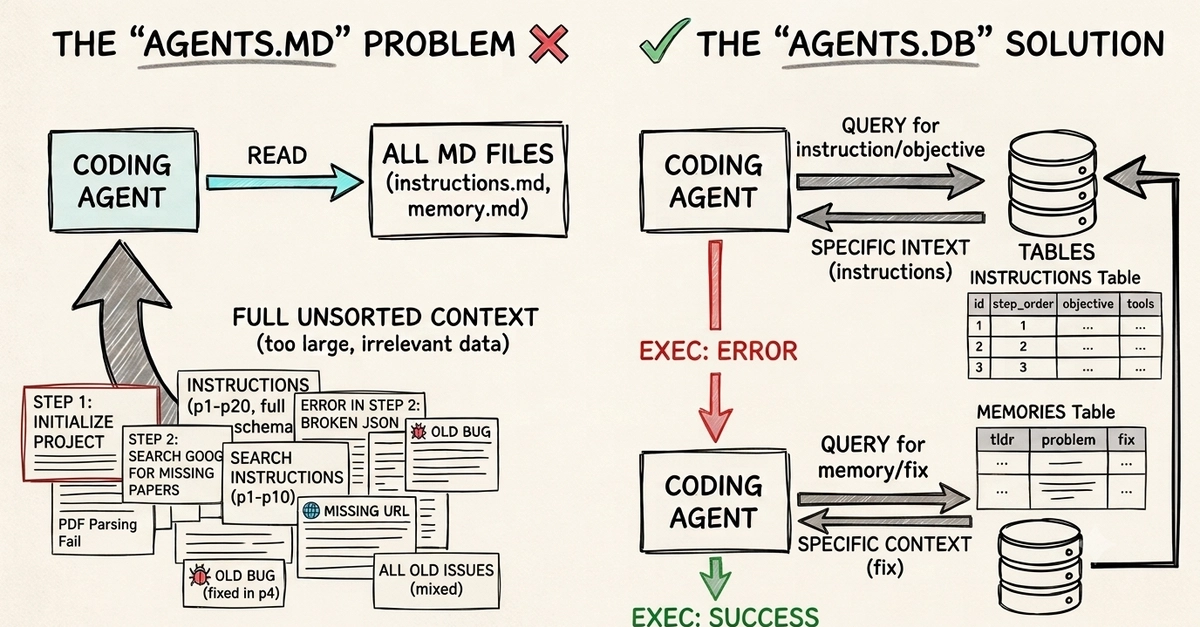
The Problem with Fragile Agent Workflows
Building complex agentic workflows with large language models (LLMs) often encounters a common, frustrating issue: hallucinations. These are instances where the LLM generates outputs that are factually incorrect, nonsensical, or not supported by the provided context. For Exam Intelligence, a company focused on deep analysis and note generation, this problem manifested as unexpected bugs within their end-to-end LangGraph workflow. External factors like missing or unparseable documents, network errors (503s), and malformed JSON outputs from agents derailed the entire process. The initial approach required building an entire coding agent just to manage these edge cases, a sign that the underlying architecture was not robust enough.
Switching to a Structured Database Approach
The core insight for fixing these pervasive hallucinations was to move away from a purely file-based, sequential markdown approach and adopt a more structured, database-centric method. The developer, working with the PI coding agent harness running in a Docker sandbox and using qwen3.6:35b over Ollama, re-architected the workflow. Instead of a single, monolithic workflow, the solution involved creating discrete Command Line Interface (CLI) tools that the coding agent could leverage. Each of these CLI tools represented a specific node or task within the larger process. This modularization allowed the agent to execute these tools sequentially, treating each file as a distinct step or a self-contained workflow to achieve a particular outcome.
This shift to AGENTS.db, conceptually, treats each executable unit as a database entry. This provides several key advantages. Firstly, it enforces structure. Instead of relying on the LLM to correctly interpret and execute instructions embedded within markdown files, the agent interacts with well-defined commands and expected inputs/outputs. This reduces ambiguity and the potential for misinterpretation, a common source of hallucinations. Secondly, it enhances robustness. If a specific CLI tool fails, it fails predictably. The error can be isolated to that specific node, rather than cascading through an entire script and corrupting the overall state. This makes debugging significantly easier and allows for more resilient error handling. The agent can then retry the failed step or fall back to a predefined recovery mechanism.
The Benefits of AGENTS.db
The practical impact of this architectural change was profound. By externalizing agent logic into callable CLI tools managed by a structured system (AGENTS.db), the LLM's role shifted from orchestrating complex, error-prone scripts to intelligently selecting and invoking these specialized tools. This significantly reduced the surface area for hallucinations. The LLM no longer needs to 'invent' steps or parse ambiguous instructions; it simply calls the appropriate tool with the correct parameters. This is akin to a human programmer no longer writing every line of code from scratch but leveraging a well-documented library of functions. Each function performs a specific task reliably, and the programmer's job is to stitch them together effectively.
This structured approach also allows for better state management. Each CLI tool can report its success or failure, along with relevant outputs, back to the agent. This information can be stored and queried, providing a clear audit trail and a reliable history of the workflow execution. Unlike a markdown file that can be easily corrupted or misinterpreted, a database entry offers a much more stable and queryable record. This improved visibility and control are crucial for debugging complex, multi-step LLM applications. The agent can introspect its own execution history, understand where things went wrong, and adapt its strategy accordingly. This makes the entire system more predictable and less prone to the emergent, unexpected behaviors that characterize LLM hallucinations.
Implications for Agentic Workflows
The success of AGENTS.db highlights a broader trend in building reliable LLM applications: the necessity of robust infrastructure. While LLMs provide powerful reasoning and generation capabilities, they are not inherently reliable systems. They require a structured environment to operate within. Relying solely on prompt engineering and markdown files for complex workflows is akin to building a skyscraper on sand. The AGENTS.db approach provides a concrete foundation. It separates the concerns of LLM reasoning from the execution of specific tasks, allowing each component to be optimized independently. Developers can focus on crafting better prompts and agentic strategies, while the underlying system ensures that tasks are executed reliably and predictably.
This pattern is not limited to this specific implementation. Any developer building complex, multi-agent systems should consider how to externalize and structure the execution of discrete tasks. This could involve using traditional databases, task queues, or even custom-built microservices. The key is to move away from ad-hoc, file-based scripting towards a more formalized, robust, and queryable system. The reduction in hallucinations is not just a matter of improving LLM output quality; it's about building systems that are fundamentally more stable, maintainable, and scalable. For founders building AI-powered products, this means transitioning from experimental LLM prototypes to production-ready applications that can be trusted by users.