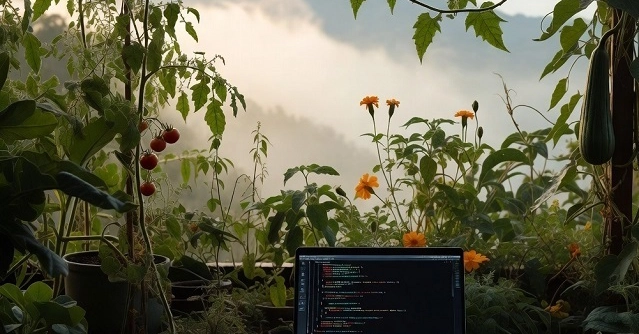
The Garden as an Unconventional Debugging Tool
Many developers face the familiar frustration of being stuck on a bug. The typical responses range from pacing the office to endless coffee refills or that agonizing stare-down with lines of code. For one developer, the solution emerged not from more screen time, but from stepping into their garden. This shift, initially organic, became a deliberate practice that fundamentally altered their approach to coding and problem-solving. The realization was simple: some problems become clearer the moment you stop actively trying to solve them.
Over the past year, gardening evolved from a casual hobby into a structured part of the developer's morning routine. Before opening the laptop and diving into code, a dedicated period is spent tending to plants. This might involve watering, adding compost, or simply observing the subtle changes from the previous day. This quiet communion with nature serves as a powerful, albeit unconventional, debugging method. It's not about escaping the problem, but about creating mental space for the subconscious mind to work through complex issues.
This practice is rooted in the understanding that intense focus, especially on intricate technical problems, can lead to tunnel vision. When you're too close to the problem, every detail can seem overwhelming, and solutions appear elusive. The garden offers a different environment—one that is complex yet operates on natural rhythms, providing a contrast to the often rigid logic of software development. The act of nurturing living things, which have their own unpredictable growth patterns and needs, can foster a more flexible and patient mindset. This external, low-stakes environment allows the brain to relax and re-engage with the coding challenge from a fresh perspective.
The key takeaway is the power of intentional disengagement. Instead of fighting a mental block head-on, the developer found that a change of scenery and activity could unlock breakthroughs. The garden provides a sensory experience—the smell of soil, the feel of leaves, the visual progression of plant life—that engages different parts of the brain. This sensory input, combined with the rhythmic, repetitive nature of gardening tasks, can lead to a state of relaxed alertness. It's in this state that the mind is most receptive to novel connections and insights.
Consider this not as procrastination, but as a form of active rest and cognitive reframing. When a developer is deep in the weeds of a complex bug, their cognitive load is exceptionally high. Pushing harder often leads to diminishing returns, increasing stress and potentially introducing new errors due to fatigue. By stepping away, the developer effectively “resets” their mental workspace. The subconscious mind, freed from the immediate pressure of finding a solution, can continue processing the problem in the background. This often leads to the “aha!” moment occurring not at the desk, but during the quiet moments spent among the plants.
The benefits extend beyond just bug fixing. This practice has fostered a more holistic view of the development process. It highlights the importance of work-life integration, where activities outside of coding can directly enhance productivity and creativity within it. The patience required for gardening—waiting for seeds to sprout, for plants to mature—translates into a more patient approach to software development. Developers often face pressure to deliver quickly, but this experience suggests that sometimes, the most efficient path involves deliberate pauses and a broader perspective.
Beyond the Screen: Cultivating a New Problem-Solving Paradigm
The developer's experience underscores a critical, yet often overlooked, aspect of modern software engineering: the need for mental models that extend beyond the immediate task. Debugging is not merely a technical exercise; it's a cognitive one. The garden acts as a powerful metaphor and a practical tool for cultivating these broader cognitive skills. It teaches that complex systems, whether biological or digital, require observation, patience, and an understanding of interconnectedness.
This approach challenges the prevailing culture in some tech circles that glorifies constant grind and immediate results. The garden offers a counterpoint, demonstrating that intentional breaks and engagement with non-digital activities can yield superior outcomes. It’s akin to a musician practicing scales before attempting a complex concerto. The scales are not the performance, but they build the foundational dexterity and muscle memory necessary for mastery. Similarly, gardening, in this context, builds the cognitive dexterity for tackling intricate coding challenges.
What this experience suggests is that the most effective developers might be those who actively cultivate diverse experiences outside of their core technical work. These experiences provide different frameworks for thinking, analogous to how different programming paradigms offer distinct ways to structure solutions. The farmer understands soil and weather; the carpenter understands wood and structure; this developer understands plants and growth. Each domain offers unique insights that can, surprisingly, inform the digital realm.
The integration of gardening into the daily routine wasn't a sudden decision but a gradual realization of its impact. It started with noticing how problems seemed less daunting after a morning spent outdoors. This led to a more conscious effort to maintain the practice, recognizing it not as an escape, but as an integral part of the development workflow. The garden became a laboratory for cognitive resilience, a place where the developer could observe natural processes and apply those observations to the artificial systems they build.
Ultimately, this is a story about finding balance and leveraging the external world to enhance internal cognitive processes. It’s a testament to the fact that innovation and effective problem-solving often come from unexpected places. By stepping away from the desk and into the soil, this developer didn't just find solutions to bugs; they cultivated a more profound and sustainable way of working.