
The Context Window Problem: Reactive vs. Proactive Curation
Large language models (LLMs) operate with a finite context window. As interactions grow, this window fills, leading to a degradation of performance and relevance. Developers typically face two primary strategies for managing this: reactive compaction and proactive curation. The reactive approach waits until the context window is nearly full, then attempts to compress or discard older information. Most coding agents employ this method. The proactive approach, however, aims to be selective from the outset, carefully deciding what information is valuable enough to retain and what can be discarded before it consumes precious tokens.
One developer, who built an AI system named PRAANA, opted for the proactive route. The goal was to prevent the accumulation of noise and ensure that the most pertinent information remained accessible to the AI at all times. This involved months of development, aiming to create a system that intelligently prioritized information density and relevance over sheer volume.
PRAANA's Architecture: Tiers of Working Memory
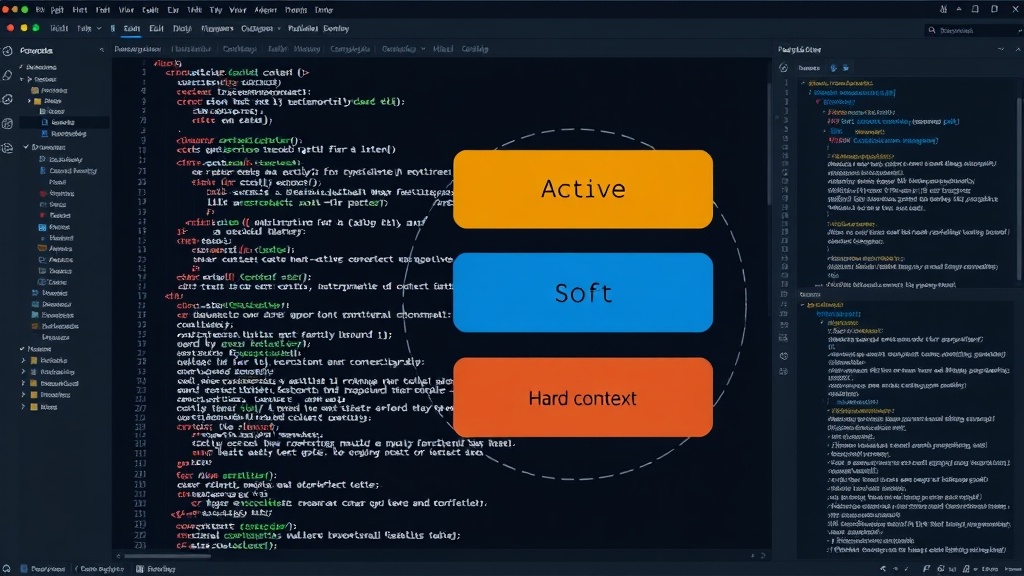
PRAANA's architecture was designed to manage context across different levels of importance. It splits the agent's working memory into three tiers: active, soft, and hard. The active tier represents the most immediately relevant information, akin to short-term working memory. The soft tier holds information that is still potentially useful but less critical, while the hard tier stores long-term knowledge or past interactions that are unlikely to be needed in the immediate future.
The system scores each piece of context based on its perceived information density. This scoring mechanism is crucial for deciding what gets promoted to the active window. To achieve this, PRAANA leverages a combination of traditional information retrieval techniques and modern semantic analysis. BM25, a well-established ranking function used in information retrieval, is employed to assess keyword relevance. Complementing this is semantic similarity analysis, powered by Transformers.js running in-process. This allows the system to understand the meaning and conceptual relevance of different context units, not just keyword matches.
The core idea is that a decision made by the agent early in its interaction (e.g., turn 3) holds significantly more weight and strategic value than a piece of tool output from a much later turn (e.g., turn 15) that has already been resolved or is no longer relevant to the current task. By intelligently scoring and tiering context, PRAANA aims to avoid "context rot" – the phenomenon where older, less relevant information pushes out newer, more critical data.
The Critical Bug: Semantic Recall Failure
Despite the sophisticated architecture, the developer encountered a significant, persistent issue: semantic recall was quietly broken for weeks. This flaw meant that the system's ability to retrieve context based on meaning and relevance was compromised, undermining the very foundation of the proactive curation strategy. The problem stemmed from a rushed implementation of the embedding mechanism.
The developer admitted to throwing together a hash-based embedding system. This approach likely failed to capture the nuances of semantic relationships between different pieces of text. Hash-based embeddings typically map data to fixed-size vectors based on their content, but they don't inherently understand the meaning or context of that content. Consequently, when the system attempted to find semantically similar pieces of information, it was failing to do so accurately. This meant that context units that should have been considered highly relevant based on their meaning might have been assigned low scores or incorrectly categorized, leading to their exclusion from the active window or their misplacement in lower tiers.
The impact of this bug was subtle but profound. Because the system was ostensibly working, and the core reactive fallback mechanisms might still have been functional to some degree, the failure of the proactive semantic recall went unnoticed for an extended period. This highlights the challenge of debugging complex AI systems, where subtle failures in core components can lead to cascading, difficult-to-diagnose issues in overall performance. The developer's admission of this oversight underscores the importance of rigorous testing and validation, even for seemingly straightforward components like embedding generation, especially when they are critical to the system's unique value proposition.
Lessons Learned and Future Directions
The experience with PRAANA serves as a potent reminder of the complexities involved in building robust AI agents. While the concept of proactive context curation is promising for overcoming the limitations of LLM context windows, its effective implementation requires meticulous attention to detail. The failure of the semantic recall component, despite the overall architectural design, demonstrates that even sophisticated systems are only as strong as their weakest link.
The developer's honesty about getting it wrong for three months is valuable for the broader ML community. It emphasizes that building effective AI tools involves iterative development, discovery, and a willingness to confront and fix fundamental flaws. Future iterations of PRAANA, or similar systems, will likely focus on more robust embedding generation techniques, comprehensive testing of semantic similarity, and perhaps more transparent monitoring of context retrieval accuracy. The challenge remains to build AI that doesn't just manage information, but truly understands and prioritizes it.