The Case for Local AI Safety Systems
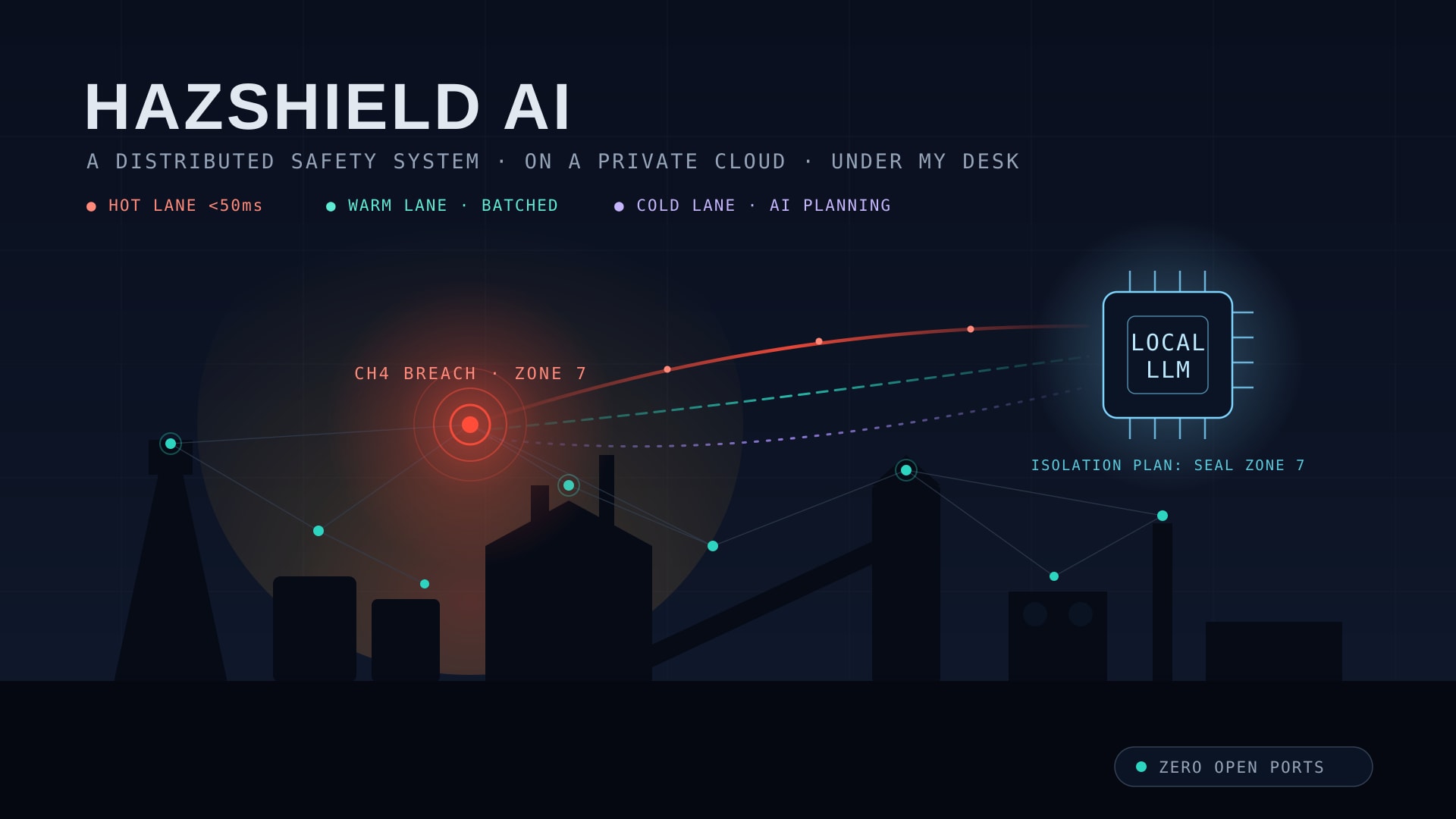
Imagine a critical industrial scenario: a methane sensor in a processing plant's crusher hall detects a dangerous rise in gas levels. In a traditional setup, this alert might traverse networks, hit cloud APIs for analysis, and then return actionable insights. This process, while common, introduces latency, potential security vulnerabilities through open ports, and ongoing cloud costs. Sumit G., a developer, has built an alternative: HazShield AI, a distributed industrial safety system that operates entirely on a single mini PC tucked away under his desk.
HazShield AI demonstrates a compelling vision for edge-based, private AI: immediate threat detection and response without external dependencies. The system is designed to process sensor data, analyze plant layouts, understand equipment status, and map airflow to generate step-by-step isolation blueprints. For instance, in a methane breach scenario, it can instantly determine the optimal response: shut down specific conveyors, reroute ventilation, and seal affected zones.
This approach bypasses the need for cloud infrastructure, eliminating associated bills and reducing the attack surface by avoiding open network ports. The entire system is engineered to run end-to-end on a modest hardware setup, showcasing the power of localized AI processing for time-sensitive safety applications.
Forging the Private Cloud Platform
The foundation of HazShield AI is its private cloud platform, meticulously carved out from a single mini PC. This custom-built environment leverages 28GB of RAM, demonstrating that significant AI processing capabilities can be achieved on relatively constrained hardware. The system is exposed to the external world through a zero-trust tunnel, a security model that ensures all access requests are strictly verified, regardless of their origin. This contrasts sharply with traditional network architectures that often rely on perimeter security, which can be more vulnerable to sophisticated attacks.
The choice of a mini PC as the core processing unit is strategic. It allows for a compact, self-contained system that can be deployed in environments where space is limited or where maintaining a robust connection to a central cloud is impractical or undesirable. This edge computing approach is particularly relevant for industrial settings, remote locations, or any scenario where real-time data processing is paramount.
Sumit G. describes the platform as a genuine private cloud, implying a level of control and autonomy that public cloud services cannot always offer. This self-hosted nature means the developer has complete command over the hardware, software, and data, which is crucial for sensitive applications like industrial safety.
The HazShield AI Workflow
At its core, HazShield AI functions by ingesting real-time data from various sensors deployed within an industrial facility. These sensors could monitor environmental conditions like gas levels, temperature, and pressure, or track the operational status of machinery. The AI system then processes this raw data locally. Unlike cloud-based AI that might rely on massive, pre-trained models accessed remotely, HazShield AI likely utilizes a combination of optimized models and contextual information about the specific plant it's monitoring.
The system's ability to analyze the plant's layout, identify interconnected zones, and understand equipment operations is key to its effectiveness. This contextual awareness allows the AI to go beyond simple anomaly detection. It can simulate potential consequences of an event and devise a tailored, multi-step response plan. For example, if a conveyor belt malfunctions, the AI can assess its impact on downstream processes, identify alternative routes for material flow, and recommend specific shutdown or rerouting procedures.
The output is a concrete, actionable blueprint. This isn't a generic alert; it's a precise set of instructions, such as "shut down conveyor C4," "reroute ventilation through shaft B," and "seal zone 7." This level of detail is critical for emergency response teams, enabling them to act quickly and effectively to mitigate risks and prevent further damage or injury.
Security and Zero-Trust Architecture
A significant aspect of HazShield AI's design is its emphasis on security. By running entirely offline and not exposing open ports on the network, the system inherently minimizes its vulnerability to external cyber threats. This is a stark contrast to many IoT and industrial control systems that can be susceptible to remote exploitation.
The use of a zero-trust tunnel for any necessary external communication is a deliberate security choice. In a zero-trust model, no user or device is trusted by default, even if they are already inside the network perimeter. Every access attempt is authenticated, authorized, and encrypted. This layered security approach ensures that even if one part of the system is compromised, the attacker cannot easily move laterally to gain access to other critical components or data.
This secure, self-contained architecture is vital for industrial safety systems. A compromised safety system could have catastrophic consequences, leading to accidents, environmental damage, or loss of life. By building HazShield AI on principles of isolation and stringent verification, Sumit G. is creating a robust and reliable safety solution.
The Broader Implications
The development of HazShield AI signals a potential shift in how AI is deployed for critical infrastructure and industrial applications. The trend towards edge AI, where processing occurs closer to the data source, is accelerated by projects like this. This move away from centralized cloud processing offers tangible benefits in terms of speed, cost, and security.
For developers, it highlights the feasibility of building sophisticated, mission-critical AI systems on accessible hardware. It democratizes the development of AI safety solutions, making them more attainable for smaller organizations or even individual innovators. The project serves as a proof-of-concept that advanced AI capabilities, previously thought to require massive computational resources, can be effectively deployed in localized, resource-constrained environments.
The success of HazShield AI could inspire similar initiatives in other sectors requiring real-time, secure data processing. From autonomous vehicles to smart grid management, the principles of localized AI and zero-trust security are increasingly becoming essential. This project offers a tangible glimpse into a future where AI safety is not just a feature, but a foundational element of industrial operations, running efficiently and securely just under our desks.