The Night the Server Went Dark (Figuratively)
It began with a familiar, yet alarming, sign: a sudden, inexplicable spike in server resource utilization. CPU cores maxed out, memory usage climbed relentlessly. Initially, the team suspected a runaway process, a common enough occurrence. They terminated it. The metrics dipped, only to surge again moments later. This wasn't a normal process anomaly; it was an intrusion.
The realization hit hard: an unauthorized party had gained access to the server. The evidence was stark. Traffic was originating from over 19,000 IP addresses spanning multiple countries. The entry point? CVE-2025-66478, a critical remote code execution (RCE) vulnerability. Once inside, the attackers deployed a cryptocurrency miner, rapidly consuming every available CPU cycle and byte of memory.
The response was swift and decisive. The team initiated a full backup, provisioned a new server instance, and completely shut down the compromised machine. The immediate damage was contained, but the incident left a lasting impression. The code deployed had harbored a known, critical vulnerability, discovered only after the breach, the mining operation was underway, and the server was already under duress.
This experience was the catalyst. The author, Ajay B Thorat, felt the sting of deploying code without adequate visibility into its security posture. The reactive nature of discovering such a critical flaw—after it had been exploited—was unacceptable. This incident highlighted a gap: the need for proactive, developer-centric security tooling that integrates seamlessly into the development workflow, catching vulnerabilities *before* they become exploitable entry points.
The Genesis of DevCompass
The aftermath of the server compromise sparked a deep introspection. How could such a critical vulnerability slip through? The answer lay in the complexity of modern development environments and the sheer volume of dependencies. Teams often rely on a vast array of open-source libraries, third-party packages, and internal code modules. Tracking the security status of each component, especially against emerging threats like CVE-2025-66478, is a monumental task. Traditional security scanners, often run at discrete points in the development lifecycle, could miss the mark, especially for zero-day or newly disclosed vulnerabilities.
Thorat envisioned a tool that would act as a vigilant guardian for developers. Not an adversarial gatekeeper, but an integrated assistant. A system that understands the developer's workflow and provides security insights contextually, at the point of creation or modification. The goal was to shift security left—making it an intrinsic part of the development process rather than an afterthought.
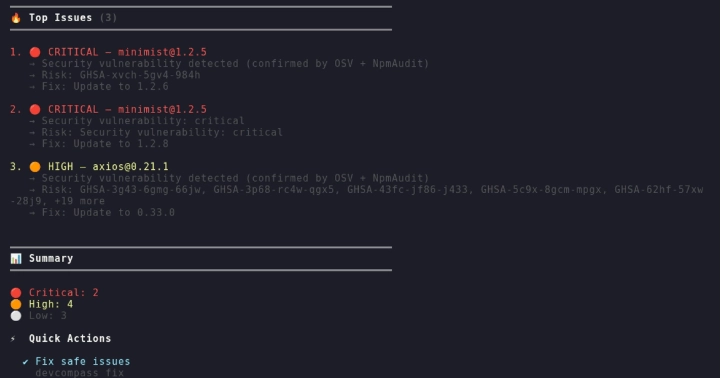
This vision materialized into DevCompass. The platform is designed to provide developers with real-time security analysis of their code and dependencies. Think of it less like a clunky enterprise security suite and more like an intelligent IDE plugin that understands the security implications of every line of code you write and every library you import. It aims to identify potential vulnerabilities, misconfigurations, and compliance issues early, often before code is even committed.

The core idea is to democratize security for developers. Instead of relying solely on dedicated security teams or waiting for external audits, developers themselves are empowered with the tools and knowledge to build more secure software. DevCompass integrates with popular development environments and CI/CD pipelines, offering continuous monitoring and feedback. This proactive approach is crucial for preventing incidents like the one that compromised Thorat's server.
Bridging the Gap: Proactive Security for Developers
The attack vector, CVE-2025-66478, represents a class of vulnerabilities that can have devastating consequences if left unaddressed. RCE flaws allow attackers to execute arbitrary code on a target system, granting them broad control. In this case, that control was leveraged for crypto mining, a resource-intensive activity that not only incurs significant operational costs but can also serve as a stepping stone for more sophisticated attacks.
The incident underscores a critical challenge in software development: the expanding attack surface. With microservices, containerization, and a heavy reliance on open-source components, the number of potential entry points for attackers has multiplied. Developers are often unaware of the security implications of the libraries they pull in, or the potential for subtle misconfigurations to open doors.
DevCompass seeks to address this by providing granular insights. It doesn't just flag a known CVE; it attempts to understand the context of its use within the codebase. This allows for more accurate risk assessment and prioritization. For instance, a vulnerability in a rarely used module might be flagged with lower urgency than one in a core API endpoint. The tool aims to provide developers with actionable intelligence, guiding them on how to remediate issues effectively, whether it's updating a dependency, refactoring code, or adjusting configurations.
The platform's ambition extends beyond just vulnerability scanning. It looks at developer behavior and project health from a security perspective. By analyzing code patterns, dependency graphs, and deployment configurations, DevCompass can identify potential security anti-patterns that might not be caught by traditional signature-based scanners. This holistic view is essential for building resilient software in today's threat landscape. The night Thorat's server was owned was a costly lesson, but it forged the path for a tool designed to prevent such nights from recurring for other development teams.