The Vulnerability: A Flaw in the Trust Root
Most organizations view their artifact repository as a storage solution, a place for build outputs and a source for dependencies. They rarely consider it a critical security boundary. However, an attacker gaining control of an artifact repository effectively turns both the inbound and outbound software supply chain into a hostile environment. This is precisely the scenario enabled by CVE-2026-82329, a severe authentication bypass vulnerability discovered in self-hosted JFrog Artifactory instances.
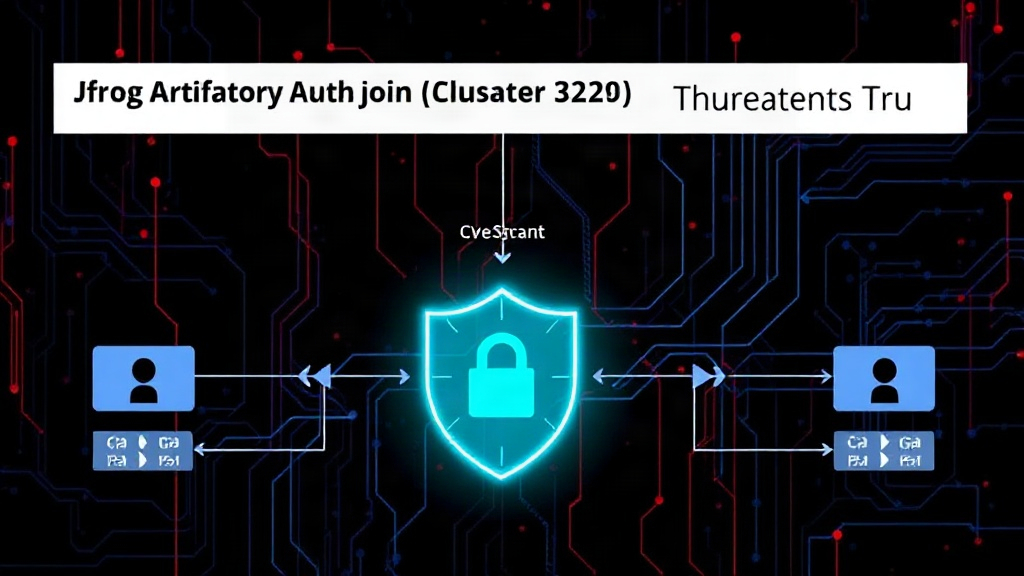
Rated with a CVSS score of 9.8, this vulnerability is critical. JFrog released a fix on August 28, 2026, urging self-hosted customers to upgrade to specific versions: 7.161.20, 7.146.38, or 7.133.29, depending on their active maintenance branch. The technical root of the issue lies in the default trust configuration used during cluster join operations. JFrog Access, the component responsible for managing access and security within Artifactory, ships with a default join key validation that includes an empty string. This seemingly innocuous default means that the signing key derived from an empty input is deterministic. An attacker who understands this mechanism can leverage it to bypass authentication, effectively gaining unauthorized access to the Artifactory instance.
Understanding the Attack Vector
The core of the bypass hinges on the predictable nature of the signing key generation when an empty string is used as input. In a clustered Artifactory setup, nodes communicate and establish trust using shared secrets or keys. When a new node attempts to join a cluster, or when nodes re-authenticate, a signing key is generated. JFrog Artifactory's cluster join process, by default, uses a shared secret. If this secret is not properly configured or is manipulated, an attacker can exploit the default behavior where an empty string input results in a known, deterministic signing key. By knowing this deterministic key, an attacker can forge valid requests that appear to originate from a trusted node or administrative user, thereby bypassing standard authentication and authorization checks.
This bypass allows an attacker to perform actions that should be restricted to authenticated administrators. These actions could include uploading malicious artifacts, modifying existing legitimate artifacts, deleting critical build outputs, or even reconfiguring Artifactory to serve as a pivot point for further network intrusion. The implications are profound: any software artifact passing through or stored within a compromised Artifactory instance becomes suspect. Developers and CI/CD pipelines relying on Artifactory for dependencies or for publishing build artifacts are at immediate risk of consuming or distributing malware, backdoors, or tampered code.
The Broader Implications for Software Supply Chain Security
Artifact repositories like JFrog Artifactory are increasingly becoming central to the software development lifecycle. They are not just passive storage; they are active participants in the build and deployment pipeline. When an artifact repository is compromised, it strikes at the heart of trust in the software supply chain. Developers implicitly trust artifacts pulled from their configured repositories, and the build systems implicitly trust the repository to store legitimate build outputs. A compromised repository breaks this chain of trust completely.
Consider the ramifications: if an attacker can inject malicious code into a seemingly legitimate dependency pulled from Artifactory, every project that uses that dependency is now compromised. If an attacker can replace a production build artifact with a malicious version, the consequences for end-users can be catastrophic. This vulnerability underscores a fundamental truth: artifact repositories must be treated with the same security rigor as any other critical infrastructure component, including authentication servers, certificate authorities, and CI/CD orchestrators. They are, in essence, a trust root for the software being built and deployed.
The fact that the vulnerability is tied to a default configuration—an empty string for a join key—is particularly concerning. It suggests that many organizations might have been vulnerable from the moment they set up Artifactory, especially if they did not immediately change default security settings or if their cluster join process was not meticulously secured. This highlights a common pitfall in security: relying on default configurations without understanding their implications can leave systems wide open to well-understood attack vectors.
Mitigation and Defense
The primary and most effective mitigation is to upgrade JFrog Artifactory to a patched version as recommended by JFrog. For self-hosted instances, this means applying the appropriate patch for your maintenance branch (7.161.20, 7.146.38, or 7.133.29). Organizations should have robust patch management processes in place to ensure critical security updates are applied promptly.
Beyond patching, organizations should review their Artifactory security configurations. This includes:
- Secure Cluster Join Keys: Ensure that the shared secrets or join keys used for cluster communication are strong, unique, and regularly rotated. Never rely on default or empty values.
- Access Control and Auditing: Implement the principle of least privilege for Artifactory access. Regularly audit access logs and administrative actions to detect suspicious activity.
- Network Segmentation: Isolate Artifactory instances within secure network segments, restricting access to only necessary hosts and services.
- Artifact Scanning: Integrate security scanning tools (SAST, DAST, SCA) into the CI/CD pipeline to scan artifacts both before they are published to Artifactory and before they are consumed. This provides a secondary layer of defense against malicious artifacts, even if the repository itself is compromised.
- Dependency Management: Use tools that can verify the integrity and provenance of dependencies. Implement policies to block the use of artifacts from untrusted sources or with known vulnerabilities.
The JFrog Artifactory authentication bypass serves as a stark reminder that the security of the software supply chain depends on securing every link. Treating artifact repositories as mere storage is no longer an option; they are critical infrastructure that must be hardened and actively monitored.