The Conventional Approach: Direct LLM Calls
Building AI agents, whether simple chatbots or complex ReAct agents with tool integration, fundamentally relies on sending prompts to a language model. This interaction typically occurs via a remote or local API. The core concept involves crafting prompts and receiving responses, a process that underpins most AI agent architectures, from basic conversational bots to sophisticated systems employing techniques like Retrieval Augmented Generation (RAG) or complex graph-based reasoning.
This direct LLM call model, while effective, often presents a significant cost barrier. Each interaction with a powerful LLM, especially via commercial APIs, incurs charges. For agents that require frequent or extensive LLM interactions, these costs can escalate rapidly, becoming a primary constraint on development and deployment, particularly for startups or projects with tight budgets. The raw performance comes with a premium price tag.
The Novel Solution: Agent-on-Agent Architecture
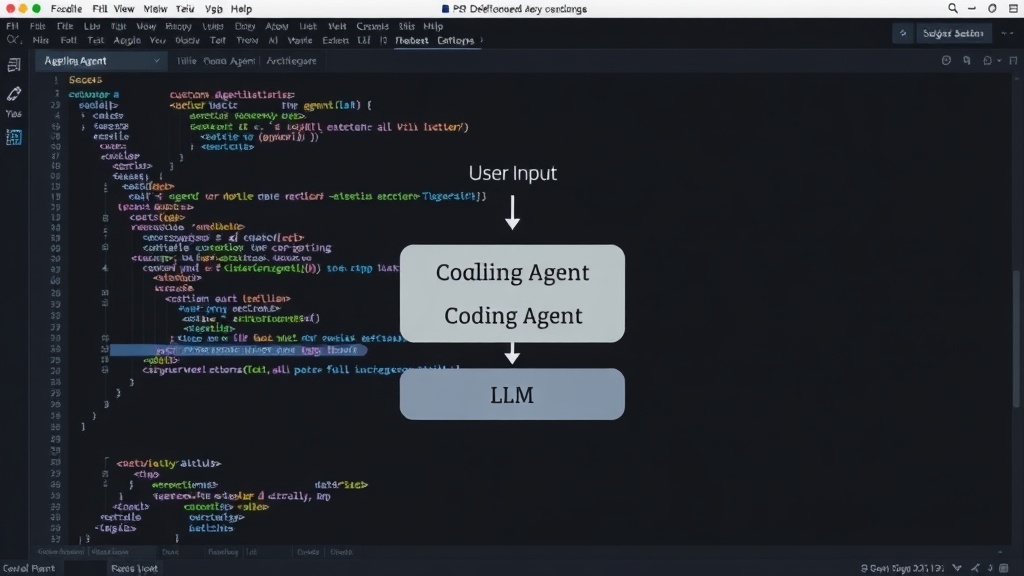
Instead of directly querying a general-purpose LLM for every task, a developer explored a different paradigm: using an existing, capable coding agent as the foundational layer for a new, specialized agent. The premise is straightforward: if you already have a powerful agent equipped with a suite of tools capable of handling complex problem-solving, why not leverage that existing intelligence? This approach allows developers to focus on the unique, custom functionality they want to build for their specific agent, offloading the common, general AI capabilities to the underlying agent.
The intuition might be that such a layered approach would be even more expensive, as it involves an intermediary agent. However, the reality proved to be the opposite. The developer discovered that specialized coding assistants, designed for tasks like code generation, debugging, and complex instruction following, are surprisingly cost-effective when contrasted with the per-token or per-call pricing of large, general-purpose LLMs. These coding agents offer a richer set of functionalities beyond raw language processing, often at a lower operational cost.
The architecture works by framing the problem for the specialized coding agent. Instead of a raw text prompt intended for a generic LLM, the input is structured as a task that the coding agent is optimized to understand and execute. For instance, if the goal is to generate a specific piece of code, the prompt would detail the requirements, constraints, and desired output format. The coding agent, with its built-in understanding of programming logic, syntax, and common libraries, can then process this request more efficiently and effectively than a general LLM might, especially when the task requires intricate logical steps or adherence to specific coding standards.
This strategy is akin to using a specialized craftsman for a particular job rather than asking a general handyman to do everything. If you need intricate woodworking, you hire a carpenter, not someone who can also fix your plumbing and paint your walls. The carpenter, while perhaps not as versatile as the handyman, will perform the woodworking task with greater skill, speed, and precision, and potentially at a lower cost for that specific service.
Cost Savings and Performance Gains
The primary driver for this architectural shift was cost reduction. Direct API calls to leading LLMs can quickly become prohibitive. By routing requests through a coding agent, the developer was able to significantly reduce the number of expensive LLM calls. The coding agent itself might still utilize an LLM, but it does so in a more optimized and controlled manner, often employing techniques to minimize token usage and focusing on task-specific outputs. Furthermore, many coding agents can be run locally or via more cost-effective dedicated services, offering a predictable pricing model that is easier to manage than the variable, consumption-based pricing of large public LLM APIs.
Beyond cost savings, the developer reported enhanced performance. Coding agents are trained on vast datasets of code and technical documentation, giving them a deep understanding of programming languages, algorithms, and software development best practices. This specialized knowledge allows them to perform tasks like code generation, debugging, and refactoring with a higher degree of accuracy and efficiency than a general-purpose LLM. For tasks requiring logical reasoning within a coding context, the specialized agent often outperforms its generalist counterpart, producing more relevant, functional, and syntactically correct code.
The implications of this approach extend to agent design. Developers can now conceptualize agents not just as direct interfaces to LLMs, but as orchestrators of specialized AI tools. This modular approach allows for greater flexibility and customization. A custom agent can be built to handle a specific business logic or user interaction flow, and then delegate the complex AI-heavy lifting—like code generation or data analysis—to a pre-existing, optimized coding agent. This separation of concerns simplifies development and maintenance.
The Unanswered Question: Scalability of Specialized Agents
While this method demonstrates significant cost and performance benefits, a crucial question remains: what is the upper limit of this agent-on-agent approach? As the complexity of tasks increases, and as the underlying coding agent needs to perform more nuanced reasoning or handle more diverse types of problems, will it still remain more cost-effective and performant than a direct call to a more powerful, general-purpose LLM? The current success is tied to tasks where coding agents excel. What happens when an agent needs to perform sophisticated creative writing, complex strategic analysis, or nuanced human-like conversation? The boundary between what a specialized agent can handle cost-effectively and what requires the broad capabilities of a frontier LLM is still being defined.
Broader Implications for AI Development
This shift away from monolithic LLM calls towards a more modular, agent-based architecture has profound implications for the future of AI development. It suggests a move towards a more specialized AI ecosystem, where different agents and models are optimized for specific tasks. This mirrors trends seen in other areas of computing, such as microservices architecture, where breaking down complex systems into smaller, manageable, and independently scalable components leads to greater robustness and efficiency.
For founders, this represents an opportunity to build more powerful AI products at a lower cost, potentially lowering the barrier to entry for AI-powered applications. For developers, it offers a more granular control over AI functionalities, allowing for fine-tuning of performance and cost. The ability to abstract away complex AI operations behind specialized agents means that developers can integrate advanced AI capabilities into their applications without needing to be deep experts in LLM prompting or fine-tuning. This democratizes access to sophisticated AI tools, fostering innovation across the board.
The success of this strategy hinges on the availability of robust, well-defined coding agents. As the market for AI tools matures, we can expect to see an proliferation of specialized agents for various domains, not just coding, but also for data analysis, scientific research, creative arts, and more. This modular approach promises a more efficient, cost-effective, and ultimately, more scalable future for AI development.