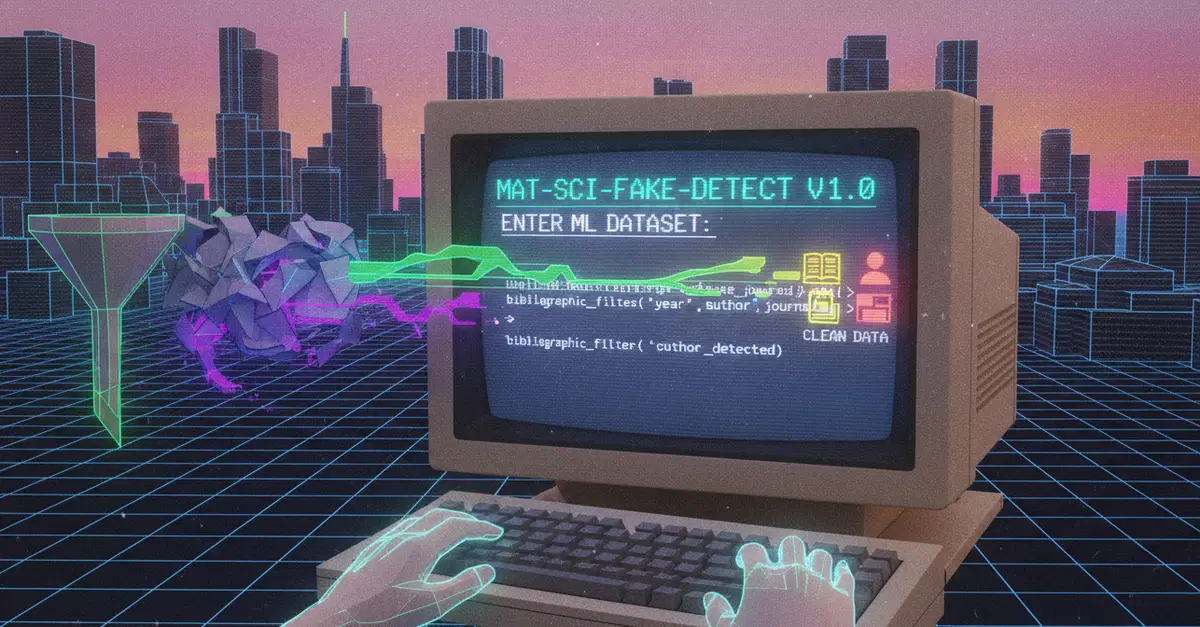
The Problem: Models Reading the Letterhead, Not the Science
Machine learning models trained to predict material properties, like stability, can fall into a trap: learning to associate certain authors, journals, or publication years with specific outcomes, rather than understanding the underlying chemical or physical principles. This phenomenon, known as bibliographic confounding or metadata leakage, allows a model to appear accurate on its training data and even in initial tests, but it fails in practice because it hasn't learned true scientific relationships. It's akin to a student acing a history test by memorizing the dates of the textbooks rather than the historical events themselves.
This isn't a coding error; it's a spurious signal embedded within the training data. When a model learns that papers from 'Group X', published in 'Journal Y' around 'Year Z', consistently report 'stable' materials, it classifies based on this 'bibliographic letterhead' instead of the material's actual structure or composition. The result is a model that performs well on data with similar metadata characteristics but is fundamentally flawed and unreliable when applied to new, unseen data that doesn't carry the same bibliographic baggage.

Introducing the 'Bibliographic Fingerprint' Test
To combat this, researchers have developed a method to detect this type of leakage, drawing inspiration from the 'Clever Hans' effect. Clever Hans was a horse that appeared to do arithmetic, but it was actually responding to subtle cues from its owner. Similarly, a machine learning model might appear to understand material science, but it's actually responding to the 'cues' of bibliographic metadata.
The core idea is to test whether the model's predictions are dependent on information that is scientifically irrelevant but statistically correlated with the target property in the training set. If a model consistently predicts a material is stable simply because the associated paper comes from a specific, high-impact journal or a prolific research group known for reporting stable materials, it's exhibiting this problematic behavior.
How the Test Works: Unpacking the Metadata Leakage
The process involves training a predictive model and then evaluating its performance using different subsets of features. The critical step is to train and evaluate the model not only on the scientific features (like atomic composition, crystal structure, or simulated properties) but also on the bibliographic metadata (author affiliations, journal names, publication dates, citation counts, etc.).
Specifically, the test aims to answer: does the model's predictive power significantly drop when the bibliographic metadata is removed or scrambled, while keeping the scientific features intact? If the model's accuracy plummets when it can no longer 'see' the author names or journal titles, it's a strong indicator of bibliographic confounding.
Consider an analogy: imagine trying to identify a book's genre. You could learn to recognize that books published by 'Penguin' in the '2000s' are often fiction. This might work for many books. However, a true genre identifier would look at the plot, characters, and writing style. If you remove the publisher and date, and your ability to guess the genre disappears, you were relying on bibliographic cues, not the content itself.
The 'Clever Materials' Test Framework
The 'Clever Materials' framework, as described in the source material, provides a structured way to perform this falsification. It essentially asks the model to predict a property (e.g., stability) using only scientific features. Then, it asks the model to predict the same property using only bibliographic metadata. Finally, it compares the model's performance in both scenarios.
If a model trained on both scientific features and bibliographic metadata performs significantly better than a model trained on scientific features alone, but performs similarly to or worse than a model trained on bibliographic metadata alone, it suggests the model is heavily reliant on the spurious bibliographic signals. The 'true' scientific understanding is being overshadowed by the metadata 'cheatsheet'.
Implications for Material Science AI
The implications of this research are substantial for the field of AI in material science. As more researchers turn to machine learning to accelerate the discovery of new materials, ensuring the scientific validity of these models is paramount. Models that rely on bibliographic confounding can lead to wasted resources, failed experiments, and a false sense of progress.
This test provides a crucial diagnostic tool. It allows researchers to:
- Validate Model Reliability: Ensure that discovered materials or predicted properties are based on genuine scientific understanding, not statistical artifacts.
- Improve Model Robustness: Identify and mitigate biases introduced by metadata, leading to models that generalize better to novel datasets and real-world applications.
- Guide Future Research: Encourage the development of models that focus on extracting true scientific insights from material data, rather than exploiting data quirks.
The challenge now is to move beyond models that simply 'read the letterhead' and develop those that can truly 'understand the science' of materials. This requires careful data curation, feature engineering that prioritizes scientific relevance, and rigorous validation methodologies like the 'bibliographic fingerprint' test.