The Core Problem: Reliable Automated Trading Cycles
Building automated trading systems, especially those handling multiple trading pairs across exchanges, presents a fundamental challenge: ensuring reliable execution of repeatable sequences of actions. The goal isn't necessarily market prediction, but practical automation. A typical spot trading cycle involves buying an asset, placing a sell order above the entry price, and waiting for it to fill before starting the next cycle. However, in a production environment, each step in this seemingly simple sequence is prone to failure.
Consider the common spot trading cycle:
- Buy an asset for a specified amount.
- Place a limit sell order above the entry price.
- Wait until the sell order is filled.
- Start the next cycle.
Each arrow in this flow represents a potential point of failure. An HTTP response might be lost after an exchange confirms an order. WebSocket connections can drop unexpectedly. The system might restart between the buy and sell operations, leaving the bot in an indeterminate state. User-provided API credentials could change mid-execution, invalidating ongoing operations. These are not edge cases; they are the realities of distributed systems operating in a volatile financial market.
The NOVA project, a Telegram-based system for automating repeatable spot trading cycles, highlights the need for robust API boundary design. The core problem is to execute user-defined sequences reliably without losing track of orders, duplicating requests, or becoming overly dependent on a single exchange's API. This necessitates a system architecture that anticipates and gracefully handles failures at every interaction point.
Architectural Considerations for API Boundaries
Designing safe API boundaries involves abstracting the complexities of exchange interactions and providing a consistent interface to the core trading logic. This abstraction layer acts as a buffer, shielding the main application from the direct chaos of real-time exchange communication.
Several key architectural patterns and considerations are crucial:
1. State Management and Idempotency
A critical aspect is managing the state of each trading cycle and ensuring operations are idempotent. Idempotency means that making the same request multiple times has the same effect as making it once. In trading bots, this is vital to prevent accidental duplicate orders. For instance, if a buy order request is sent but the confirmation is lost, the system must be able to safely re-send the request without creating a second order. This requires meticulous tracking of order states (e.g., pending, filled, cancelled) and using unique identifiers for each operation.
2. Exchange Adapters
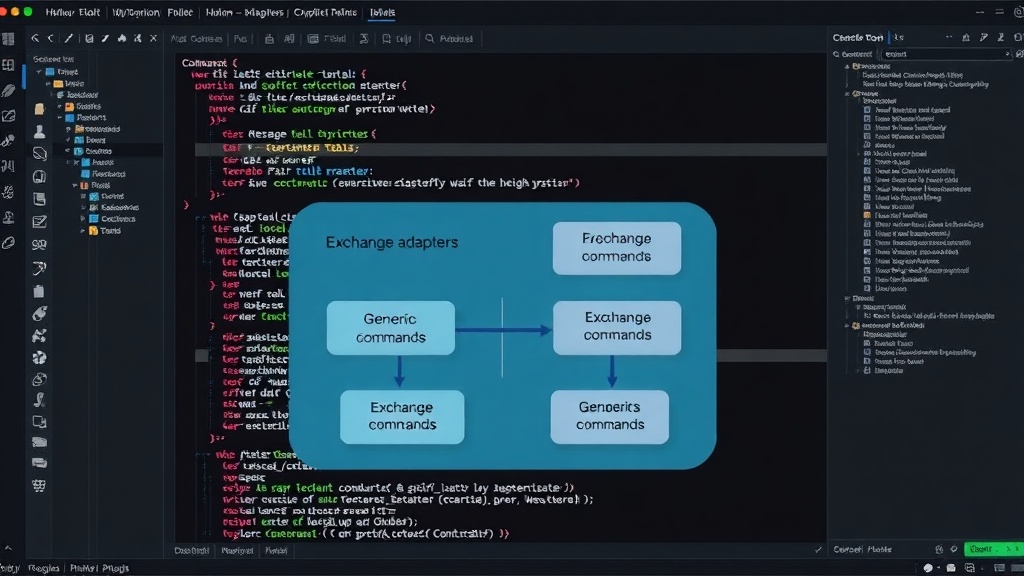
To avoid coupling the system to a single exchange's API, an adapter pattern is highly effective. Each exchange (e.g., Binance, Coinbase Pro, Kraken) would have its own adapter. This adapter translates the generic commands from the trading bot's core logic into the specific API calls required by that exchange. It also handles the parsing of exchange-specific responses and error codes. If a new exchange is added, only a new adapter needs to be developed, leaving the core logic untouched.
These adapters must abstract away not only the REST API calls for placing orders but also the WebSocket streams for real-time price updates and order status changes. The core trading logic should not need to know the difference between a Binance WebSocket message and a Kraken WebSocket message; it should receive a standardized stream of events.
3. Error Handling and Retries
A robust error handling strategy is non-negotiable. This includes:
- Connection Management: Detecting and recovering from WebSocket disconnections. Re-establishing connections and re-subscribing to necessary streams.
- Rate Limiting: Adhering to exchange API rate limits. Implementing backoff strategies (e.g., exponential backoff) when rate limits are hit.
- Order Failures: Handling specific order rejection codes from exchanges. Deciding whether to retry, alert the user, or move to a fallback strategy.
- Network Issues: Managing timeouts and transient network errors. Implementing retry mechanisms with sensible delays.
The system should distinguish between transient errors (which might be retried) and permanent errors (which require user intervention or a different strategy).
4. Transactional Integrity
Ensuring transactional integrity across multiple steps is a significant challenge. If a bot buys an asset and then crashes before placing the sell order, the bot needs to recover its state upon restart and identify the open buy order to place the corresponding sell order. This can be achieved through persistent storage of the state of each trading cycle. Databases or even simple file-based persistence can store the current stage of a cycle, the entry price, the order ID, and other relevant details.
5. Security of API Credentials
Handling API keys and secrets securely is paramount. These credentials should be encrypted at rest and transmitted securely. The system should allow for dynamic updates or revocation of credentials without requiring a full system restart, especially if a user suspects their keys have been compromised.
The Human Element: User Interaction and Transparency
While the focus is on technical API boundaries, the human element is equally important. Users need transparency into what the bot is doing. A Telegram-based interface, as used in NOVA, provides a convenient channel for notifications, status updates, and alerts. However, the API boundary design must ensure that the bot communicates its state and any encountered issues clearly to the user. This includes notifying users about order fills, rejections, or any manual intervention required due to unexpected exchange behavior.
The design must also consider how users interact with the bot. If a user updates API credentials, the system needs a mechanism to gracefully handle this change, potentially invalidating existing sessions or re-authenticating with the exchange using the new keys. This requires careful state management within the adapter layer.
Beyond Basic Cycles: Advanced Scenarios
The principles discussed apply to simple buy-sell cycles. However, real-world trading bots often involve more complex scenarios:
- Multiple Pairs Simultaneously: Managing independent cycles for different trading pairs, each with its own state and API interactions.
- Conditional Orders: Implementing stop-loss orders, take-profit orders, or more complex order types that interact with the exchange's API in specific ways.
- Order Book Analysis: Interfacing with order books to inform trading decisions, which adds another layer of real-time data processing and potential failure points.
Each of these adds complexity to the API boundary design, demanding even more rigorous state management, error handling, and abstraction.
Conclusion: A Foundation for Reliability
Designing safe API boundaries for a multi-pair spot trading bot is not merely an implementation detail; it is the foundation of reliability. By abstracting exchange interactions, managing state meticulously, implementing robust error handling, and prioritizing security, developers can build systems that operate predictably even in the face of network instability and exchange-specific quirks. The NOVA project's focus on this practical problem underscores a critical truth: the most sophisticated trading algorithms are useless if the underlying execution layer cannot reliably interact with the market.