The Core Components of the LLM Stack
Building applications powered by Large Language Models (LLMs) involves more than just calling an API. A robust LLM stack encompasses several critical layers, each serving a distinct purpose. For developers aiming to build and deploy sophisticated AI-driven features, understanding this architecture is paramount. Think of it less like a monolithic application and more like a finely tuned orchestra, where each instrument (component) plays a vital role in producing a harmonious result.
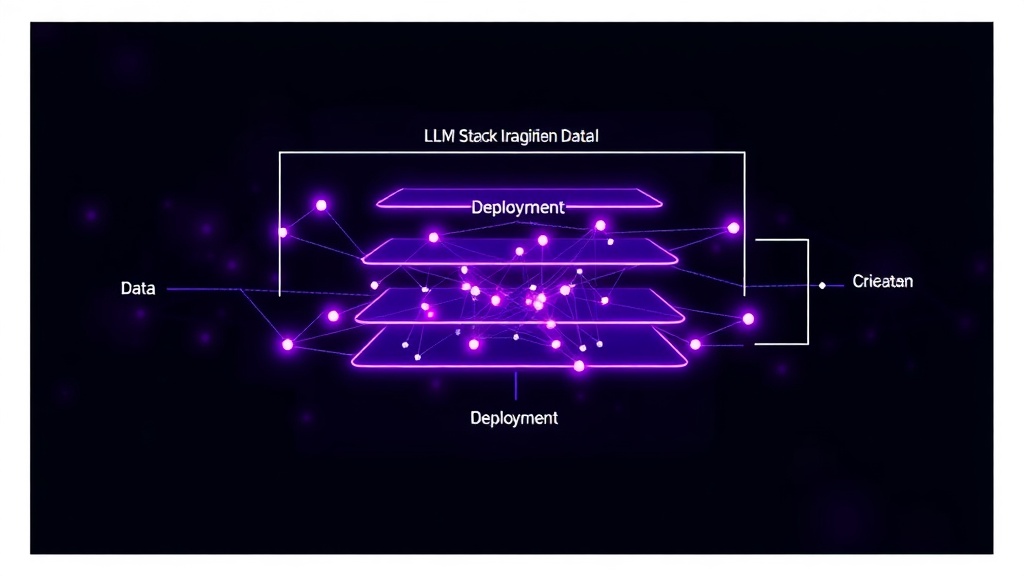
At its foundation lies the Data Layer. This is where the raw material for your LLM application resides. It includes not only the massive datasets used for pre-training foundational models but also the specific, often proprietary, data that fine-tunes these models for particular tasks or domains. Effective data management here means robust pipelines for collection, cleaning, labeling, and versioning. Without high-quality, relevant data, even the most advanced LLM will falter. This layer is also concerned with data privacy and security, ensuring sensitive information is handled responsibly throughout the lifecycle.
The next critical layer is the Model Layer. This is where the actual LLM lives. It can be a proprietary, closed-source model accessed via an API (like OpenAI's GPT-4 or Anthropic's Claude), or an open-source model (like Llama 3 or Mistral) that you host and manage yourself. Developers must consider factors like model size, performance, cost, and licensing when selecting a model. This layer also includes techniques for model adaptation, such as fine-tuning, prompt engineering, and retrieval-augmented generation (RAG), which allow developers to steer the model's behavior without retraining it from scratch.
Bridging Models and Applications
Moving upwards, we encounter the Orchestration Layer. This is the glue that binds the LLM to the rest of your application logic. It handles tasks such as managing conversational state, routing user queries to the appropriate LLM or tool, parsing LLM outputs, and executing actions based on those outputs. Frameworks like LangChain and LlamaIndex are prominent examples of tools that help developers build this layer. They provide abstractions for chaining LLM calls, integrating external data sources, and defining complex workflows. This layer is crucial for creating interactive and context-aware AI experiences.
The Application Layer represents the user-facing part of your LLM-powered product. This is where the user interacts with the AI. It includes the user interface (UI), the backend services that serve the UI, and the business logic that defines the application's purpose. Whether it's a chatbot interface, a content generation tool, or a data analysis dashboard, this layer translates user needs into prompts for the LLM and presents the LLM's responses in a meaningful way. Developers in this layer focus on user experience, performance, and integrating AI capabilities seamlessly into existing workflows.
Deployment and Infrastructure Considerations
Finally, the Deployment and Infrastructure Layer is responsible for getting your LLM application into the hands of users and keeping it running reliably. This includes choosing the right cloud provider or on-premises infrastructure, setting up compute resources (CPUs, GPUs), managing containerization (e.g., Docker, Kubernetes), and implementing monitoring and logging systems. For self-hosted models, this layer involves optimizing inference speed and cost, which can be a significant engineering challenge. This layer ensures scalability, availability, and maintainability of the entire stack. It's where the theoretical becomes practical reality for end-users.
Within this deployment layer, a key consideration is the Vector Database. While not a layer in the same sense as the others, it's a critical infrastructure component for many LLM applications, particularly those employing RAG. Vector databases store high-dimensional embeddings of data, enabling rapid similarity searches. This allows LLMs to quickly retrieve relevant context from large knowledge bases, vastly improving the accuracy and relevance of their responses. Examples include Pinecone, Weaviate, and ChromaDB. Their performance and scalability directly impact the responsiveness of RAG-enabled applications.
The journey from raw data to a deployed LLM application is complex. Each layer builds upon the one below, requiring specialized knowledge and tools. Developers must understand how data quality, model selection, orchestration logic, application design, and robust infrastructure all interoperate. Mastering this stack allows for the creation of powerful, intelligent applications that can transform industries.
Future Trends and Developer Focus
Looking ahead, the LLM stack is continuously evolving. We're seeing increased abstraction and tooling that simplifies complex tasks. For instance, the rise of managed services for vector databases and LLM inference reduces the operational burden on developers. Furthermore, the integration of multimodal capabilities—allowing LLMs to process and generate not just text, but also images, audio, and video—will add new dimensions to the stack. Developers will need to adapt to these new data types and models.
The trend towards smaller, more efficient models is also significant. While massive foundational models will remain important, there's a growing demand for specialized, task-specific models that can run on edge devices or at a lower cost. This will influence model selection and deployment strategies. The focus will increasingly be on building applications that leverage the right model for the right job, rather than relying on a single, all-powerful LLM.
What nobody has addressed yet is how the rapid evolution of LLM architectures and training methodologies will impact the long-term maintainability of existing LLM applications. As new, more capable models emerge, will applications built on older architectures become legacy systems overnight, or will abstraction layers prove robust enough to handle these shifts with minimal refactoring? This question is becoming increasingly urgent for organizations investing heavily in LLM technology.