%22%20%2F%3E%0A%20%20%3C%2Fsvg%3E)
Scaling AI Compute: The Home Cluster Approach
The dream of running large-scale AI models locally, without the immense cost and complexity of enterprise server farms, has taken a significant step forward with Dell's Pro Max GB10. This hardware, designed to house and connect multiple Nvidia Grace Blackwell Superchips, offers a compelling, albeit still premium, solution for developers and researchers seeking to cluster powerful AI compute resources within a more manageable footprint. The Pro Max GB10, when equipped with two Grace Blackwell units, presents a potent combination that aims to democratize access to high-performance AI processing for those who need it outside of dedicated data centers.
At approximately $6,332 per unit, the Pro Max GB10 is not an impulse purchase. However, when compared to the aggregated costs of individual high-end GPUs, specialized interconnects, robust power supplies, cooling solutions, and the physical space required for a traditional server rack, this figure begins to look more reasonable for a scaled-out solution. The Pro Max GB10 essentially consolidates these needs into a more accessible form factor, fitting comfortably on a desk rather than requiring a dedicated server room. This consolidation is key for individuals or small teams who are serious about pushing the boundaries of local AI development and experimentation.
Understanding the Nvidia Grace Blackwell Architecture
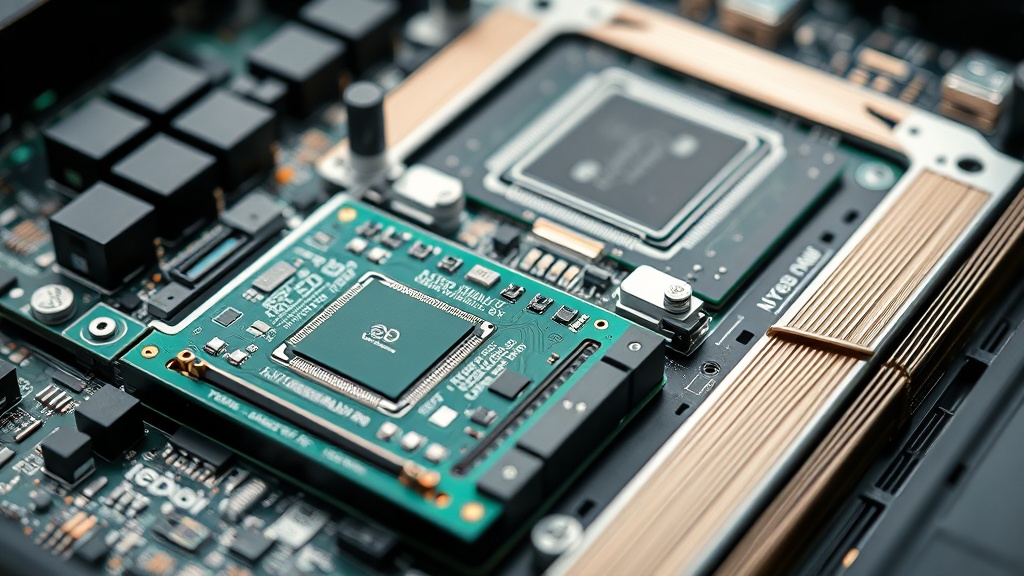
The heart of the Pro Max GB10's AI prowess lies in the Nvidia Grace Blackwell Superchip. This architecture represents a significant leap in AI processing capabilities, designed from the ground up for the demanding workloads of large language models (LLMs) and generative AI. Unlike traditional GPU architectures primarily focused on graphics, Grace Blackwell integrates high-performance ARM CPUs with powerful Tensor Cores, offering a unified memory architecture. This design minimizes data movement bottlenecks, a critical factor when dealing with the massive datasets and complex computations inherent in modern AI training and inference.
When two Grace Blackwell Superchips are brought together within the Pro Max GB10, they can operate in a clustered configuration. This isn't simply about having two independent processors; it's about enabling them to work in concert. The Pro Max GB10 facilitates this by providing the necessary high-speed interconnects and power management to ensure the chips can communicate efficiently. This allows for the distribution of AI tasks across both chips, effectively doubling the available compute power and memory bandwidth for a single, larger problem. For developers working on models that exceed the capacity of a single chip, this clustered approach is essential. It enables the training of larger, more complex models and accelerates inference times, making previously intractable problems feasible on local hardware.
The Pro Max GB10: A Desktop Server Solution
Dell's Pro Max GB10 is engineered to be more than just a container for the Grace Blackwell chips. It addresses the practical challenges of deploying such powerful hardware outside of a data center. This includes robust thermal management solutions to keep the chips operating within optimal temperature ranges, even under sustained heavy load. Power delivery is another critical aspect; the Pro Max GB10 is designed to handle the substantial power requirements of two Grace Blackwell Superchips, ensuring stable operation. The chassis itself is designed for a desktop environment, meaning it's built with considerations for noise levels and physical dimensions, making it a viable option for a professional's workspace.
The connectivity options within the Pro Max GB10 are also tailored for AI workloads. High-speed networking interfaces are crucial for distributed training scenarios where data needs to be shared rapidly between nodes, or even between the two Grace Blackwell chips within the same chassis. While the Tom's Hardware review focuses on the internal clustering, the extensibility of the Pro Max GB10 suggests it could be part of a larger, multi-node cluster. This modularity allows users to start with a dual-chip configuration and potentially scale out further by connecting multiple Pro Max GB10 units, creating a formidable local AI cluster without the need for enterprise-grade infrastructure.
Cost and Accessibility: A Premium Niche
The primary barrier to entry for such a powerful local AI solution remains its cost. At $6,332 per unit, purchasing even two Pro Max GB10s to create a dual-chip cluster represents a significant investment, totaling over $12,000 before considering the Grace Blackwell Superchips themselves, which are also a substantial cost. This price point firmly places the Pro Max GB10 in the realm of professionals, well-funded research labs, or serious hobbyists who can justify the expenditure for the performance gains and operational flexibility it offers. It’s a far cry from the accessible consumer-grade hardware that has fueled the recent explosion of smaller, local AI projects.
However, it’s crucial to reiterate the comparative value. The cost of a comparable setup using individual high-end GPUs, such as multiple Nvidia H100s or even the newer B100/B200 series, coupled with the necessary supporting infrastructure, can easily run into tens or even hundreds of thousands of dollars. The Pro Max GB10, by integrating CPU, memory, and GPU-like AI acceleration into a single, optimized package, and by streamlining the setup process, offers a more consolidated and potentially more efficient path to achieving substantial AI compute power locally. The question for potential buyers is whether the convenience and integrated performance justify the premium over piecing together a similar system from discrete components.
The Future of Local AI Clusters
The Dell Pro Max GB10 with dual Nvidia Grace Blackwell Superchips signifies a growing trend: the decentralization of high-performance AI compute. As AI models continue to grow in size and complexity, the reliance on massive, cloud-based data centers becomes increasingly challenging due to cost, latency, and data privacy concerns. Solutions like the Pro Max GB10 aim to bring that power closer to the user, enabling more iterative development, faster feedback loops, and greater control over sensitive data. While the current cost is prohibitive for many, the existence of such solutions indicates a clear market demand and a technological pathway towards more accessible, powerful local AI infrastructure. As the technology matures and production scales, it's plausible that similar, more affordable solutions will emerge, further empowering developers and researchers to innovate without being solely dependent on cloud providers.