The Undervalued Help Button
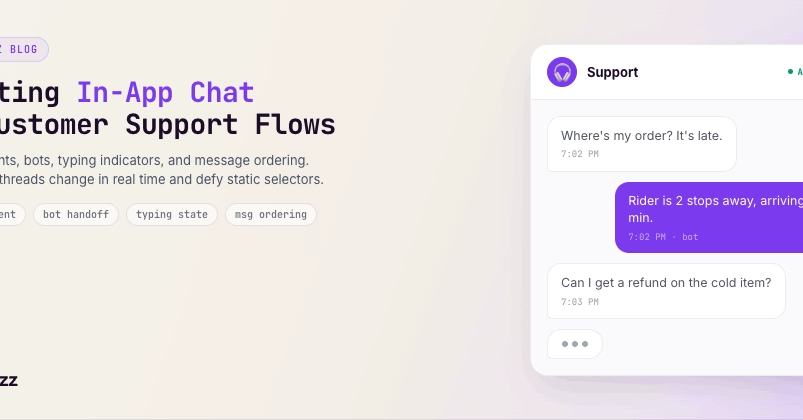
In the competitive landscape of delivery apps, a single tap on the "Help" or "?" icon often dictates a customer's next action: a resolved issue leading to loyalty, or a frustrated experience resulting in a one-star review and app uninstallation. This critical support layer, encompassing chatbot flows, live agent chats, order-specific help menus, photo uploads for issue reporting, refund request forms, and escalation paths, is surprisingly neglected by Quality Assurance (QA) teams. While the core app functionality might undergo rigorous regression testing, the in-app support system, which directly impacts customer retention, is frequently tested only during initial development and then largely forgotten.
This oversight is problematic because the support flows are dynamic. Chatbot conversation trees are updated weekly to improve deflection rates. Live agent handoff logic sees monthly revisions. Refund calculation rules are altered with every policy change. These frequent updates, crucial for operational efficiency and customer satisfaction, often do not trigger a full regression test because the help button is not considered part of the app's "critical path." This creates a significant risk: a seemingly minor change in a support flow could lead to a cascade of negative customer experiences without immediate detection.
Why Support Flows Are Crucial for Retention
A delivery app's success hinges not just on efficient delivery but also on its ability to handle inevitable issues. When an order goes wrong – a missing item, a damaged product, a late delivery – the customer's interaction with the support system becomes the primary determinant of their future engagement. A smooth, efficient resolution reinforces trust. Conversely, a clunky, unresponsive, or unhelpful support experience erodes it. This is where the in-app chat and customer support flows play an outsized role. They are the safety net, the problem-solver, and ultimately, the retention engine.
Consider the direct impact: a customer experiencing a refund issue. If the process is straightforward, clearly communicated, and swiftly executed through the app's support interface, the customer feels valued and understood. They are likely to order again. If, however, the customer navigates a confusing menu, waits an eternity for a chatbot response that doesn't understand their query, and is then bounced to a live agent who asks for the same information again, their frustration mounts. This negative experience is not just about the initial problem; it's about the entire interaction. It’s like trying to put out a small fire with a leaky hose – the intention is there, but the execution fails, leaving a bigger mess. The current QA practice of deprioritizing these flows means this leaky hose is often deployed without proper checks.
The Evolving Nature of Support Systems
The dynamic nature of support systems is a key reason why continuous testing is paramount. Chatbots are not static entities. Their conversational logic, intent recognition, and response libraries are constantly refined by support teams aiming to automate more interactions and reduce operational costs. This optimization process, while beneficial for efficiency, can inadvertently introduce new bugs or break existing conversation paths. For instance, a new keyword added to improve chatbot understanding might trigger an unintended response in a different, unrelated flow.
Similarly, integrations with third-party customer relationship management (CRM) systems or payment gateways for refunds can change. API updates, policy shifts regarding what qualifies for a refund, or new fraud detection mechanisms all require adjustments to the backend logic that powers the support flows. These changes, often implemented rapidly to adapt to market conditions or regulatory requirements, can break the delicate chain of events that leads to a successful customer support interaction.
Implementing Robust Testing Strategies
To address this gap, QA teams need to integrate support flow testing into their regular regression cycles. This requires a shift in perspective, recognizing these flows as core to the user experience and business success. The first step is identifying all possible customer support scenarios. This includes:
- Common Issues: Missing items, wrong items, damaged items, late deliveries, app bugs.
- Refund/Cancellation Flows: Initiating a refund, cancelling an order, partial refunds.
- Escalation Paths: When a chatbot cannot resolve an issue and needs to escalate to a live agent.
- Photo Uploads: Testing the functionality and data integrity of image submissions for proof of issues.
- Form Submissions: Ensuring all fields in request forms capture data correctly and are processed.
- User Feedback: Testing the collection and processing of post-support interaction feedback.
Automated testing is essential here. While end-to-end user interface (UI) tests can be brittle and time-consuming for complex chat dialogues, targeted API-level tests can verify the backend logic. For instance, one could simulate a user reporting a missing item via an API call and then verify that the correct refund amount is calculated and processed in the system, bypassing the UI entirely.
For chatbot flows, testing can be more nuanced. It involves not just verifying that a conversation reaches a logical conclusion, but also assessing the quality of responses, the accuracy of intent recognition, and the effectiveness of the deflection strategy. This might involve using natural language processing (NLP) testing tools or even having a dedicated human tester role-play as a customer with various intents.
The integration of live agent chat requires testing the handoff mechanism. Does the context from the chatbot session transfer correctly to the live agent? Are agent responses timely? Is the resolution logged properly? These steps ensure that the human element of support is as seamless as the automated parts.
Furthermore, performance testing of these support flows is crucial. Long wait times for a chatbot or a live agent can negate any potential benefit. Load testing the support infrastructure ensures it can handle peak demand, especially during service outages or major events.
The Unanswered Question: Who Owns Support Flow QA?
What is still unclear is the precise ownership and resourcing for this critical QA function. Is it solely the responsibility of the QA team, or should product managers, support operations, and engineering teams share accountability? Without clear lines of responsibility and dedicated resources, these vital flows remain vulnerable to neglect. If the support team is optimizing for deflection, and engineering is focused on new features, and QA is constrained by scope, the customer experience suffers in the silent cracks of the application.
Moving Forward: A Call for Integrated Testing
Delivery apps cannot afford to treat their support channels as an afterthought. The "Help" button is not a secondary feature; it is a primary driver of customer satisfaction and retention. By incorporating comprehensive, automated, and continuous testing of all in-app support flows into the development lifecycle, companies can ensure that when things go wrong, their app is equipped to make it right. This proactive approach transforms a potential point of failure into a strength, building customer loyalty one resolved issue at a time.