The Challenge of Defensible Suspect-Condition Pipelines
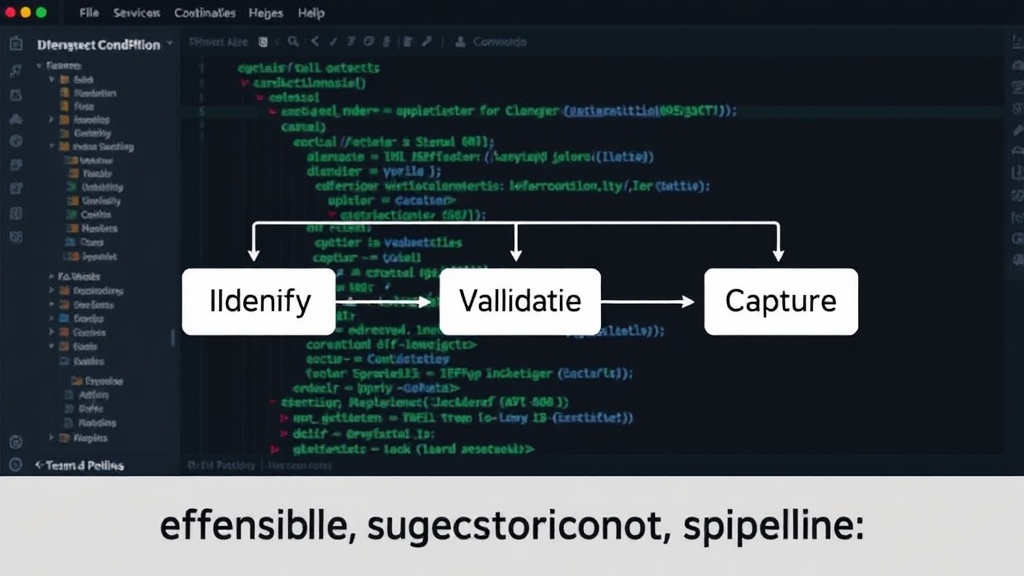
Identifying potential Hierarchical Condition Categories (HCCs) in a member's clinical record is the easy part. Anyone can prototype a system that flags "this member might have HCC X." The real difficulty lies in engineering a pipeline whose outputs can withstand scrutiny, particularly from audits like Risk Adjustment Data Validation (RADV). This isn't just about pattern detection; it's about building a robust, defensible system. This article outlines the three critical stages—Identify, Validate, and Capture—and the engineering decisions that make a suspect-condition pipeline truly defensible.
Stage 1: Identify — From Rules to Candidate HCCs
The initial stage, 'Identify,' is fundamentally about pattern detection. It involves analyzing a member's clinical data, including labs, medications, prior diagnoses, and utilization patterns, to emit candidate HCCs. This can be modeled as a set of rules or features that, when triggered, suggest a potential HCC. For example, a specific lab result combined with a particular medication might point to a candidate HCC. The engineering challenge here is to move beyond simple keyword matching or basic rule sets. A defensible identification stage requires considering the nuances of clinical data, handling variations in coding, and establishing clear logic for each candidate HCC. This might involve sophisticated natural language processing (NLP) for unstructured clinical notes, complex feature engineering that combines multiple data points, and a well-defined taxonomy of potential HCCs. The output of this stage is a list of *suspect* HCCs, not confirmed ones.
Stage 2: Validate — The Crucial Audit Defense
Validation is where most prototyped systems falter. Simply identifying a suspect HCC is insufficient. A defensible pipeline must rigorously validate these candidates against established criteria, often dictated by payers or regulatory bodies. This stage requires access to and analysis of the supporting clinical documentation that justifies the presence of an HCC. For a RADV audit, this means ensuring that the documentation meets specific requirements: it must be from an eligible provider, within the correct timeframe, and clearly indicate the diagnosis and its medical necessity or management. Engineering for validation involves building mechanisms to:
- Retrieve Supporting Documentation: Systems must be able to locate and extract relevant clinical notes, lab reports, and other records associated with the identified suspect HCC.
- Apply Audit Criteria: Develop logic that checks the retrieved documentation against the specific rules of the relevant audit (e.g., RADV, CMS guidelines). This includes verifying date ranges, provider types, and the presence of specific keywords or phrases indicating the condition's active management.
- Handle Ambiguity and Edge Cases: Clinical documentation is rarely perfect. The validation engine must be designed to handle incomplete records, ambiguous entries, or conditions that are implied but not explicitly stated, while still adhering to audit standards. This might involve confidence scoring for identified HCCs based on the strength of evidence.
- Generate Audit Trails: Every step of the validation process must be logged. This creates an immutable record of how a suspect HCC was validated or rejected, which is critical for audit defense.
Think of this stage less like a simple checklist and more like building a meticulous legal case for each identified HCC. You need to present clear, undeniable evidence that meets a strict set of legalistic standards. Without this rigor, your identified HCCs are merely suggestions, easily dismissed by an auditor.
Stage 3: Capture — Operationalizing Confirmed HCCs
The final stage, 'Capture,' is about operationalizing the validated HCCs. Once an HCC has been confirmed through the validation process, it needs to be accurately captured and reported. This involves integrating the validated HCCs into the organization's reporting systems, such as encounter data submission or risk adjustment models. Key engineering considerations for this stage include:
- Data Integration: Seamlessly feeding validated HCCs into downstream systems. This requires robust APIs and data pipelines that ensure data integrity and timeliness.
- Workflow Automation: Automating the process of submitting validated HCCs to relevant authorities or internal systems. This reduces manual effort and minimizes the risk of human error.
- Feedback Loops: Establishing mechanisms to incorporate feedback from validation failures or audit outcomes back into the 'Identify' and 'Validate' stages. This continuous improvement loop is essential for maintaining a defensible pipeline over time. If certain types of documentation consistently fail validation, the identification rules might need adjustment.
- Performance Monitoring: Continuously monitoring the performance of the entire pipeline, from identification accuracy to validation success rates and capture efficiency. Key metrics include the number of suspect HCCs identified, validated, and ultimately captured, as well as the rate of false positives and false negatives.
The 'Capture' stage transforms the insights generated into actionable business intelligence and financial outcomes. It's the bridge between data analysis and tangible results, ensuring that the effort invested in the preceding stages translates into accurate risk scores and appropriate reimbursement.
Engineering for Defensibility
Building a defensible suspect-condition pipeline is an ongoing engineering effort. It requires a deep understanding of the clinical domain, the intricacies of risk adjustment models, and the specific requirements of audits. The transition from a functional prototype to a production-ready, audit-proof system hinges on investing in robust validation logic, comprehensive data retrieval capabilities, and automated capture mechanisms. Without this focus on defensibility from the outset, organizations risk significant financial and reputational damage when their HCC identification processes are challenged.