The Efficiency Revolution in Open-Source AI
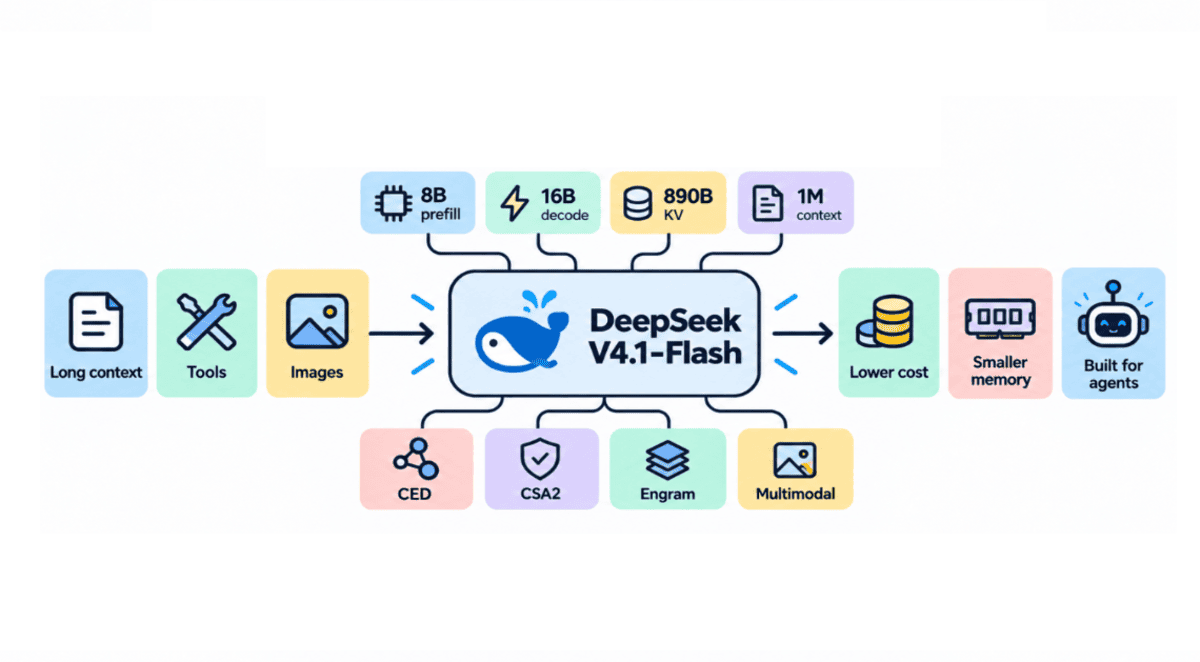
DeepSeek-V4.1-Flash is making waves in the open-source AI community, not just for its performance, but for its remarkable efficiency. This latest release from DeepSeek AI demonstrates a significant leap forward by integrating several cutting-edge architectural and optimization techniques. The core innovation lies in its Causal Encoder-Decoder architecture, a departure from the prevalent decoder-only models, coupled with Mixture-of-Experts (MoE), advanced KV cache compression, CSA2 attention, and optimized decoding strategies. These elements combine to drastically reduce the computational cost and latency associated with running large language models, making powerful AI more accessible and practical for a wider range of applications.
Traditionally, achieving high performance in large language models (LLMs) has come at the steep price of immense computational resources. Training and inference for state-of-the-art models often require specialized hardware and significant energy consumption, creating a barrier to entry for many researchers and developers. DeepSeek-V4.1-Flash directly addresses this challenge by demonstrating that efficiency and power are not mutually exclusive. The model is designed to be significantly cheaper to run, a critical factor for widespread adoption and for enabling new use cases that were previously economically unfeasible.
Architectural Innovations for Speed and Scale
At the heart of DeepSeek-V4.1-Flash's efficiency is its Causal Encoder-Decoder architecture. Unlike decoder-only models, which process text sequentially, this architecture separates the encoding of input information from the decoding of output. This separation allows for more specialized processing and can lead to more efficient handling of long contexts and complex reasoning tasks. It's akin to having a dedicated team for understanding the prompt (the encoder) and another for generating the response (the decoder), rather than one person trying to do both simultaneously. This separation can optimize computational pathways, reducing redundant calculations.
Further enhancing its performance and efficiency is the integration of Mixture-of-Experts (MoE). MoE models utilize multiple specialized sub-networks (experts) and a gating mechanism that directs input tokens to the most relevant experts. This allows the model to scale to a very large number of parameters while only activating a fraction of them for any given input. This sparse activation dramatically reduces the computational load during inference compared to dense models of similar size. Instead of activating all computational units for every task, MoE selectively activates only the necessary ones, much like a skilled craftsman choosing the right tool for a specific job rather than using a general-purpose hammer for everything.

Optimizing Memory and Decoding
Beyond architectural choices, DeepSeek-V4.1-Flash incorporates sophisticated techniques to manage memory usage and accelerate output generation. KV cache compression is a key component here. The KV cache stores intermediate attention computations, which can consume a substantial amount of memory, especially with long sequences. By compressing this cache, the model reduces its memory footprint, enabling it to run on less powerful hardware and handle longer contexts without running out of memory. This is crucial for applications involving extended conversations or document analysis.
The inclusion of CSA2 (Conditional Swin Attention 2) is another significant factor. Attention mechanisms are fundamental to LLMs, but standard self-attention can be computationally intensive, particularly with increasing sequence lengths. CSA2, an optimized variant, likely reduces the quadratic complexity associated with attention, making it more scalable and efficient. This allows the model to process longer inputs more effectively, a common bottleneck in many real-world AI applications.
Finally, the model benefits from cheaper prefill and efficient decoding. Prefill refers to the initial processing of the input prompt, and cheaper prefill means this stage is less computationally expensive. Efficient decoding refers to the process of generating the output token by token. Optimizing this stage reduces latency, meaning the model responds faster. Together, these optimizations ensure that once the model has processed the input, it can generate output rapidly and economically. This is particularly important for interactive AI applications where low latency is paramount.
Broader Implications for Open-Source AI
The release of DeepSeek-V4.1-Flash signifies a critical step towards democratizing advanced AI capabilities. By proving that high-performance models can be made significantly more efficient, DeepSeek AI is lowering the barrier to entry for developers, researchers, and startups. This allows for more experimentation, faster iteration, and the deployment of sophisticated AI in resource-constrained environments, such as edge devices or standard cloud instances, without requiring massive upfront investment in specialized hardware. The focus on efficiency means that the cost of running AI applications can be substantially reduced, potentially unlocking new business models and making AI more sustainable from an energy perspective.
This development challenges the prevailing trend where the most capable models are often proprietary and accessible only through expensive APIs. DeepSeek-V4.1-Flash offers a compelling alternative, providing a powerful, open-source option that is practical to deploy. The success of these efficiency-focused techniques may also spur further research and development in similar directions, leading to a future where advanced AI is not only powerful but also readily available and economically viable for everyone. The question now is how quickly other major model developers will adopt similar efficiency-first design principles.