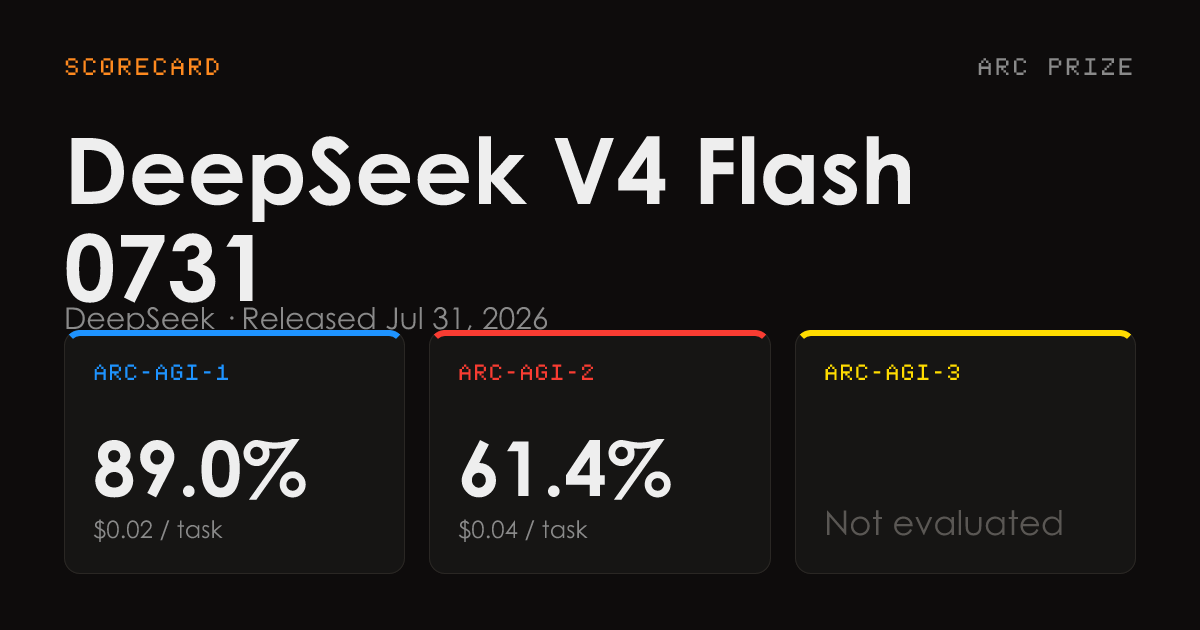
Introducing DeepSeek V4 Flash 0731
The open-source large language model (LLM) ecosystem continues its rapid expansion, with new models frequently challenging the established leaders. DeepSeek V4 Flash 0731 is the latest entrant, aiming to provide a high-performance, yet accessible, option for developers and researchers. This model, released by DeepSeek AI, represents a significant step forward in democratizing access to cutting-edge AI capabilities. Unlike many proprietary models that remain closed-source, DeepSeek V4 Flash 0731 is designed for broad adoption and modification, fostering innovation within the community. The model's architecture and training regimen are key to its performance. While specific architectural details often remain proprietary or are complex to convey to a general audience, the emphasis for DeepSeek V4 Flash 0731 has been on achieving strong benchmarks across a variety of natural language processing tasks. Early indications from the Hacker News community and related discussions suggest that this model is competitive with, and in some cases surpasses, other leading open-source models available today. This competitiveness is crucial for its adoption, as developers often weigh performance against ease of use and licensing.Performance Benchmarks and Capabilities
DeepSeek V4 Flash 0731 has been evaluated on a range of standard LLM benchmarks, demonstrating notable improvements over previous iterations and competing models. While precise figures are best sourced directly from the official release notes or benchmark reports, the general consensus points to strong performance in areas such as text generation, summarization, translation, and complex reasoning. The 'Flash' designation in its name hints at optimizations for speed and efficiency, suggesting that inference times may be reduced without a significant sacrifice in accuracy. This focus on efficiency is not merely a technical detail; it has direct implications for deployment. Faster inference means lower operational costs and the potential for real-time applications that were previously infeasible. For developers building applications, this translates to a more responsive user experience and the ability to serve more users with the same hardware. The model's ability to handle diverse tasks means it can be a versatile tool for a wide array of applications, from creative writing assistants to sophisticated data analysis tools.