The Divergence in AI Economic Growth Predictions
Economists attempting to model the impact of artificial intelligence on economic growth find themselves at a crossroads, with predictions ranging from a modest bump in productivity to a fundamental shift in the economy's growth trajectory. The surprising aspect is that this divergence doesn't stem from differences in the data they analyze. Instead, the core of the disagreement lies in the specific values assigned to just three or four key parameters within their models. These parameters, often related to the pace of task automation and new task creation, are where the real economic arguments about AI's future impact must be focused.
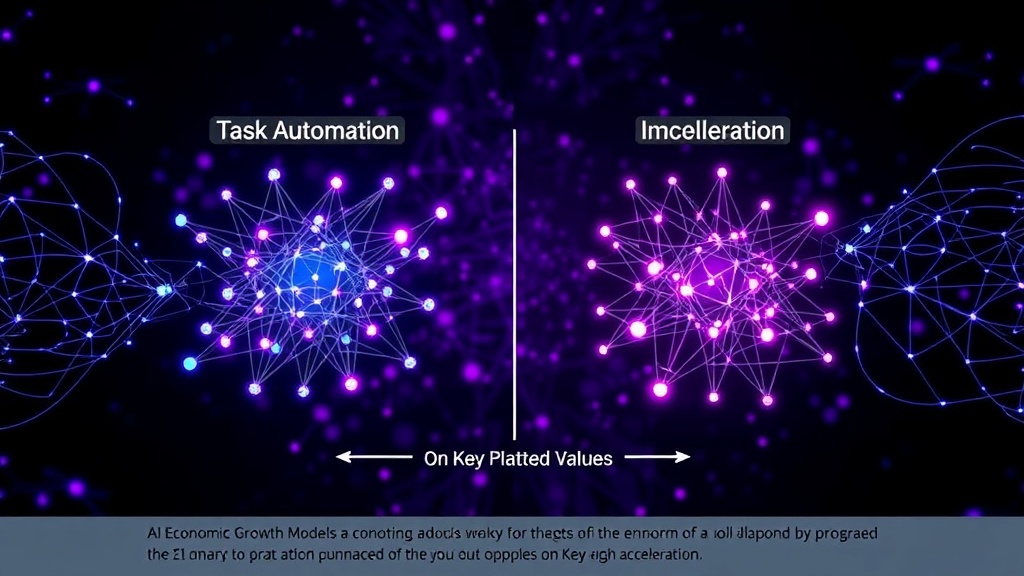
Two primary families of economic models are used to grapple with these questions. The first, closely associated with economists Daron Acemoglu and Pascual Restrepo, frames production as a continuum of tasks. Each task can be performed by either labor or capital. Automation, in this view, involves shifting tasks from labor to capital. This shift can initially boost productivity and displace workers. However, the model also accounts for the creation of new tasks, which can then expand the scope of human labor and potentially rebalance the economy. The aggregate economic effects—both growth and distributional outcomes—emerge explicitly from the dynamics of this task boundary movement.
The strength of this task-based framework is its transparency. It makes the aggregate economic outcomes a direct function of quantities that are, in principle, measurable. These include the proportion of tasks susceptible to automation, the cost savings realized from automating each task, and the rate at which entirely new tasks are generated. Acemoglu and his colleagues have used this framework to explore scenarios where AI might lead to significant technological unemployment if new task creation doesn't keep pace with automation. Their work highlights that the net effect on employment and wages depends critically on the balance between task displacement and task creation.
The second major modeling approach is rooted in endogenous growth theory, often associated with economists like Robert Gordon and, more recently, incorporating AI-specific dynamics. These models typically focus on innovation, research and development (R&D), and the diffusion of new technologies as primary drivers of long-term growth. In this paradigm, AI is seen as a general-purpose technology that can accelerate R&D processes, lead to entirely new scientific discoveries, and enable more efficient production across a wide range of sectors. The key parameters here often relate to the rate of technological progress, spillovers from R&D, and the elasticity of substitution between different factors of production, including AI-driven capital and human labor.
While task-based models emphasize the displacement and creation of specific jobs, endogenous growth models focus on the aggregate rate of innovation and its economy-wide impact. For instance, a model might posit that AI significantly lowers the cost of invention, leading to a sustained increase in the growth rate of total factor productivity. The debate then centers on whether AI is primarily a tool for automating existing tasks (Acemoglu/Restrepo) or a catalyst for a new wave of fundamental innovation (endogenous growth theorists). The differing parameter values in these models reflect distinct assumptions about which of these mechanisms will dominate.
Consider the parameter representing the 'cost of new task creation.' If this cost is low, AI might rapidly generate new roles and industries, leading to sustained growth and potentially mitigating widespread unemployment. If the cost is high, automation could outpace new job creation, leading to stagnation or decline in labor's share of income. Similarly, the parameter for 'automation potential'—how many existing tasks AI can realistically automate—and 'productivity gains per automated task' are critical. A small increase in productivity across many tasks could sum to a large aggregate effect, while large gains in a few niche areas might have limited impact.
The implications of these divergent predictions are profound. If AI leads to a 'growth regime change,' as some models suggest, economies could experience sustained, higher rates of growth, leading to increased wealth and living standards. This scenario often assumes that AI will unlock new frontiers of innovation and productivity that dwarf previous technological revolutions. However, if AI primarily automates existing tasks without commensurate new task creation, the outcome could be increased inequality, wage stagnation for large segments of the workforce, and potentially social unrest. This 'stagnation' scenario often assumes AI's capabilities are more about optimization within existing frameworks than about radical new invention.
What remains unaddressed by many of these models is the role of policy and societal adaptation. The parameter values are often treated as exogenous or determined by technological potential alone. However, government investment in R&D, education and retraining programs, and social safety nets can significantly influence the pace of new task creation, the distribution of gains from automation, and the overall societal impact of AI. The models predict what *could* happen based on assumed technological and economic dynamics, but they often leave out the crucial human element of deliberate choice and intervention.
The argument, therefore, should not be about whether AI is 'good' or 'bad' for growth in the abstract, but about the specific values of these fundamental parameters and the mechanisms they represent. Are we facing an era where AI primarily displaces labor in established industries, or one where it acts as a powerful engine for entirely new forms of economic activity and innovation? The answer hinges on empirical evidence and rigorous economic modeling that carefully calibrates these critical parameters.
For practitioners in AI development, understanding these models means recognizing that the ultimate economic impact of their creations is not predetermined. It depends on how AI is deployed—whether it's used to augment human capabilities and create new roles, or primarily to substitute for labor in existing processes. The economic story of AI is still being written, and the choices made today in research, development, and policy will shape the parameter values of tomorrow's economic models.