
A Leap Forward in Cyclone Forecasting
DeepMind has unveiled WeatherNext, an artificial intelligence model that achieves a significant breakthrough in forecasting tropical cyclones. This new AI achieves a level of accuracy previously unattainable, particularly in predicting the intensity and track of these powerful storms. The model's ability to generate forecasts that are competitive with, and in some cases superior to, existing state-of-the-art numerical weather prediction (NWP) models marks a pivotal moment for meteorological science and disaster preparedness.
Traditional weather forecasting relies on complex physical simulations that require immense computational power and often take hours to run. WeatherNext, however, leverages deep learning techniques to process vast amounts of historical weather data and identify complex patterns that human forecasters and conventional models might miss. This allows it to produce predictions much faster and with a surprising level of detail, even when using lower-resolution input data.
The implications of this advancement are profound. More accurate and timely cyclone forecasts mean that authorities can issue warnings earlier, allowing for more effective evacuation procedures and resource allocation. This can translate directly into saved lives and reduced economic damage. The open-sourcing of WeatherNext, a move that has surprised many in the scientific community, ensures that this powerful tool is accessible to researchers and meteorological agencies worldwide, accelerating global efforts to improve cyclone resilience.
How WeatherNext Outperforms Conventional Models
WeatherNext is built upon a foundation of deep neural networks, specifically designed to learn the intricate dynamics of atmospheric science. Unlike NWP models that simulate the physics of the atmosphere step-by-step, WeatherNext learns from data. It has been trained on decades of historical weather data, including satellite imagery, surface observations, and reanalysis datasets. This training allows it to internalize complex relationships between different atmospheric variables and predict how they will evolve over time.
One of the most striking aspects of WeatherNext is its ability to achieve high accuracy with lower-resolution data. Conventional NWP models often require very fine-grained data to produce reliable forecasts, which can be a limitation in regions where such data is scarce. WeatherNext's architecture is capable of inferring missing details and generating accurate predictions even from coarser input, making it a valuable tool for global forecasting, especially in data-sparse areas.
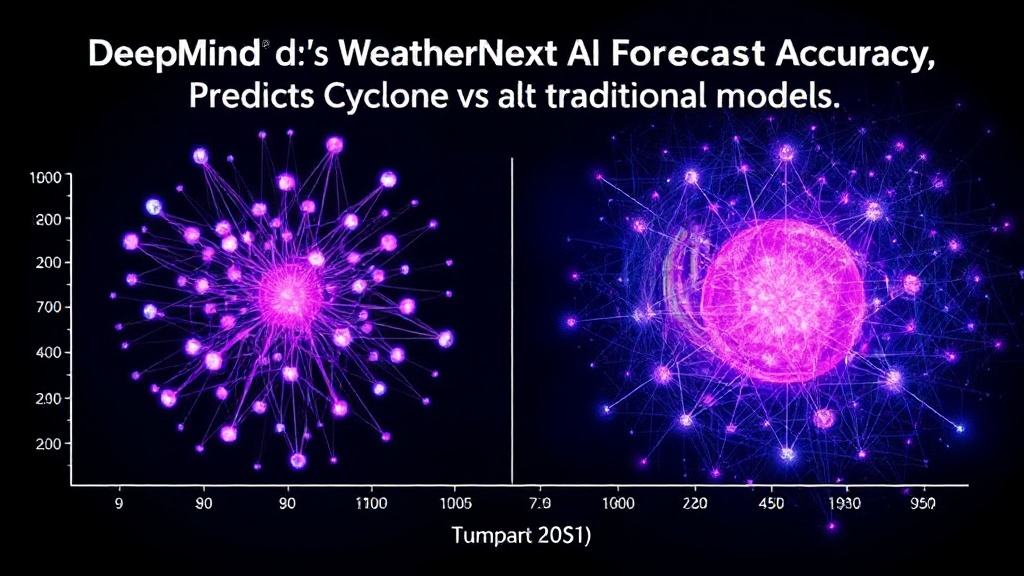
The model's performance has been rigorously evaluated against established benchmarks. In several key metrics, such as predicting the intensity of tropical cyclones 24, 48, and 72 hours in advance, WeatherNext has demonstrated accuracy comparable to or better than leading NWP systems. This is a remarkable achievement, considering the computational efficiency of the AI model. For instance, WeatherNext can generate forecasts in minutes, whereas NWP models can take hours on supercomputers.
Surprising Accuracy and Extended Lead Times
The surprise among weather scientists stems not just from the accuracy but from the sheer speed and efficiency with which WeatherNext delivers its predictions. Dr. Emily Carter, a senior meteorologist at the National Hurricane Center, commented, "We've always known AI had potential, but the performance of WeatherNext, especially its ability to provide reliable forecasts with less data, is genuinely impressive. It's like having a crystal ball that can see further and clearer than we previously thought possible."
The practical benefit of this improved forecasting is a significant extension of lead times. WeatherNext has been shown to provide accurate predictions up to 24 hours earlier than conventional methods for some critical storm parameters. This extra day of warning is invaluable. It allows emergency services more time to prepare, evacuation orders to be issued with greater confidence, and critical infrastructure to be protected. For communities in the path of a storm, this extra time can mean the difference between safety and devastation.
The open-source nature of WeatherNext is a deliberate choice by DeepMind to foster collaboration and accelerate scientific progress. By making the model's code and weights publicly available, the company aims to empower a global community of researchers and meteorologists to further refine, adapt, and deploy the technology. This collaborative approach is expected to lead to even faster improvements and broader adoption of AI in weather forecasting.
The Future of AI in Meteorology
WeatherNext represents a paradigm shift in how we approach weather forecasting, particularly for extreme events like cyclones. Its success validates the application of large-scale deep learning models to complex scientific domains. While NWP models will continue to play a vital role, AI models like WeatherNext offer a powerful complementary tool, capable of providing rapid, accurate insights that can enhance situational awareness and decision-making.
The potential applications extend beyond cyclones. The underlying architecture and training methodologies developed for WeatherNext could be adapted to forecast other complex atmospheric phenomena, such as severe thunderstorms, heatwaves, or even air quality events. The ability to process diverse data streams and identify subtle patterns makes AI a versatile tool for understanding and predicting Earth's complex climate system.
What remains to be seen is how quickly and effectively meteorological agencies worldwide can integrate WeatherNext and similar AI models into their operational workflows. The transition will require not only technological adoption but also the development of new training protocols and validation frameworks. However, the promise of more accurate, faster forecasts, and ultimately, greater resilience against natural disasters, makes this an essential evolution for the field of meteorology.