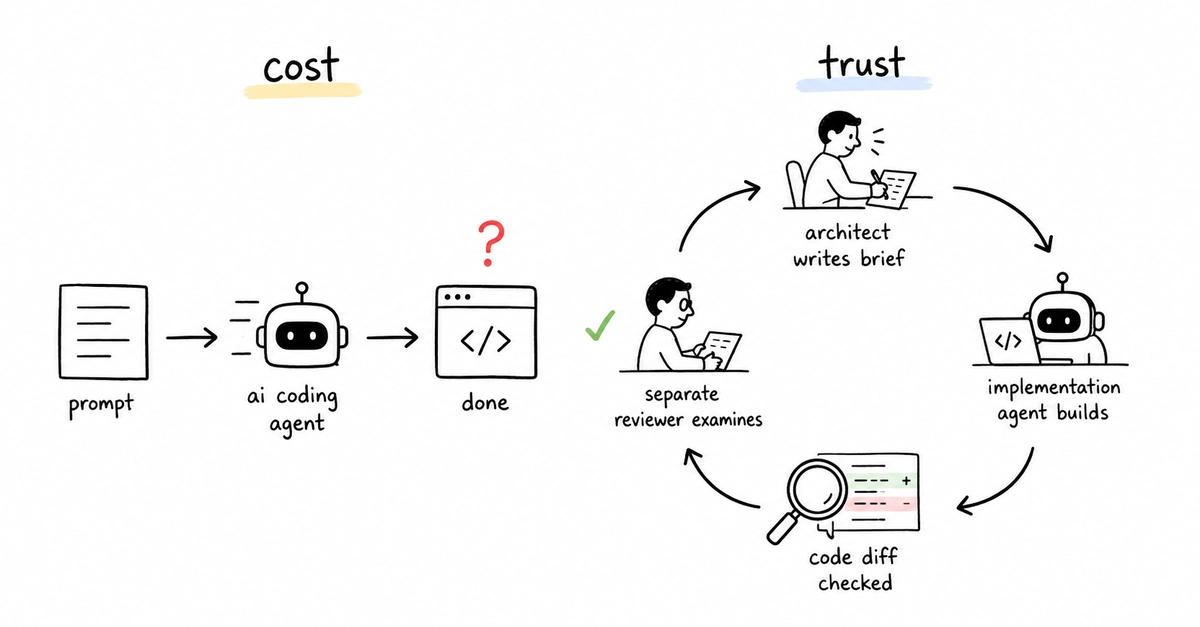
The Cost of Smarter AI Agents
Running AI agents efficiently often means balancing capability with cost. The prevailing strategy for many developers has been to deploy a tiered approach to model selection. This involves using cheaper, less powerful models for routine tasks and reserving more expensive, highly capable models for complex operations that genuinely require them. The goal is to avoid routing every single request to the most premium, and therefore most costly, AI model available. This strategy, when implemented effectively, can make it practical to operate a larger number of agents without incurring prohibitive expenses.
The author of this piece spent considerable time optimizing their AI agent infrastructure with precisely this cost-saving model routing in mind. The objective was clear: reduce operational expenditure by intelligently assigning tasks to the most appropriate model based on complexity and necessity. By segmenting tasks and matching them to models of varying price points and performance tiers, significant cost reductions were indeed achieved. This made it feasible to scale agent capacity significantly without a proportional increase in cloud spend. The initial success was palpable; the agents were cheaper to run.
However, the optimization hit a new, more fundamental bottleneck: trust. While the cost of AI operations decreased, the inherent challenge of verifying the accuracy and reliability of the AI's output remained. The core problem wasn't about the expense of the models, but about the confidence in their results. More agent capacity, enabled by the cost savings, did not inherently solve this trust deficit. In fact, it amplified it, allowing for the faster creation of potentially flawed outputs.

The Trust Deficit in AI Outputs
The crux of the trust issue lies in the gap between an AI agent reporting a task as complete and the human understanding that the task was *correctly* and *comprehensively* completed. An agent might signal completion through passing automated tests, producing clean-looking code diffs, or providing a seemingly coherent summary. Yet, these indicators often fail to confirm whether the AI agent truly understood the underlying product decision, made appropriate changes within the broader codebase, or overlooked critical assumptions elsewhere.
Consider the scenario of code generation. An agent can be instructed to implement a feature. It might generate code that compiles, passes unit tests, and adheres to style guides. It might even present a diff that looks logical at first glance. But did it grasp the architectural implications? Did it consider edge cases not covered by the existing test suite? Did it introduce subtle bugs in related modules due to a misunderstanding of the overall system design? These are the questions that automated checks and cost-saving routing strategies do not inherently answer. The agent's report of completion is objective, but the verification of its *quality* and *correctness* remains a subjective, and often manual, human endeavor.
This is particularly problematic in development workflows. If an AI agent is responsible for architectural changes, implementation, or even code review, the downstream impact of even minor misunderstandings can be severe. A misinterpretation of a product requirement could lead to an agent implementing the wrong feature, wasting development cycles and potentially introducing technical debt. Similarly, a misunderstanding of the codebase structure could result in an agent modifying files that appear unrelated but are, in fact, critical dependencies.
The problem is not that the agents are incapable of performing tasks, but that their success is measured by internal metrics (like passing tests) rather than by a holistic understanding of the problem domain and its implications. The more capable and numerous the agents become, the more efficiently they can produce outputs that *appear* correct but are fundamentally flawed. This efficiency in producing plausible-sounding but incorrect results exacerbates the trust issue. It means developers are not just dealing with the cost of running AI, but the potentially higher cost of debugging and correcting AI-generated errors that stem from a lack of deep understanding.
A Proposed Solution: Specialized Agents and Human Oversight
To address this, the author has adopted a strategy that leverages specialized agents and a more structured human-in-the-loop process. The core idea is to break down complex tasks into smaller, more manageable components, each handled by an agent with a specific role, and crucially, to introduce a distinct human review phase.
The author uses a tool called Sol Advisor, which is integrated with a powerful model like Codex. This setup is designed to separate distinct phases of the development lifecycle: architecture, implementation, and review. The primary human role is redefined to focus on objective tasks: defining the architecture, verifying intermediate steps, and providing final acceptance. This ensures that the human is guiding the overall direction and validating critical decisions.
The implementation agent is then given a more bounded job. Instead of having open-ended responsibility for an entire feature or module, it is tasked with executing specific instructions within defined parameters. This reduces the scope for misinterpretation and limits the potential blast radius of errors. The key innovation here is that a *fresh reviewer* – another agent or a human designated for review – challenges the output of the implementation agent. This adversarial approach, where one agent's work is scrutinized by another, acts as a critical quality control mechanism.
This compartmentalization serves multiple purposes. Firstly, it enhances the cost-efficiency by ensuring that only the implementation agent (which can be tailored to a specific model) is doing the bulk of the code generation, while architecture and review can potentially use different, perhaps more specialized or human-managed, processes. Secondly, and more importantly, it addresses the trust deficit. By having a separate review stage, the system introduces a layer of scrutiny that is designed to catch misunderstandings or errors that the implementation agent might have missed. The fresh reviewer acts as a proxy for broader understanding and critical evaluation, something that a single, end-to-end agent often lacks.
The success of this approach hinges on the clear definition of roles and the robustness of the review process. It acknowledges that while AI can automate many tasks, the critical thinking, contextual understanding, and high-level judgment required for complex software development still necessitate careful human involvement and structured AI collaboration. The goal is not to eliminate human oversight but to augment it, making the AI agents more effective collaborators rather than autonomous, untrusted workers.