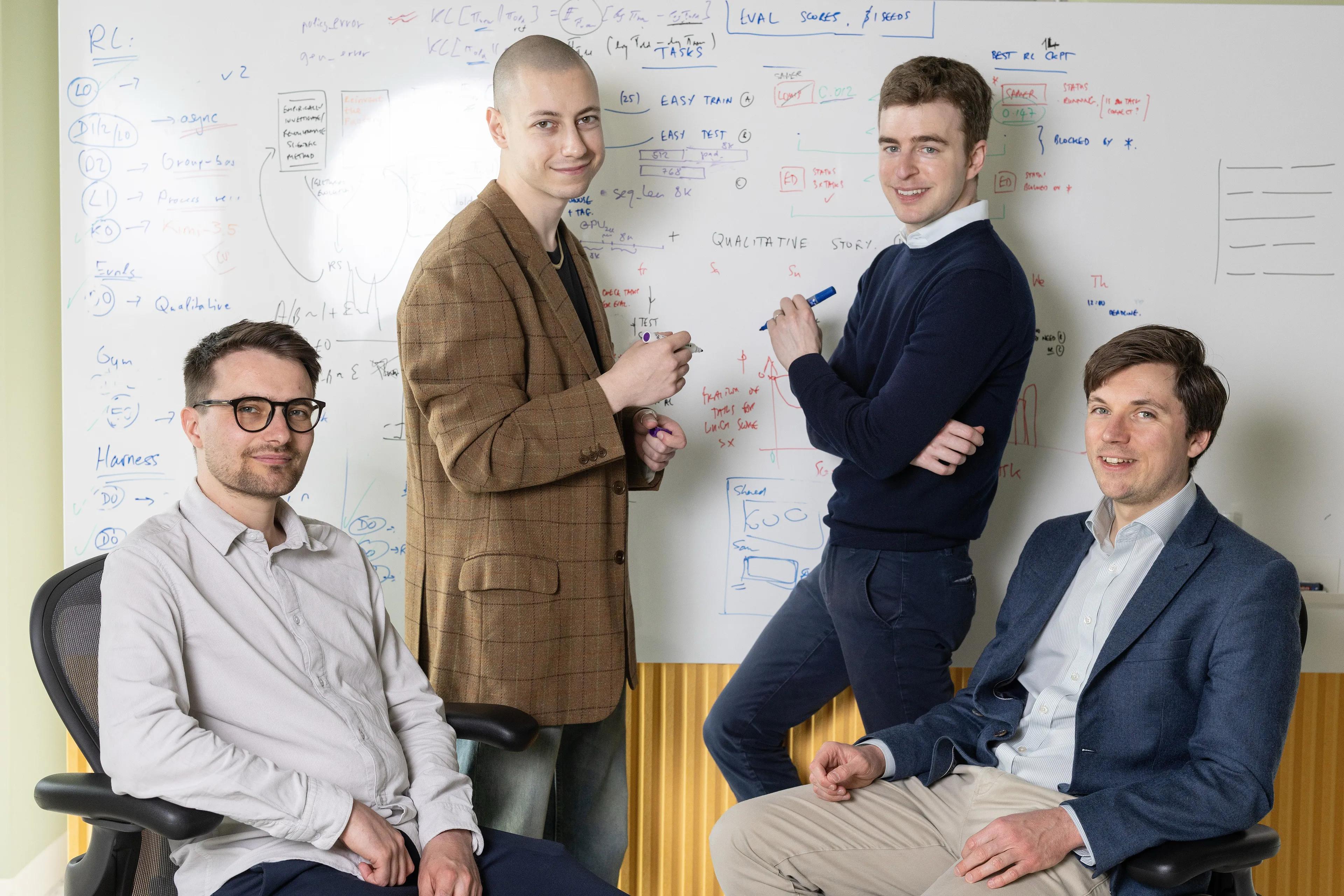
Inherent's Faraday Agent Achieves Scientific Replication Milestone
British AI lab Inherent, founded by former DeepMind researchers, has unveiled Faraday, an AI agent designed to replicate scientific research. The company claims Faraday has outperformed leading models from OpenAI and Anthropic in its ability to accurately reproduce experimental results described in scientific papers. This marks a significant step towards AI systems that can not only understand but actively participate in the scientific discovery process.
The core challenge Inherent addresses is the reproducibility crisis in science. Many published findings are difficult or impossible to replicate, hindering scientific progress. Faraday's purported success suggests a path to automating and validating research, a capability that could dramatically speed up innovation across various fields. The AI agent is built to interpret complex scientific methodologies, execute simulated experiments, and compare outcomes against published data.
Sources indicate that Faraday's performance was evaluated against a benchmark of scientific papers across disciplines. Inherent reports that Faraday achieved a higher rate of successful replication compared to prompts given to models like OpenAI's GPT-4 and Anthropic's Claude 3. The specific metrics and the exact nature of the benchmark remain proprietary, but the claim itself is a bold one in a competitive AI landscape.
The implications for research and development are profound. Imagine an AI that can take a published paper, understand its experimental setup, and run a virtual version of the experiment, confirming or refuting the results. This could drastically reduce the time and resources spent on manual replication, allowing scientists to build upon validated findings more rapidly. For startups like Inherent, achieving such a feat positions them as potential leaders in AI-assisted scientific discovery.
The 'Teammate' Analogy and Its Significance
Inherent frames Faraday not just as a tool, but as an AI 'teammate.' This anthropomorphic framing suggests a collaborative future for AI in research. Instead of AI merely summarizing literature or generating hypotheses, it would actively work alongside human researchers, performing critical validation tasks. This is akin to having a highly diligent, tireless lab assistant who can instantly process and execute complex experimental protocols based on written instructions.
The development team at Inherent, drawing from their DeepMind background, likely focused on deep scientific understanding rather than just language pattern recognition. Replicating research requires more than just understanding the text; it necessitates grasping underlying principles, experimental design, data interpretation, and potential sources of error. If Faraday can truly do this consistently, it represents a leap in AI's ability to engage with the physical and empirical world, even if through simulation.
The competitive landscape is fierce. OpenAI and Anthropic are continuously pushing the boundaries of their large language models, with significant investment and talent dedicated to scientific applications. For Inherent to claim a lead in this specific, highly technical domain of research replication is noteworthy. It suggests a focus on specialized AI agents tailored for scientific tasks, rather than general-purpose models attempting to do everything.
What remains to be seen is the breadth of Faraday's capabilities. Can it replicate complex biological experiments with the same fidelity as it might theoretical physics simulations? The details of its training data and the specific algorithms that enable this replication are crucial to understanding its true potential and limitations. The company's announcement, while confident, is light on these technical specifics, a common characteristic of early-stage AI company disclosures.
Potential Impact on Scientific Innovation
The ability to reliably replicate scientific research could fundamentally alter the pace of innovation. Currently, a significant bottleneck is the time and effort required for independent verification of findings. If Faraday can automate much of this process, researchers could spend less time on tedious replication and more time on novel research, hypothesis generation, and experimental design. This could lead to faster breakthroughs in medicine, materials science, climate modeling, and countless other domains.
For academic institutions and R&D departments, tools like Faraday could become indispensable. They offer the potential to build a more robust and trustworthy body of scientific knowledge. Furthermore, it could democratize access to advanced research capabilities, enabling smaller labs or individual researchers to conduct more thorough validation of their work or explore complex published methodologies without extensive resource investment.
However, the success of such an AI hinges on its interpretation of scientific papers. Nuances, implicit assumptions, and experimental variations that are critical for replication might be missed by an AI. The 'black box' nature of AI also raises questions about transparency in the replication process itself. Human scientists can often intuit why a replication might fail; understanding an AI's reasoning process in such scenarios will be critical for trust and adoption.
Inherent's claim, if validated by independent researchers, represents a significant advancement. It shifts the conversation from AI as a generator of text or code to AI as a partner in empirical discovery. The challenge for Inherent now is to provide concrete evidence and demonstrate the practical utility of Faraday in real-world research workflows. The race to build the AI-powered scientific laboratory has just intensified.