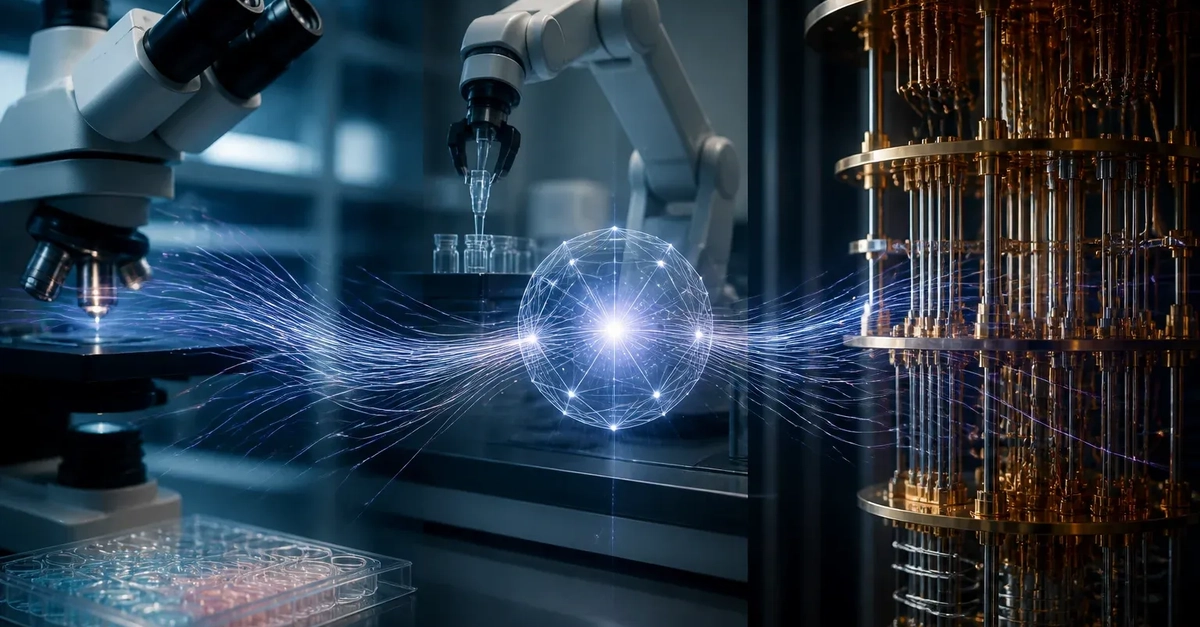
Anthropic has launched a research preview of its Model Hardware Standard (MHS), a specification designed to simplify the connection between AI agents and physical laboratory and industrial equipment. This initiative, currently in an early access phase for select research labs and manufacturers, seeks to reduce the significant friction typically involved in integrating AI systems with diverse hardware and software platforms. The goal is to enable AI agents to operate complex machinery, from laboratory automation systems to quantum computing hardware, with greater ease and safety.
Bridging the AI-Software Gap with Physical Hardware
AI models excel at processing and generating text, images, code, and data. However, translating these sophisticated reasoning capabilities into actions within the physical world has historically been a complex and custom undertaking. Each new piece of hardware or laboratory setup often requires bespoke integrations, a process that is time-consuming, expensive, and prone to errors. MHS aims to establish a common, standardized interface that allows AI agents to discover, understand, and interact with physical devices more seamlessly.
The significance of MHS lies not just in enabling AI models to issue commands to hardware, but in creating a more robust and reliable framework for these interactions. Anthropic emphasizes that MHS is designed with safety checks and human approval workflows built-in, particularly for higher-risk operations. This layered approach ensures that while AI agents can automate tasks, critical decisions remain under human oversight, mitigating potential risks associated with autonomous physical systems.

Early Adopters and Applications
The research preview is already being piloted in demanding environments. Early participants include Genentech, a leading biotechnology company; HHMI Janelia Research Campus, a prominent biomedical research institution; and QuEra, a company at the forefront of quantum computing. These diverse applications highlight MHS's potential across various scientific and industrial domains.
At Genentech and HHMI Janelia, MHS is being explored for automating laboratory processes, such as controlling advanced microscopy equipment and managing complex experimental workflows. This could dramatically accelerate research by enabling AI agents to perform repetitive or intricate tasks with high precision, freeing up scientists to focus on experimental design and data analysis. Imagine an AI agent not just analyzing microscope images, but also autonomously adjusting focus, stage position, and illumination based on real-time feedback to capture optimal data for a specific experiment. This level of automation was previously out of reach for many standard laboratory setups due to integration challenges.
QuEra is investigating MHS for applications in quantum computing, specifically for controlling laser systems. The precise calibration and operation of quantum hardware are critical for achieving stable and reliable quantum computations. By using MHS, AI agents can potentially manage these complex laser controls, fine-tuning parameters and responding to system feedback to maintain optimal quantum states. This could lead to more efficient and stable quantum computing platforms, pushing the boundaries of what is possible in this rapidly evolving field.
Reducing Friction, Enhancing Safety
The core value proposition of MHS is the reduction of integration friction. Traditionally, connecting an AI model to a specific piece of hardware involved developing custom drivers, APIs, and control logic. This process is akin to building a unique translator for every single device an AI might need to communicate with. MHS seeks to establish a universal translator, a common language that AI agents can use to interact with a wide array of hardware, provided that hardware adheres to the MHS specification.
Furthermore, the standard incorporates mechanisms for safety and governance. This is crucial when AI agents are tasked with operating physical machinery that could pose risks if malfunctioning. MHS is designed to allow for the definition of operational boundaries, monitoring of system states, and the flagging of anomalous conditions. For critical operations, it can be configured to require explicit human approval before proceeding, ensuring that AI-driven automation remains aligned with human intent and safety protocols.
The Future of Physical AI
While MHS is currently a research preview, its potential implications are far-reaching. If widely adopted, it could accelerate the development and deployment of AI-powered automation in numerous industries. The standardized approach could foster an ecosystem where hardware manufacturers build MHS-compatible interfaces into their devices, and AI developers create agents capable of operating a broad range of equipment without extensive custom work.
The success of MHS will depend on several factors, including the willingness of hardware manufacturers to adopt the standard, the robustness and flexibility of the specification itself, and the ability of AI agents to reliably interpret and execute commands within complex physical environments. However, the early pilots at leading institutions suggest a strong demand for such a solution. This initiative represents a significant step towards making AI agents not just intelligent assistants for digital tasks, but capable operators of the physical world.
What remains to be seen is how MHS will evolve beyond this research preview. Will it become an open standard, or will it remain proprietary? The path forward will significantly influence its adoption rate and its impact on the broader landscape of AI-driven physical automation.