The Problem: AI Agents Understand Code, But Not Its Intent
The rapid advancement of AI agents in software development has brought about a paradigm shift, making code generation almost a commodity. However, this progress has introduced a new bottleneck: the review process. Developers are increasingly bogged down by the sheer volume of security issues flagged by AI tools like Mythos and Glasswing, leading to a draining cycle of debugging and re-evaluation. The core issue, according to engineers who have grappled with this, is that current AI agents understand code structure but lack a deep, semantic comprehension of what the code actually *does*.
This gap in understanding prevents agents from effectively offloading the critical tasks of bug detection and security analysis. The current approach often burns through billions of tokens with limited efficacy in identifying nuanced issues. The need is for AI agents that can move beyond superficial syntax and grasp the intricate data flows, conditional logic, and functional intent within a codebase. This is the void Decypher seeks to fill.
Decypher's Approach: Compilers as the Foundation for Deep Understanding
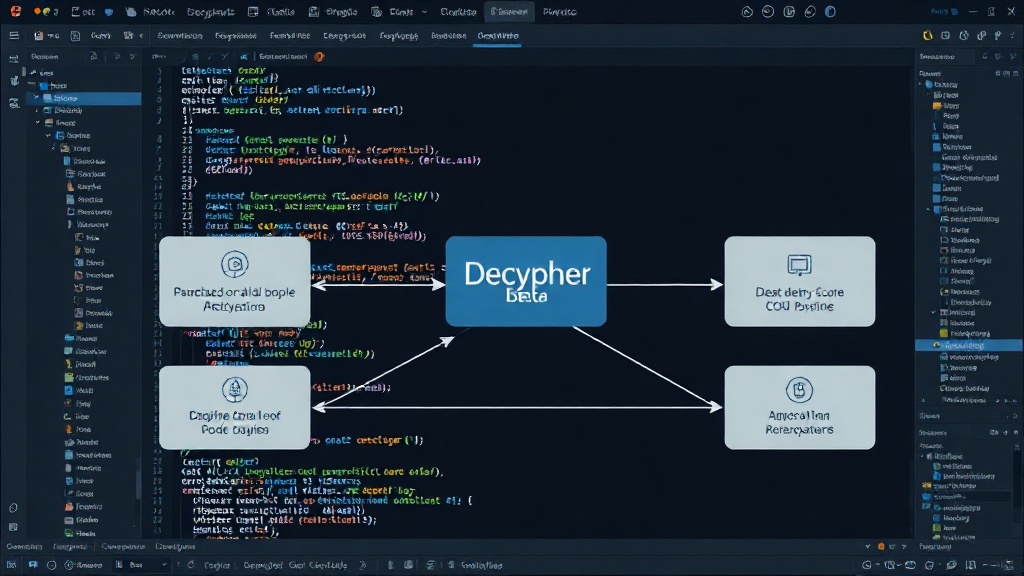
Decypher is built from the ground up with a singular focus: enabling AI agents to achieve a truly deep, semantic understanding of code. Unlike tools that rely on abstract syntax trees (ASTs) alone, Decypher leverages language-specific compilers. This foundational choice allows Decypher to process code at a much deeper level, effectively mirroring how a human compiler understands and optimizes source code before execution.
By integrating with the compilation pipeline, Decypher gains access to rich, intermediate representations of the code. This enables it to track the precise flow of data, map out complex conditional branches, understand the implications of return statements, and analyze function call graphs with unparalleled accuracy. The goal is to transform AI agents from code generators into intelligent code reviewers and security analysts capable of identifying subtle bugs and vulnerabilities that current tools miss.
The beta launch signifies a critical step towards making this advanced understanding accessible to development teams. The promise is a future where AI agents can effectively shoulder the burden of code review and security auditing, freeing up human developers to focus on higher-level design and innovation rather than sifting through endless alerts. This deep semantic understanding is the key to unlocking more efficient, secure, and scalable agentic coding workflows.
Beyond Syntax: What Decypher Unlocks for AI Agents
The true power of Decypher lies in its ability to provide AI agents with a contextual and functional understanding of code. This is not merely about parsing code; it's about interpreting its behavior and intent. For developers, this translates into a more reliable and insightful AI assistant.
Consider the task of identifying a potential security vulnerability. A traditional tool might flag a function call based on its signature or known patterns. Decypher, however, can trace the data originating from user input through multiple function calls, across different modules, and into a sensitive operation. It can understand if that data is properly sanitized at each step, if it's used in a way that could lead to injection attacks, or if it exposes unintended information. This level of analysis is akin to a seasoned security engineer manually auditing the code, but at machine speed.
Similarly, for bug detection, Decypher can identify race conditions by understanding concurrent data access patterns, or detect off-by-one errors by analyzing loop invariants and boundary conditions. It can also help in refactoring by understanding the dependencies and side effects of functions, allowing agents to suggest changes that are less likely to introduce regressions.
The implications for agentic coding are profound. Instead of agents generating code and then human developers painstakingly reviewing it, Decypher enables agents to perform a significant portion of that review themselves. This could drastically reduce the feedback loop, accelerate development cycles, and improve the overall quality and security of software produced by AI.
The Path Forward: From Beta to Production-Ready Agentic Coding
The beta release of Decypher is a signal to the industry. It indicates that the technology to imbue AI agents with deep code comprehension is maturing. For software engineering teams, this presents an opportunity to experiment with and integrate tools that can move beyond simple code generation.
The immediate challenge for developers will be to understand how to best leverage Decypher's capabilities. Integrating a deep semantic code graph into existing CI/CD pipelines and agentic workflows will require adaptation. However, the potential payoff – significantly reduced review overhead and improved code quality – makes this an endeavor worth exploring.
What remains to be seen is how quickly other players in the AI coding space will adopt similar deep semantic analysis techniques. If Decypher proves successful, it could set a new benchmark for what is expected from AI coding assistants, forcing competitors to move beyond surface-level code understanding. The journey from beta to widespread adoption will depend on the tool's performance, scalability, and ease of integration into diverse development environments.