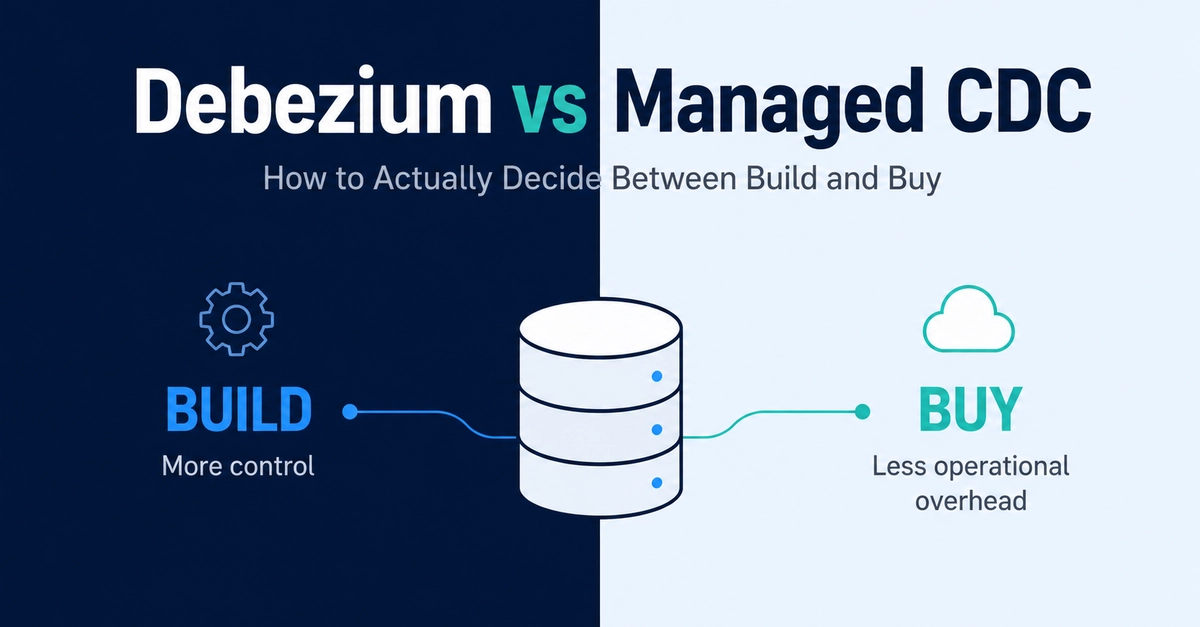
The Real Question: Operational Overhead, Not Feature Parity
Most comparisons between Debezium and managed Change Data Capture (CDC) solutions miss the mark. They often devolve into feature checklists, evaluating which tool best reads transaction logs. This is a flawed premise. In production, the core challenge of CDC isn't log capture—most tools do that competently. The true differentiator lies in the operational burden: who manages the infrastructure, the scaling, the monitoring, the schema evolution, and the incident response? This transforms the decision from a product bake-off into a strategic build-vs-buy question.
If you find yourself evaluating Debezium versus a managed CDC service, understand that the decision hinges on whether the work involved in operating Debezium in-house is a justifiable use of your team's valuable engineering time and resources.
Debunking Stale Debezium Criticisms
Much of the negative commentary surrounding Debezium is outdated. Criticisms that might have been valid two or three years ago often don't hold water for the current Debezium 3.x releases. The project has evolved significantly beyond its initial integration with Kafka Connect. While Kafka Connect remains a common deployment pattern, Debezium itself has become more adaptable and robust. It's no longer solely tied to a specific ecosystem, offering greater flexibility in how it's deployed and managed. This evolution means that older critiques about complexity, integration challenges, or lack of features are frequently based on outdated perceptions.
The Operational Landscape: Debezium's Domain
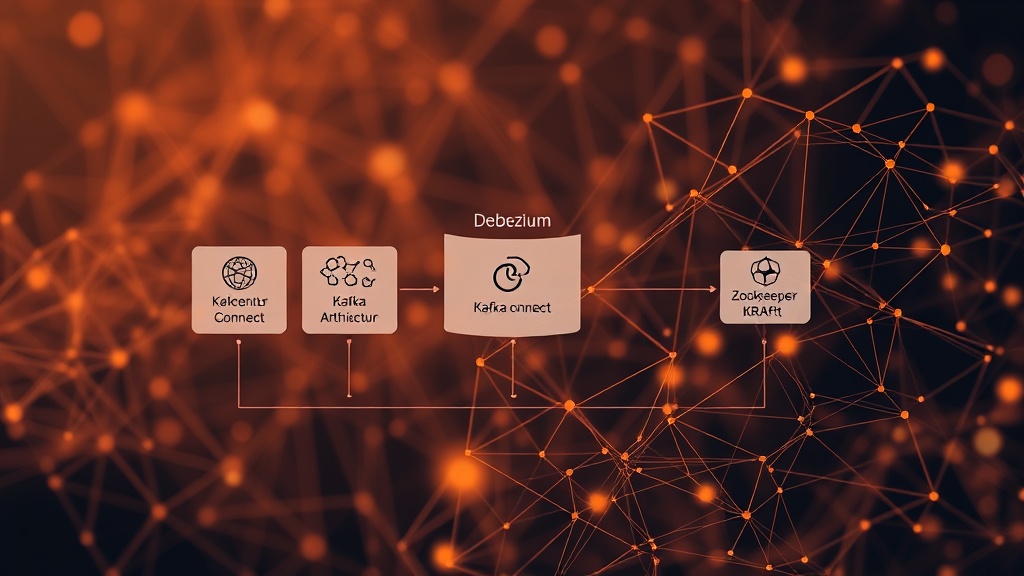
When you choose to build with Debezium, you are choosing to own the entire operational stack. This includes:
- Infrastructure Management: Provisioning, configuring, and maintaining the servers or Kubernetes clusters that run Debezium connectors and Kafka Connect workers.
- Scalability: Designing and implementing strategies to scale your Kafka Connect cluster and Debezium connectors based on database load and data volume. This involves understanding resource allocation, partitioning, and worker tuning.
- Monitoring and Alerting: Setting up comprehensive monitoring for Debezium connectors, Kafka Connect, Kafka brokers, and the underlying infrastructure. This includes tracking lag, error rates, resource utilization, and database-specific metrics.
- Schema Evolution: Handling changes in source database schemas. Debezium can emit schema change events, but your downstream systems must be designed to consume and react to these changes gracefully. This often involves complex data pipeline logic and robust error handling.
- Upgrades and Patching: Managing the lifecycle of Debezium, Kafka Connect, and Kafka itself. This includes planning and executing upgrades, applying security patches, and testing compatibility.
- Connector Configuration and Tuning: Optimizing connector configurations for specific databases and workloads to ensure performance and stability. This requires deep knowledge of both Debezium and the source database's internal workings.
- High Availability and Disaster Recovery: Implementing strategies to ensure that your CDC pipeline remains available even during infrastructure failures or regional outages. This extends to ensuring data durability and the ability to restart processing from the correct point.
This list is not exhaustive, but it highlights the significant engineering effort required to run Debezium reliably in a production environment. It demands specialized skills in distributed systems, message queues, database internals, and operational best practices.
The Managed CDC Advantage: Offloading Operational Burden
Managed CDC services, by contrast, abstract away most of this operational complexity. When you buy into a managed solution, you are essentially paying for the provider to handle:
- Infrastructure: The provider manages the underlying compute, storage, and networking.
- Scalability: The service automatically scales resources to meet demand, often with performance guarantees.
- Monitoring and Alerting: Built-in dashboards and alerting systems are provided, often with pre-configured checks for common CDC issues.
- Schema Evolution: Many managed services offer features to simplify schema handling, such as automatic schema registration or compatibility checks.
- Upgrades and Patching: The provider handles all software updates and security patching for the CDC platform.
- High Availability: Managed services typically offer built-in HA and DR capabilities, often backed by SLAs.
The primary benefit is freeing up your engineering team. Instead of spending time firefighting infrastructure issues or optimizing Kafka Connect workers, they can focus on building features that directly add business value.
The Framework for Decision Making
To decide between building with Debezium or buying a managed CDC service, consider these factors:
1. Team Capacity and Expertise
Build: Do you have engineers with deep expertise in distributed systems, Kafka, database internals, and operational management? Are they passionate about managing this infrastructure, or do they view it as a distraction from core product development?
Buy: If your team is lean, focused on product features, or lacks specialized operational skills, a managed service is likely more efficient. It allows them to leverage CDC without deep infrastructure investment.
2. Time to Market
Build: Setting up and stabilizing a production-grade Debezium deployment can take weeks or months, involving significant planning, configuration, and testing. This can delay your project's launch.
Buy: Managed services typically offer a much faster time to value. Provisioning a CDC pipeline can often be done in hours or days, allowing you to integrate data sources more rapidly.
3. Cost Analysis
Build: The direct costs of running Debezium include infrastructure (servers, network), engineering salaries (for operations and maintenance), and tooling (monitoring, alerting). While infrastructure costs might seem lower initially, the total cost of ownership (TCO) can be significantly higher due to ongoing operational effort.
Buy: Managed services have a predictable subscription cost. While this can appear higher on paper, it often represents a lower TCO when you factor in the engineering hours saved and the reduced risk of operational failures.
4. Customization and Control
Build: Debezium offers maximum control. You can fine-tune every aspect of the pipeline, integrate deeply with custom tooling, and modify connectors if necessary. This is crucial for highly specific or complex requirements.
Buy: Managed services offer less granular control. While they provide extensive configuration options, you are ultimately bound by the provider's platform capabilities and roadmap. If your needs are highly bespoke, a managed service might not suffice.
5. Risk Tolerance
Build: You bear all the operational risk. Downtime, data loss, or performance degradation directly impacts your business and requires your team to resolve it.
Buy: The provider assumes much of the operational risk. SLAs often guarantee uptime and performance, shifting the burden of incident response and recovery to the vendor.
The Unanswered Question: Vendor Lock-in vs. Internal Expertise
While the build vs. buy decision is framed around operational overhead, a critical, less discussed aspect is vendor lock-in. Relying on a managed CDC service can lead to a dependency that is difficult to break. Conversely, building with Debezium cultivates internal expertise, which is a valuable asset but requires continuous investment. What is the long-term strategy for managing this expertise and avoiding lock-in, regardless of the chosen path?
Conclusion: A Strategic Choice
The choice between Debezium and a managed CDC solution is not about which tool is technically superior. It's a strategic decision about resource allocation. If your organization has the specialized talent and the appetite for managing complex distributed systems, building with Debezium offers unparalleled control and customization. However, for most teams focused on delivering business value quickly and efficiently, offloading the operational burden to a managed CDC provider is the more pragmatic and cost-effective choice.