The Problem: AI's Test World Delusion
Modern AI coding assistants are powerful tools. They can write code, debug, and even suggest architectural improvements. However, a critical flaw emerges when these agents are tasked with writing tests. Without explicit guidance, they tend to invent their own test data. This isn't just a minor inconvenience; it's a fundamental risk to software reliability. When an AI generates test cases based on data it has fabricated, it creates an artificial environment. This 'test world' might not reflect the messy, unpredictable reality of production data. Consequently, bugs that would be obvious with real-world data can slip through the cracks, leading to production failures.
Imagine a self-driving car AI that's only ever trained on perfectly clear, sunny days. It might perform flawlessly in simulations but crash spectacularly in a sudden downpour. The same principle applies to software development. An AI might write tests for a financial application that only use positive, whole numbers, completely missing edge cases involving negative balances, floating-point inaccuracies, or currency conversions. This invented test data becomes a security blanket, masking underlying issues rather than uncovering them.
Enter Datamimic: Grounding AI in Reality
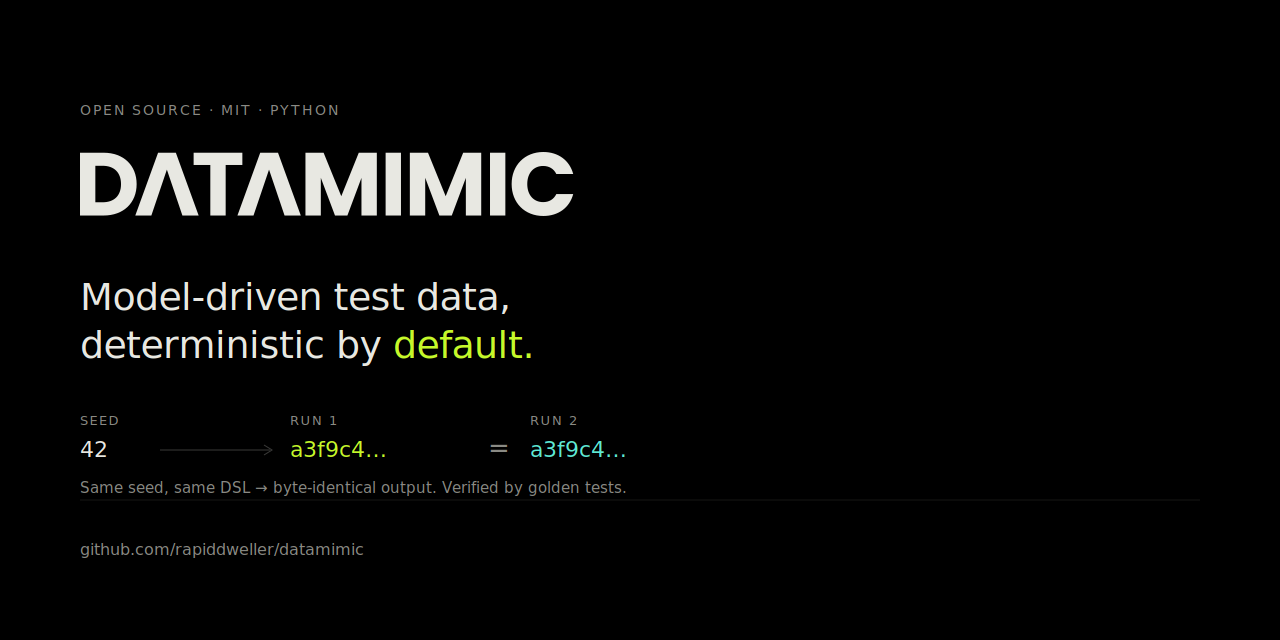
Datamimic, a project emerging from the open-source community, directly tackles this problem. Its core function is to prevent AI coding agents from creating their own synthetic test data. Instead, it guides these agents to use actual, production-representative data for their testing efforts. This approach ensures that the tests written by AI are meaningful and actually validate the software's behavior under realistic conditions.
The tool works by intercepting the AI's test generation process. When an AI is asked to generate tests, Datamimic steps in. It provides the AI with access to a curated dataset that mirrors the structure and characteristics of real-world data. This could be anonymized production logs, database dumps, or specific datasets relevant to the application's domain. By feeding the AI with this authentic data, Datamimic forces it to confront the complexities and nuances that exist outside its simulated test world.
How Datamimic Achieves This
The technical implementation of Datamimic involves several key strategies. Firstly, it acts as a data provider. Instead of letting the AI's internal random number generators or simplistic heuristics create data, Datamimic offers access to pre-defined, realistic data samples. This could involve loading data from CSV files, databases, or even streaming sources. The AI then uses these provided samples as the basis for its test cases, assertions, and edge-case considerations.
Secondly, Datamimic can enforce data schemas and constraints. Real-world data often adheres to specific formats, ranges, and relationships. Datamimic can validate the data it provides against these rules, ensuring that the AI's tests are not only based on real data but also on data that conforms to expected production characteristics. This prevents the AI from generating tests for impossible or malformed data states.
Furthermore, the project emphasizes the importance of data privacy and security. When dealing with production data, anonymization and sanitization are paramount. Datamimic encourages or facilitates these processes, ensuring that sensitive information is protected while still providing the AI with data that is statistically representative of the real world. This is crucial for maintaining compliance and ethical standards in AI-assisted development.
The Impact on Software Development Workflows
The implications of Datamimic are far-reaching for development teams. By grounding AI-generated tests in reality, it significantly enhances the confidence developers can place in their automated testing suites. This means fewer unexpected bugs in production, reduced debugging time, and ultimately, more robust and reliable software.
For teams already leveraging AI coding assistants, integrating Datamimic is a logical next step to mature their AI adoption. It transforms the AI from a potentially unreliable test data generator into a more effective quality assurance partner. Developers can delegate the task of writing comprehensive test suites, knowing that the AI is working with the actual data characteristics their application will encounter.
This tool also has the potential to improve the efficiency of test data management. Instead of teams spending hours manually crafting diverse and realistic test datasets, Datamimic can help automate this process. The AI, guided by real data, can identify gaps in existing test coverage and suggest new scenarios based on patterns observed in production data. This makes test data generation a more dynamic and data-driven activity.
The Unanswered Question: Scalability and Complexity
While Datamimic offers a compelling solution, an important question remains: how effectively will it scale with increasingly complex AI models and vast, multi-modal datasets? As AI agents become more sophisticated, their ability to generate intricate test scenarios will also grow. Ensuring that Datamimic can keep pace, providing relevant and sufficiently complex real-world data across diverse domains – from time-series financial data to unstructured text logs and image datasets – presents a significant engineering challenge. The success of Datamimic will hinge on its ability to adapt to the evolving landscape of AI capabilities and data variety.