Automating Airflow DAG Generation from DataHub Metadata
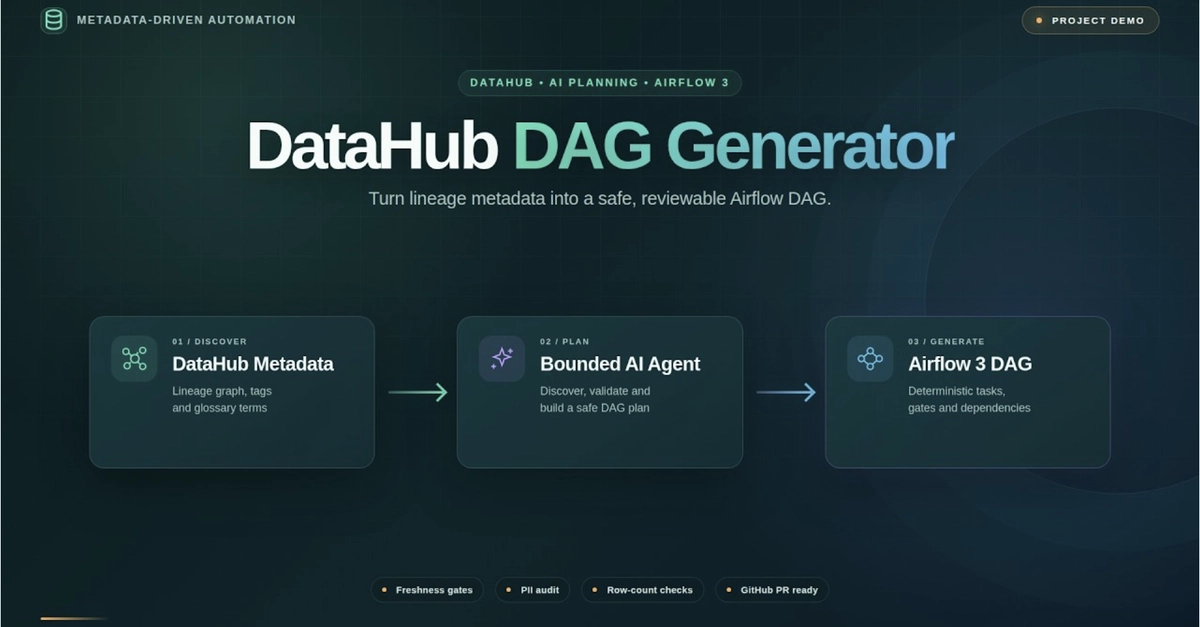
The manual process of translating rich metadata within data cataloging tools like DataHub into executable Airflow Directed Acyclic Graphs (DAGs) is a significant bottleneck for data engineering teams. DataHub, a popular open-source metadata platform, already houses critical information such as data lineage, freshness Service Level Agreements (SLAs), Personally Identifiable Information (PII) tags, and glossary terms. However, deriving actionable Airflow DAGs from this data has historically required considerable manual effort. A new AI agent, developed by a team that participated in DataHub's 'Build with DataHub: The Agent Hackathon,' aims to bridge this gap by automating the creation of deterministic Airflow 3 DAGs directly from DataHub metadata.
The core problem this agent addresses is the disconnect between having comprehensive metadata and being able to leverage it directly within data orchestration pipelines. Teams using DataHub accumulate a wealth of information about their data assets – their origins, dependencies, quality metrics, and business context. Without automation, engineers must manually inspect this metadata and then code corresponding tasks, checks, and dependencies into Airflow DAGs. This is not only time-consuming but also prone to errors and inconsistencies, especially as data environments scale and evolve.
How the DataHub-to-Airflow Agent Works
The agent operates by taking a table name as input and then systematically processing the associated metadata within DataHub. Its workflow involves several key steps:
- Lineage Traversal: It walks the lineage graph backwards from the specified table to identify all upstream dependencies. This ensures that the generated DAG accurately reflects the data flow required to produce the target table.
- Metadata Ingestion: The agent reads relevant tags and glossary terms associated with each table. This includes signals like PII tags, refresh frequencies (e.g., 'daily_refresh'), and specific glossary terms like 'FreshnessSLA' or 'EmptyLoad'.
- Signal Mapping: It intelligently maps these ingested signals to specific Airflow tasks. For instance, a PII tag might trigger an 'audit task' to ensure compliance, while a 'FreshnessSLA' term could translate into a 'freshness check' task. Similarly, an 'EmptyLoad' term might instigate a task to handle potential data load failures.
- Graph Reduction and Sorting: The agent then applies topological sorting and graph reduction algorithms. This process organizes the identified dependencies and tasks into a clean, ordered structure, eliminating redundancies and ensuring a deterministic execution path.
- DAG Rendering: Finally, it renders a clean, deterministic Airflow 3 DAG. This output is directly usable within an Airflow environment, minimizing the need for manual adjustments.
Beyond DAG generation, the agent offers an optional feature to create a GitHub Pull Request (PR) that includes a lineage summary. This functionality enhances collaboration and documentation by providing a clear overview of the generated pipeline and its dependencies directly within the version control system.
Development and Future Trajectory
The project was initially developed for DataHub's hackathon, demonstrating its practical utility in a competitive environment. The team is committed to its continued development, indicating a roadmap beyond the initial proof-of-concept. The agent is built with flexibility in mind, supporting multiple modes. One such mode is an 'agent mode' that can leverage Large Language Models (LLMs) like Claude or any model accessible via OpenRouter. This LLM integration suggests potential for more sophisticated interpretation of metadata and more nuanced DAG generation logic in the future.
The choice of LLMs highlights a broader trend in AI agent development where the process and tools used are as critical as the final output. While traditional software engineering relies on unit and integration tests for confidence, AI agents introduce variability. The journey of building these agents involves evaluating their trajectories, tool usage, and internal processes, not just the success of a single execution. This agent's development path acknowledges this by focusing on robust metadata interpretation and deterministic output, while also exploring the power of LLMs for enhanced capabilities.
For data engineers, this agent represents a significant step towards reducing toil. By automating the translation of declarative metadata into imperative code (Airflow DAGs), it frees up valuable engineering time that can be redirected towards more strategic tasks such as data modeling, performance optimization, and building advanced analytics capabilities. The ability to automatically enforce freshness checks and PII audits directly within the orchestration layer also enhances data governance and compliance efforts.
The success of this agent hinges on its ability to accurately interpret the diverse and often complex metadata present in DataHub. As DataHub itself evolves and incorporates more signals and richer metadata, the agent will need to adapt. The integration of LLMs provides a flexible framework for this adaptation, allowing the agent to potentially understand new metadata types or infer relationships that were not explicitly programmed. The optional GitHub PR feature further integrates the agent into existing DevOps workflows, making it a practical addition for teams already leveraging CI/CD practices for their data pipelines.
The broader implication for the data ecosystem is a move towards more intelligent and automated data operations. Tools that can seamlessly translate high-level metadata into executable pipeline code reduce the cognitive load on engineers and accelerate the deployment of data workflows. This project is a concrete example of how AI agents can move beyond theoretical concepts and deliver tangible value by solving real-world data engineering challenges.