Introduction: Beyond N+1 Queries
Developers often tackle performance bottlenecks by optimizing Object-Relational Mappers (ORMs) to eliminate inefficient query patterns like the infamous N+1 problem. For Python applications using frameworks like Django or SQLAlchemy, functions such as select_related, prefetch_related, or selectinload can reduce the number of database queries per request to a manageable few. However, once these initial optimizations are in place, the next significant performance hurdle emerges: the cost of each individual query when tables grow to contain millions of rows. This is almost invariably a problem of database indexing.
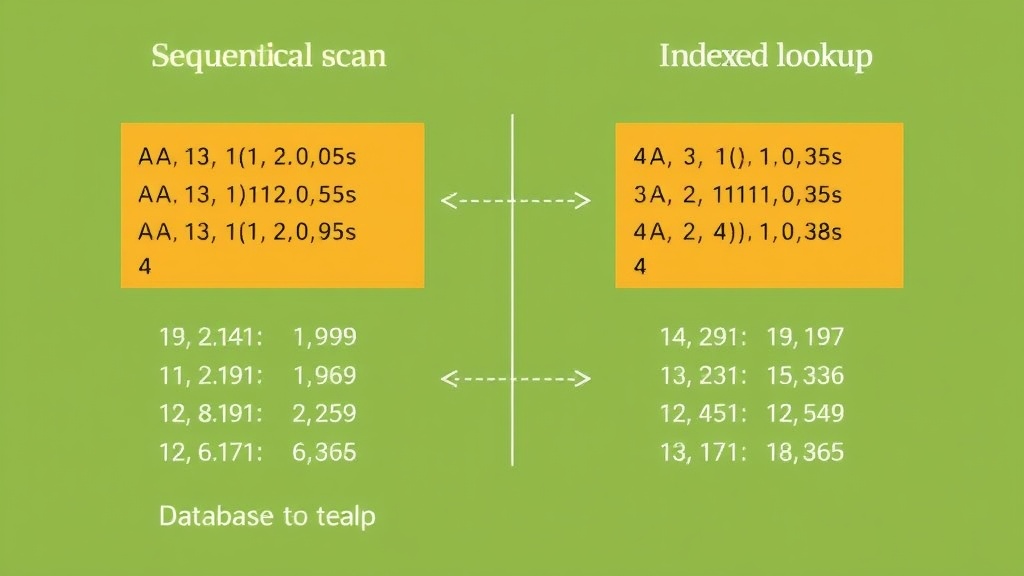
An index fundamentally transforms a database operation. Instead of forcing the system to perform a sequential scan – reading and checking every single row in a table – an index allows the database to locate specific data directly. Without proper indexing, a query that executes in milliseconds during development can balloon into seconds-long operations in production, leading to user frustration and application instability. Getting indexing right is not an optional step; it's a critical requirement for scaling any data-intensive application.
How Indexes Work: The B-Tree Intuition
At its core, a database query with a WHERE clause often requires the database to examine each record to see if it matches the specified criteria. This is known as a sequential scan, and its computational cost is directly proportional to the number of rows in the table. In Big O notation, this is O(n), meaning the time taken grows linearly with the size of the dataset (n).
To circumvent this inefficiency, databases employ indexes. The most common data structure used for indexing is the B-tree. Think of a B-tree index not as a simple list, but as a highly organized, multi-level directory. Each node in the tree contains a range of sorted values from the indexed column(s) and pointers to the next level of nodes or, ultimately, to the actual data rows on disk. When you query a column that is indexed, the database doesn't scan the entire table. Instead, it navigates this B-tree structure, which is significantly faster. Because B-trees are balanced and designed for efficient disk access, searching for a specific value typically takes logarithmic time, denoted as O(log n). This difference between linear and logarithmic complexity is profound, especially as tables grow into the millions or billions of rows.
Consider a table with millions of user records, and you need to find a user by their `email` address. Without an index on the `email` column, the database must read every user record, compare its email to the target email, and repeat this process until it finds a match or exhausts the table. This could take seconds. With a B-tree index on `email`, the database can quickly traverse the tree, narrowing down the search space exponentially with each step, and locate the specific row containing the desired email in milliseconds.
Choosing the Right Columns to Index
Not all columns benefit equally from indexing. The decision of which columns to index should be driven by query patterns. Columns frequently used in WHERE clauses, JOIN conditions, and ORDER BY clauses are prime candidates for indexing. Columns that are highly selective – meaning a query on them typically returns a small percentage of the total rows – are also excellent candidates. For instance, indexing a `user_id` or `email` column in a users table is usually beneficial because queries like WHERE user_id = 12345 or WHERE email = 'test@example.com' are expected to return only one or a few rows.
Conversely, indexing columns with very low cardinality (few distinct values) or columns that are rarely queried is generally not advisable. Indexing a boolean `is_active` column in a table with millions of rows where 99% of users are active might not provide significant performance gains for queries filtering by `is_active = TRUE`. In such cases, a sequential scan might even be faster than navigating a large, inefficient index. Furthermore, every index adds overhead. Indexes need to be updated whenever data in the table changes (inserts, updates, deletes), which slows down write operations. They also consume disk space. Therefore, a strategy of indexing only necessary columns, often referred to as a judicious indexing strategy, is key.
Compound indexes, which are indexes on multiple columns, are useful for queries that filter or sort by those columns in combination. For example, an index on (last_name, first_name) can efficiently serve queries like WHERE last_name = 'Smith' AND first_name = 'John'. The order of columns in a compound index matters; it should generally reflect the order of columns in the WHERE or ORDER BY clause, with the most selective columns appearing first.
Understanding Query Execution Plans
To truly understand how the database is executing your queries and whether it's using indexes effectively, you need to examine the query execution plan. Most database systems (like PostgreSQL, MySQL, SQLite) provide a command, often `EXPLAIN` or `EXPLAIN ANALYZE`, that shows the steps the database optimizer intends to take or has taken to execute a query. This plan details whether a sequential scan is being used, which indexes are being considered or utilized, join strategies, and estimated costs.
A typical output might show lines like Seq Scan on users (cost=0.00..15000.00 rows=1000000 width=120), indicating a full table scan, or Index Scan using users_email_idx on users (cost=0.29..8.30 rows=1 width=120), showing efficient use of an index named `users_email_idx`. Analyzing these plans is an essential skill for any developer aiming to optimize database performance. It allows you to identify queries that are performing poorly, diagnose the root cause (often missing or inappropriate indexes), and verify that your indexing strategy is effective. Developers should regularly profile slow queries in production or staging environments and use the `EXPLAIN` output to guide their optimization efforts.
The Role of ORMs and Python
While ORMs abstract away much of the direct SQL interaction, they do not eliminate the need for understanding underlying database principles like indexing. ORMs can sometimes generate suboptimal SQL, and their performance is heavily reliant on the database schema and indexing strategy. Python developers must remember that the ORM is a layer of abstraction, not a magic bullet. When performance issues arise, digging into the SQL generated by the ORM and then inspecting the database's execution plan is often necessary.
Frameworks like Django provide tools within their ORM to inspect generated SQL. For instance, using `str(queryset.query)` in Django can reveal the SQL statement. For more complex scenarios, tools like Django Debug Toolbar can display database queries executed for a request, including their execution times. This visibility is critical. Understanding how to apply ORM features like .annotate() and .aggregate() in conjunction with database indexes can unlock significant performance gains. For example, if you frequently need to calculate the average order value per customer, an index that supports both filtering customers and potentially ordering or grouping by order value can be highly beneficial.
Ultimately, building performant applications at scale requires a holistic approach. Optimizing ORM usage is a vital first step, but it must be complemented by a deep understanding of database fundamentals, particularly indexing and query optimization techniques. By mastering these concepts, Python developers can ensure their applications remain responsive and efficient, even as data volumes grow exponentially.