The Allure of API-First AI
The promise of API-first artificial intelligence is seductive. Developers can integrate powerful AI capabilities into their applications with minimal friction. A few lines of code, a simple API call, and suddenly sophisticated natural language processing, image generation, or complex data analysis is at their fingertips. This approach abstracts away the immense complexity of training and deploying large language models (LLMs) and other AI systems, allowing teams to focus on their core product and user experience. It feels like a clean, modular way to build, akin to using pre-fabricated components in construction.
However, this ease of integration comes with a hidden cost. The very mechanism that makes API-first AI so attractive—the abstraction and simplicity—also creates a subtle but powerful form of vendor lock-in, often termed 'data gravity.' This phenomenon, familiar from earlier cloud computing eras with services like AWS S3, now operates at a higher level in the AI stack, specifically around LLM hosting and related services.
Understanding Data Gravity in AI
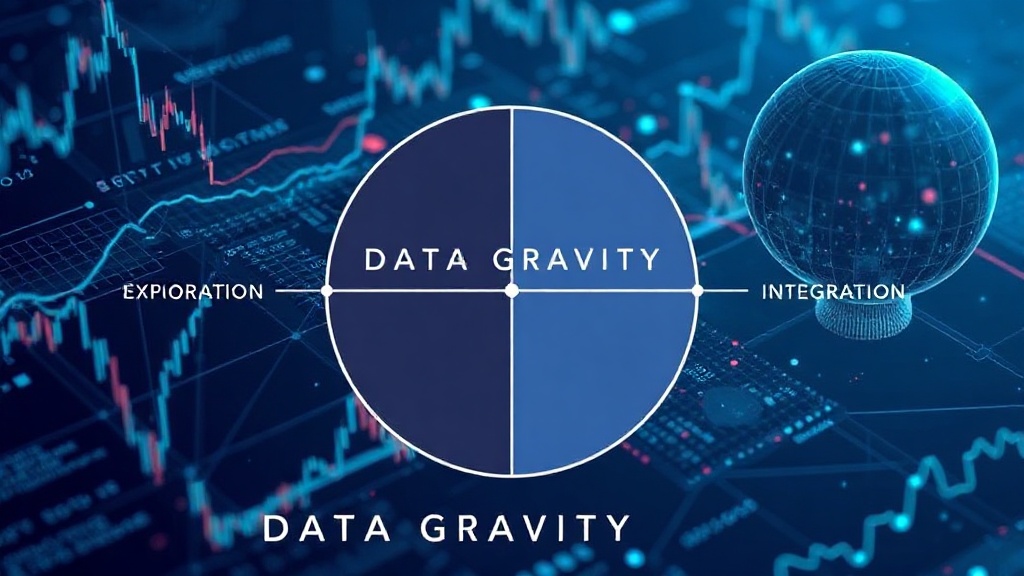
Data gravity, in this context, refers to the tendency for data and associated artifacts to become more difficult and expensive to move as they accumulate around a particular vendor's ecosystem. When teams begin using an AI API, their initial interactions might be experimental. They might fine-tune models on small datasets, build evaluation harnesses to test outputs, and define tool schemas for specific integrations. Each of these actions, while seemingly straightforward, creates dependencies.
Consider the lifecycle of an AI integration. It typically begins with Exploration, where developers test different models and APIs. This naturally progresses to Integration, where the chosen AI service becomes a core part of the application's workflow. As usage scales, teams move into Optimization, fine-tuning models for better performance, caching results, and storing embeddings generated by the service. The final stage is Dependency, where the accumulated data, fine-tuned checkpoints, evaluation frameworks, and custom tooling are so deeply intertwined with the vendor’s specific output formats and APIs that switching to a different provider becomes an exponentially more complex and costly undertaking.
This isn't about malicious vendor practices or restrictive contracts, though those can exacerbate the problem. It's about compounding integration debt. Every fine-tuned model version, every specific output format that your application has learned to parse and rely on, and every evaluation metric calibrated against a particular vendor’s response style adds to the inertia. Moving this pile of AI-specific assets becomes akin to trying to relocate an entire data center rather than just changing a network router.
The DOCX Analogy: Complexity Under the Surface
The problem of hidden complexity is not unique to AI APIs. A compelling analogy can be drawn from the challenges of handling complex document formats like DOCX. Initially, a simple document demo might appear straightforward. A single page, a basic font, a small table—these elements are easy to parse and render. The initial implementation might focus only on these simple cases, giving the impression that the task is largely complete.
However, when faced with a real-world document—a complex legal contract, for instance—the facade crumbles. These documents often contain intricate formatting: missing fonts, nested tables, merged cells, complex numbering schemes, headers, footers, section breaks, and precisely positioned signature blocks. A system that flawlessly handled the demo document can fail spectacularly when confronted with these real-world complexities. The initial 'easy' parsing of the ZIP package is trivial compared to the nuanced understanding required to render these documents correctly across different environments and with varying system configurations.
This experience highlights a critical truth: A file that opens is not a file that renders correctly. The surface-level API call that returns a JSON payload is easy. Understanding and reliably processing that payload, especially when it’s one of many output formats from a specific AI model, is where the real work—and the potential for data gravity—begins. Your application becomes attuned to the nuances of the vendor’s output, treating them not as arbitrary data structures but as the defined structure of reality for that AI task.
The Compounding Cost of Vendor-Specific Artifacts
As teams move deeper into dependency, the costs of switching vendors become prohibitive. These costs manifest in several ways:
- Data Reformatting and Migration: Fine-tuned model checkpoints are often proprietary or optimized for a specific vendor’s infrastructure. Migrating them requires significant effort, potentially involving re-training or extensive conversion processes. Similarly, cached embeddings or vector databases populated with data generated by a specific model may need to be re-indexed or regenerated using a new model.
- Evaluation Harness Overhaul: Evaluation datasets and scripts are frequently designed around the specific output schema and quirks of a particular AI model. When switching vendors, these harnesses must be rewritten or heavily modified to accommodate the new model’s behavior and output format. What was once a simple validation step becomes a complex re-engineering task.
- Tooling and Integration Recalibration: Custom tooling, prompt engineering frameworks, and application-level logic are built to interact with the chosen API. This includes handling specific error codes, parsing particular response structures, and managing state based on vendor-specific session management. Adapting this entire stack to a new provider requires substantial development time.
- Performance Tuning Loss: Optimization efforts, such as prompt engineering for a specific model or fine-tuning for particular tasks, are vendor-specific. The performance gains achieved with one provider are rarely transferable directly to another.
The cumulative effect is that the initial cost savings and development speed offered by API-first AI are gradually offset by escalating integration debt. This debt makes it increasingly difficult and expensive to explore alternative vendors, even if they offer better pricing, superior performance, or more advanced features. The decision to switch is no longer a simple routing change; it’s a major project, often requiring a significant portion of engineering resources.
Navigating the Data Gravity Trap
The challenge for developers and product leaders is to balance the immediate benefits of API-first AI with the long-term implications of data gravity. This requires a proactive strategy:
- Abstraction Layers: Develop internal abstraction layers or adapters that isolate the core application logic from the specifics of any single AI vendor. This allows for easier swapping of underlying AI services.
- Standardized Data Formats: Where possible, enforce standardized data formats for inputs and outputs, even if the underlying AI service uses proprietary formats. This involves creating translation layers.
- Modular Evaluation: Design evaluation harnesses to be as vendor-agnostic as possible, focusing on desired outcomes rather than specific output structures.
- Vendor Diversification: Avoid becoming exclusively reliant on one vendor for critical AI capabilities. Explore multi-vendor strategies or consider in-house solutions for core AI components if feasible.
- Continuous Cost Assessment: Regularly assess the total cost of ownership, including integration debt and the potential cost of switching, not just the API call fees.
Ignoring data gravity is like building a house on shifting sand. The convenience of today’s API-first AI solutions can lead to significant long-term costs and reduced flexibility. By understanding this phenomenon and implementing strategies to mitigate it, teams can harness the power of AI without becoming irrevocably tethered to a single provider.