The Real Culprits Behind Exploding AI Bills
The runaway cost of Large Language Model (LLM) usage often catches businesses off guard. When audit teams dive into these bills, they consistently find the problem isn't the per-token price of the models themselves. Instead, the waste stems from inefficient token management: sending excessive, irrelevant context with every API call and defaulting to the most expensive, capable models for every task, even simple ones. My approach begins with granular measurement – understanding precisely where each dollar is spent before implementing any cuts. This diagnostic phase is crucial; random cost-cutting rarely yields sustainable results and can degrade performance.
Consider a scenario where a user asks a simple question, like "What is the capital of France?" If the system sends the entire content of Wikipedia's France page, the user's entire chat history, and several unrelated documents as context for every single query, the token count skyrockets. This is akin to hiring a Michelin-star chef to make toast every morning – overkill and unnecessarily expensive. The intelligence is there, but it's being applied to trivial tasks, and the cost of that intelligence is being wasted on volume rather than value.
Caching: The First and Most Effective Lever
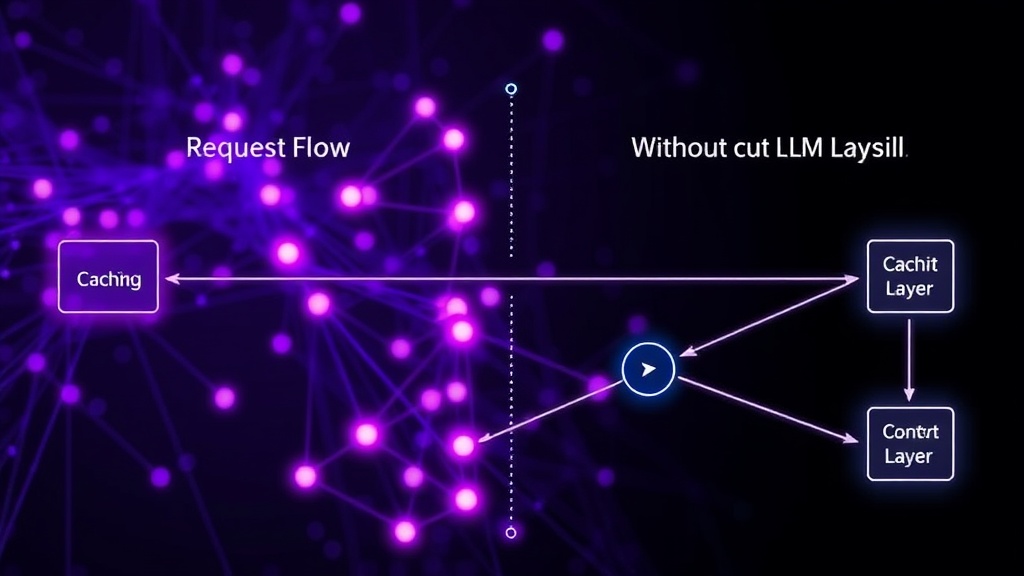
Caching is almost universally the first and most impactful lever for reducing LLM costs. In production environments, a significant portion of API calls are near-duplicates or identical. Users often ask the same questions, rephrase existing ones, or trigger workflows that result in the same underlying prompt. By implementing a robust caching layer, you can serve these repeated requests directly from your cache, bypassing the LLM entirely. This immediately eliminates waste without altering the user experience. In many cases, teams see a substantial reduction in their LLM bills within days of deploying effective caching strategies.
Think of caching like a diligent personal assistant who remembers your common requests. If you ask for the same report every Monday, the assistant doesn't go back to the filing cabinet and reassemble it from scratch each week. They have a copy ready. Similarly, an LLM caching system stores previous successful responses. When an identical or highly similar input arrives, it retrieves the stored answer, saving compute time and, critically, tokens. The key is to define similarity effectively – whether it's an exact string match or a more nuanced semantic comparison, depending on the application's needs.
Strategic Model Routing: One Size Fits None
The notion that a single, state-of-the-art LLM should handle every task is a costly misconception. Different tasks demand different levels of cognitive power. Using a highly sophisticated, expensive model like GPT-4 Turbo for simple tasks such as sentiment analysis, basic data extraction, or summarizing a short paragraph is like using a supercomputer to add two numbers. It's vastly overpowered and therefore, vastly overpriced for the job.
The correct approach is strategic model routing. This involves analyzing the complexity and requirements of each task and directing it to the most appropriate model. For simple, predictable tasks, smaller, faster, and significantly cheaper models (e.g., GPT-3.5 Turbo, Mistral 7B, or even fine-tuned smaller models) suffice. For complex reasoning, creative generation, or nuanced analysis, the more advanced models can be employed. This tiered approach ensures you're only paying for the advanced capabilities when you truly need them. Implementing a routing layer requires careful evaluation of model performance and cost trade-offs for various task categories within your application.
Context Window Management: Less is More
The context window of an LLM refers to the amount of text it can consider at once. While larger context windows offer more power, they also dramatically increase token consumption and cost, especially when that context is sent with every single interaction. A common pitfall is including vast amounts of static, unchanging information in the prompt for every user query. This could be company policies, large knowledge bases, or extensive user profiles that don't change frequently.
Effective context management involves several strategies. First, dynamically adjust the context provided based on the specific query. If a user asks about a product feature, only include documentation relevant to that product, not the entire company manual. Second, utilize techniques like Retrieval-Augmented Generation (RAG) where relevant information is fetched from an external knowledge base and injected into the prompt only when needed, rather than pre-loading everything. Third, be ruthless about pruning unnecessary conversational history. Not every turn of a dialogue needs to be re-sent. Summarizing previous turns or only retaining the most salient recent messages can significantly reduce token overhead. This is less about the model's inherent capability and more about intelligent data management before the data even hits the model.
Beyond the Big Three: Fine-tuning and Prompt Engineering
While caching, model routing, and context optimization address the bulk of token waste, other techniques can further refine costs and performance. Fine-tuning smaller, specialized models on your specific data can yield performance comparable to larger, general-purpose models for particular tasks, often at a fraction of the cost. This requires an upfront investment in data preparation and training but can provide a significant long-term economic advantage and better performance for niche applications.
Prompt engineering is another critical, often underestimated, lever. Crafting clear, concise, and effective prompts can reduce the number of tokens required to elicit a desired response. This includes using techniques like few-shot learning (providing examples within the prompt) judiciously, specifying output formats precisely, and instructing the model to be concise. Poorly engineered prompts can lead to verbose, inaccurate, or incomplete answers, necessitating multiple retries and increasing overall token usage.
The Path Forward: Measurement, Iteration, and Intelligence
Cutting LLM bills by 30% to 70% is achievable, but it requires moving beyond a simplistic view of token pricing. It demands a strategic, data-driven approach focused on optimizing how tokens are used. By implementing intelligent caching, judicious model routing, precise context management, and advanced techniques like fine-tuning and sophisticated prompt engineering, organizations can dramatically reduce their AI expenditures without sacrificing performance. The key is continuous measurement and iteration, treating LLM cost management not as a one-time fix, but as an ongoing engineering discipline.