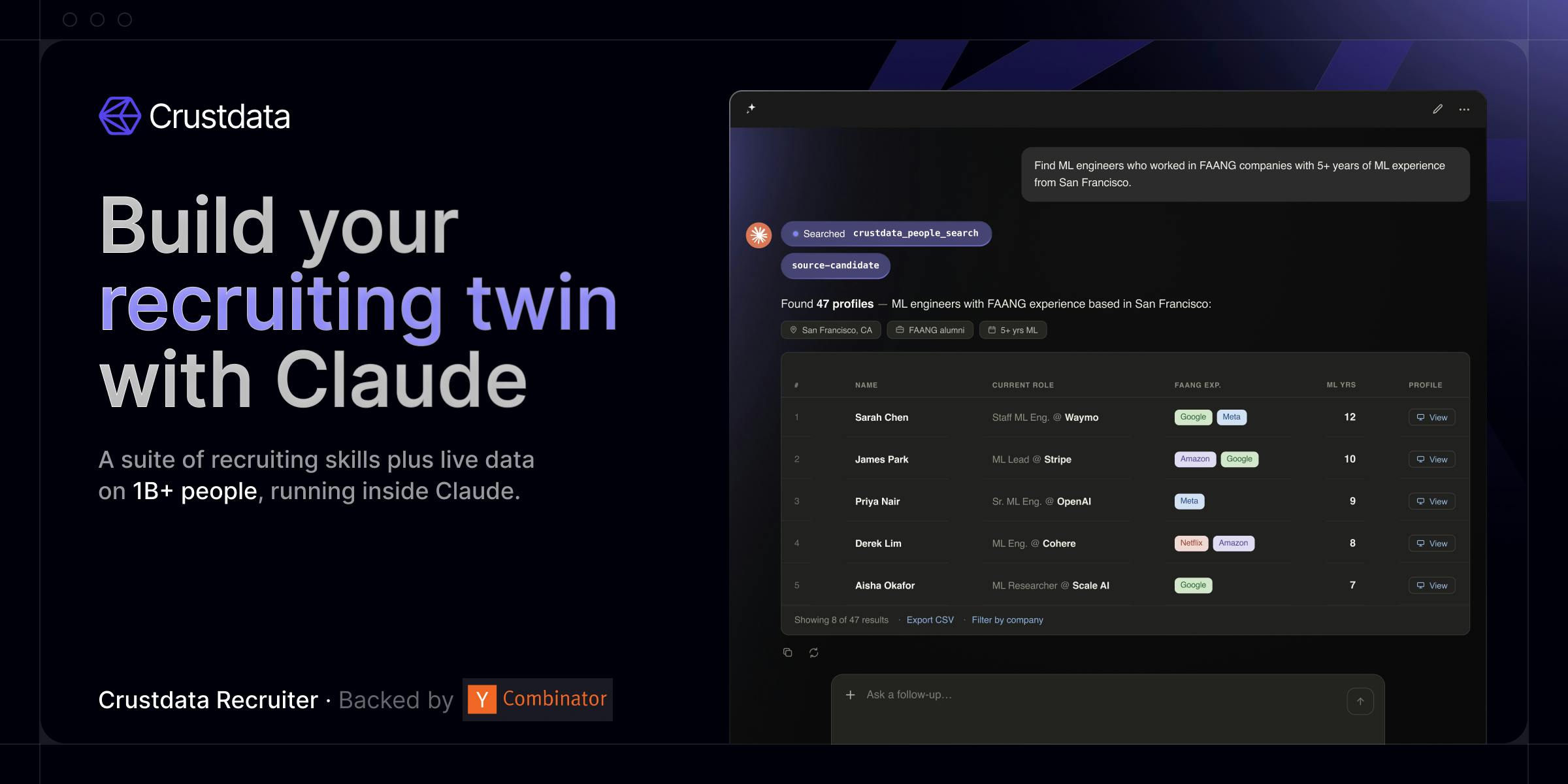
Crustdata Recruiter: AI-Powered Hiring Assistant
Crustdata Recruiter enters the competitive landscape of AI-powered recruitment tools with a clear objective: to transform the hiring process into a significantly more efficient and effective operation. The platform promises to leverage the capabilities of Claude, Anthropic’s advanced large language model, to assist recruiters in various stages of candidate sourcing, screening, and engagement. The core value proposition hinges on augmenting a recruiter’s capacity, effectively turning a single individual into a "100x Recruiter" as suggested by its Product Hunt description.
The recruitment industry, long ripe for technological disruption, often grapples with high volumes of applications, time-consuming manual screening, and the challenge of identifying the best-fit candidates quickly. Crustdata Recruiter positions itself as a solution to these pain points, aiming to automate repetitive tasks and provide deeper insights into candidate profiles.
Core Functionality and AI Integration
At its heart, Crustdata Recruiter is designed to integrate seamlessly with a recruiter's existing workflow, augmenting their capabilities rather than replacing them entirely. The tool focuses on several key areas where AI can provide a substantial advantage:
- Automated Candidate Sourcing: The platform aims to scan vast pools of potential candidates across various platforms, identifying individuals who match specific job requirements with greater speed and accuracy than manual methods.
- Intelligent Screening: Beyond simple keyword matching, Crustdata Recruiter is built to understand the nuances of resumes and cover letters. It can assess skills, experience, and cultural fit based on a deeper comprehension of the text, powered by Claude's advanced natural language understanding.
- Candidate Engagement: The tool can assist in drafting personalized outreach messages, follow-ups, and even initial interview questions, ensuring a consistent and professional candidate experience while saving recruiter time.
- Skill Analysis: A key differentiator highlighted is the ability to derive detailed skill sets from candidate profiles. This goes beyond listed skills to infer capabilities based on project descriptions, responsibilities, and achievements, offering a more comprehensive candidate assessment.
The reliance on Claude AI is central to Crustdata Recruiter's functionality. Claude is known for its strong performance in understanding context, generating human-like text, and handling complex reasoning tasks. By harnessing these abilities, Crustdata Recruiter can perform sophisticated analysis of unstructured data found in resumes and job descriptions, a critical task in modern recruitment.
The "100x Recruiter" Promise
The ambitious claim of enabling a "100x Recruiter" suggests a significant leap in productivity. This isn't about simply speeding up existing processes; it's about fundamentally changing the recruiter's capacity. Imagine a recruiter no longer spending hours sifting through hundreds of resumes for a single role. Instead, Crustdata Recruiter could present a curated shortlist of the top 10 candidates, each with a detailed breakdown of why they are a good fit, including inferred skills and potential alignment with company culture. This frees up the recruiter to focus on higher-value activities such as strategic candidate engagement, building relationships with top talent, and collaborating with hiring managers on nuanced requirements.
This enhanced efficiency is particularly critical in today's competitive talent market. Companies that can identify and engage with top candidates faster gain a significant advantage. Crustdata Recruiter aims to provide that edge, allowing organizations to fill critical roles more rapidly and with higher quality hires. The platform's ability to process and synthesize information from diverse sources also means it can uncover talent that might be overlooked by traditional, more rigid screening methods.
Implications for the Recruitment Workflow
For recruitment teams, Crustdata Recruiter represents a potential paradigm shift. It moves the needle from a reactive, high-volume processing model to a more proactive, insight-driven approach. Recruiters can become talent strategists, leveraging AI-generated insights to inform their outreach and engagement strategies. The tool can also help standardize the initial stages of the hiring process, ensuring that all candidates are evaluated against a consistent set of criteria, thereby reducing unconscious bias inherent in manual screening.
The integration of advanced AI like Claude also suggests a future where recruitment tools can offer predictive analytics. For instance, the system might learn over time which candidate attributes, as identified by the AI, correlate most strongly with long-term employee success within a specific company. This move towards data-driven recruitment, powered by sophisticated AI, could redefine what it means to be an effective recruiter.
Future Considerations and Unanswered Questions
While Crustdata Recruiter presents a compelling vision, several questions naturally arise for potential users and the broader industry. How does the tool handle the ethical implications of AI in hiring, particularly regarding bias in algorithms and data privacy? What level of customization is available for recruiters to fine-tune the AI's parameters for specific roles or industries? Furthermore, as AI models like Claude evolve, how will Crustdata Recruiter ensure its platform remains at the cutting edge, adapting to new capabilities and potential limitations?
The success of such a tool will ultimately depend on its ability to deliver tangible results, not just in terms of speed, but in the quality of hires and the overall candidate experience. The "100x Recruiter" is a powerful aspiration, and Crustdata Recruiter's journey to realize that promise will be closely watched by the industry.