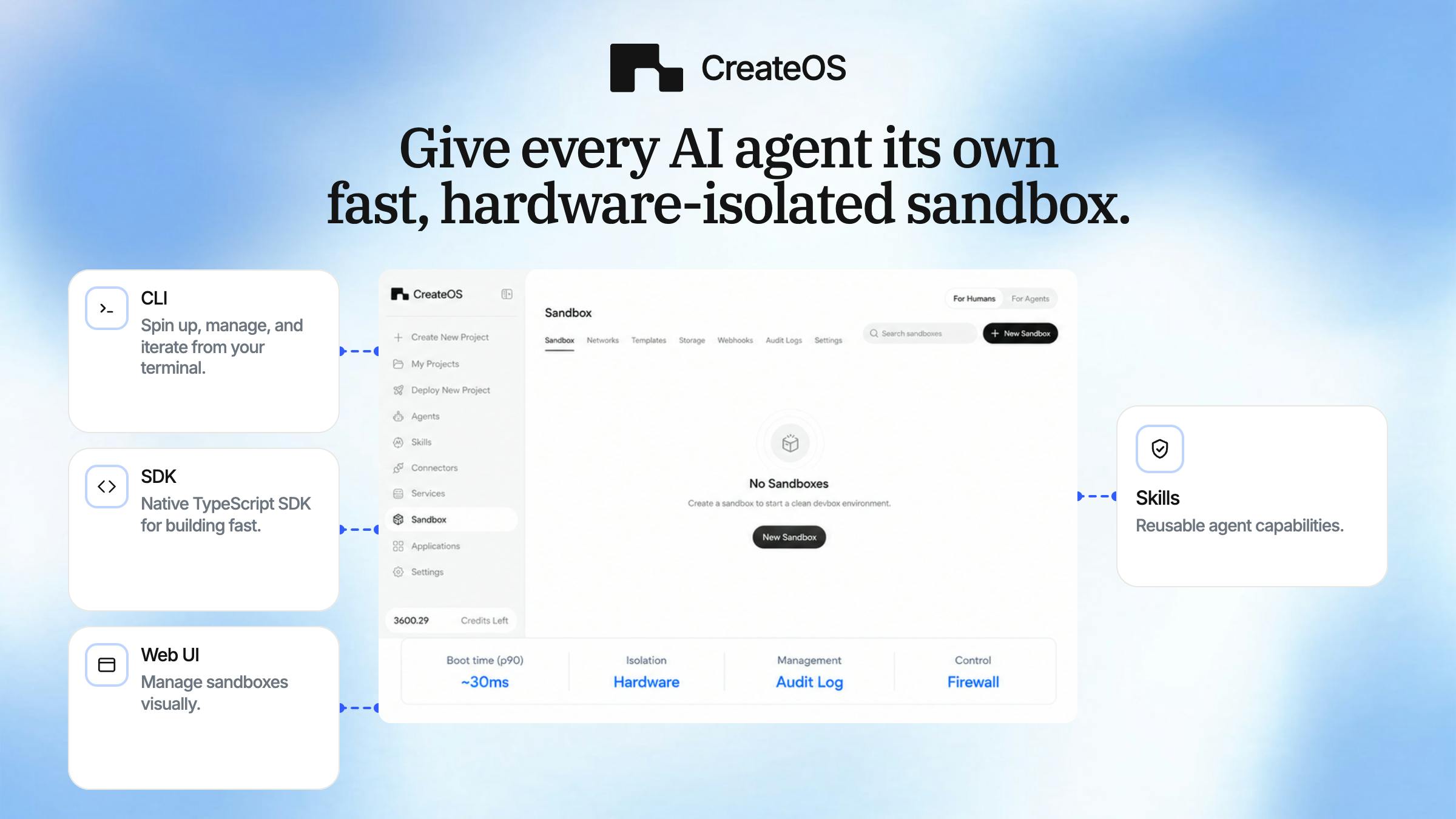
Instant, Hardware-Isolated Sandboxes for AI Agents
CreateOS Sandbox enters the market with a clear value proposition: providing instant, hardware-isolated sandboxes specifically designed for AI agents. In a landscape where AI agents are increasingly performing complex tasks and interacting with sensitive data, security and reliable execution environments are paramount. CreateOS Sandbox aims to address these needs by offering a robust solution that isolates AI agent workloads from the host system and other agents.
The core innovation lies in the hardware isolation. Unlike software-based sandboxing, which can sometimes be bypassed or suffer from performance overhead, hardware isolation offers a stronger security boundary. This means that even if an AI agent encounters a critical vulnerability or behaves maliciously, it is contained within its dedicated environment, preventing it from affecting the underlying operating system or other running processes. This approach is critical for enterprises looking to deploy AI agents for tasks ranging from data analysis and code generation to customer support and internal automation.
The term "instant" suggests a focus on rapid deployment and ease of use. For developers and teams experimenting with or deploying multiple AI agents, the ability to spin up and tear down these isolated environments quickly is a significant advantage. This agility allows for faster iteration cycles, efficient testing of agent behaviors, and dynamic scaling of AI agent deployments based on demand. The implication is a streamlined workflow where setting up a secure execution environment is no longer a bottleneck.
Addressing AI Agent Security and Resource Management
The proliferation of AI agents brings a host of new security challenges. Agents might be trained on proprietary data, interact with external APIs, or execute code. Each of these activities carries risks. A compromised agent could leak sensitive information, perform unauthorized actions, or become part of a botnet. CreateOS Sandbox’s hardware-isolated approach acts as a critical security layer, ensuring that each agent operates within its own secure perimeter. This is akin to giving each AI agent its own secure, soundproof room where its actions cannot interfere with or be observed by others.
Beyond security, resource management is another key concern. AI agents, particularly large language models (LLMs) and complex simulation agents, can be resource-intensive. Running multiple agents on a single system without proper isolation can lead to resource contention, where one agent hogs CPU, memory, or network bandwidth, impacting the performance of others. Hardware isolation, when implemented effectively, can allow for more predictable resource allocation and performance guarantees for each agent, ensuring that critical workflows are not derailed by less critical or experimental agents.
The platform’s focus on AI agents suggests it is tailored to the specific needs of this emerging technology. This could mean built-in support for common AI frameworks, optimized networking for inter-agent communication (within controlled boundaries), and simplified management of agent lifecycles. The ability to manage these isolated environments through a unified interface would further enhance its utility for teams deploying and overseeing a fleet of AI agents.
Potential Use Cases and Target Audience
The primary audience for CreateOS Sandbox appears to be developers, AI engineers, and organizations that are building, testing, or deploying AI agents. For developers, it offers a safe space to experiment with new agent designs and algorithms without risking their development environment. They can test agent interactions, security protocols, and performance under controlled conditions.
For enterprises, the benefits are substantial. Imagine a customer service department using AI agents to handle queries. Each agent could be run in a separate sandbox, ensuring that a bug in one agent doesn't bring down the entire support system. Sensitive customer data processed by one agent remains isolated, enhancing compliance and data privacy. Furthermore, companies developing AI-powered products can use these sandboxes for beta testing, ensuring that early-stage AI models do not pose a security risk to their infrastructure or early adopters.
The concept of hardware isolation for AI agents also opens doors for new types of applications. For instance, running competitive AI agents in a secure, fair environment for research or gaming purposes becomes more feasible. It could also be used in educational settings to allow students to experiment with AI without the risk of unintended consequences on shared systems.
The Future of AI Agent Deployment
CreateOS Sandbox’s emergence highlights a growing trend: the need for specialized infrastructure to support the burgeoning field of AI agents. As agents become more autonomous and capable, the tools for managing their lifecycle, security, and deployment will become increasingly critical. Hardware-isolated sandboxing represents a mature and robust approach to tackling these challenges. While the specifics of its implementation and pricing are not detailed in the initial product announcement, the promise of instant, secure, and hardware-isolated environments for AI agents positions CreateOS Sandbox as a noteworthy player in this rapidly evolving space.
The question remains whether this solution will integrate seamlessly with existing MLOps pipelines and cloud-agnostic deployment strategies, or if it will require a more bespoke integration effort. The success of such a platform will hinge on its ability to balance strong isolation with developer productivity and operational efficiency.