The Unseen Judgement Layer in Machine Learning
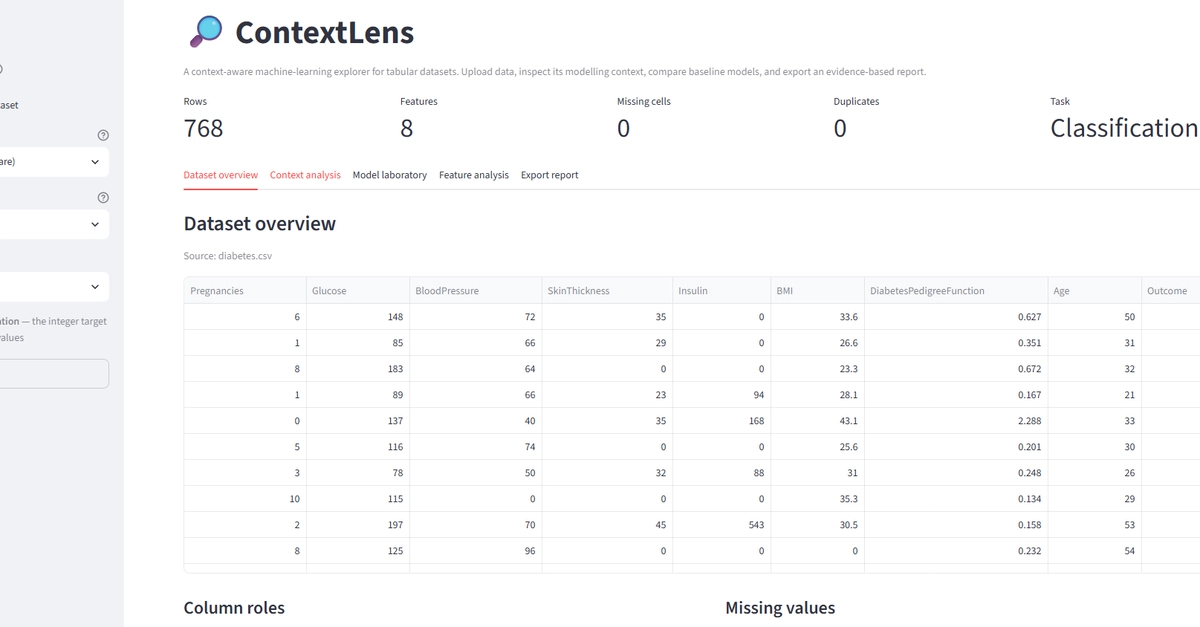
Many introductory machine learning tutorials present a linear path: load data, select a model, train it, and evaluate accuracy. This simplified workflow, while effective for basic demonstrations, omits a critical phase: the upfront analysis of the data's structure and inherent characteristics. This is the problem Anya, the creator of ContextLens, set out to address with her portfolio project. ContextLens is a Streamlit application designed to analyze tabular datasets and provide informed recommendations on how to model them, moving beyond a one-size-fits-all approach.
The project began as a practical exercise in Python, machine learning, and deployment. However, Anya soon realized that the challenges she encountered in building ContextLens mirrored fundamental questions in her PhD research on context-aware intelligent systems. This connection underscores a broader truth: understanding the 'context' of data—its nuances, potential pitfalls, and structural properties—is paramount before applying any modeling technique.
Consider the common questions that arise: Is this dataset truly suited for classification, or is it a regression task? Is the target variable so imbalanced that standard accuracy metrics will be misleading? What features are likely to be noisy or irrelevant? Answering these requires a layer of discernment that isn't always explicitly taught. ContextLens aims to automate and democratize this initial, crucial judgment phase.
ContextLens: Bridging the Gap Between Data and Models
ContextLens tackles the problem by analyzing a tabular dataset and offering guidance on its structure and appropriate modeling strategies. This isn't about automatically selecting the best model; it's about providing the user with insights that inform their own decision-making process. The goal is to empower users, especially those new to machine learning, to avoid common pitfalls and build more robust models from the outset.
The core idea is that different datasets require different approaches. A dataset with highly imbalanced classes, for instance, demands specialized techniques beyond simple accuracy checks. A dataset with a high degree of multicollinearity might require feature selection or regularization. ContextLens attempts to identify these characteristics automatically, acting as an intelligent assistant that highlights potential issues and suggests avenues for further exploration.
The development process revealed several key learnings about building effective context-aware systems. Firstly, context isn't just about external factors; it's deeply embedded within the data itself. The distribution of values, the presence of missing data, the cardinality of categorical features – all contribute to the data's context. Secondly, inferring this context requires more than just basic statistical summaries. It often involves applying heuristic rules, understanding common data science heuristics, and even employing meta-learning techniques to recognize patterns in data structures.
Challenges in Inferring Data Context
Building a system like ContextLens involves overcoming significant technical hurdles. Automatically inferring the nature of a problem (classification vs. regression) from raw data is non-trivial. While simple checks can be made (e.g., target variable type), more complex scenarios might require analyzing feature distributions in relation to the target. Similarly, detecting severe class imbalance goes beyond looking at class counts; it requires understanding the implications for model training and evaluation.
One of the surprising details Anya encountered was the sheer variety of ways data can be 'misleading' or 'problematic' for standard modeling pipelines. It's not just about missing values or outliers. It's about subtle data leakage, unexpected feature interactions, or the presence of high-cardinality categorical variables that can overwhelm many algorithms. Each of these requires a specific diagnostic approach.
The development of ContextLens highlighted the need for a robust feature engineering and analysis pipeline that can operate with minimal user input. This involves creating modules that can probe the data from multiple angles: statistical properties, feature-target relationships, inter-feature correlations, and potential data quality issues. The system needs to be flexible enough to handle diverse datasets, from small, clean CSVs to larger, messier real-world data.
The Broader Implications for Context-Aware AI
ContextLens, though a portfolio project, serves as a microcosm for the broader challenges in developing truly context-aware AI systems. These systems need to go beyond simply processing input; they must understand the environment, the user's intent, and the specific characteristics of the data they are working with.
The project demonstrates that for AI to be truly intelligent and helpful, it must incorporate a 'judgment layer.' This layer acts like an experienced data scientist, performing initial diagnostics and offering informed suggestions before any heavy computation begins. This is crucial for reproducibility, interpretability, and ultimately, the reliability of AI-driven insights.
The experience of building ContextLens also points to a future where AI tools become more proactive in guiding users. Instead of presenting a blank slate or a complex set of options, these tools could offer intelligent suggestions based on an understanding of the task at hand and the data provided. This shifts the paradigm from passive tools to active collaborators, democratizing advanced data science techniques and making them more accessible.
What remains to be seen is how such context-aware diagnostic tools will evolve. Will they become integrated into existing ML platforms, or will they emerge as standalone services? And how can we ensure these diagnostic systems themselves are reliable and unbiased? Anya's work on ContextLens provides a valuable starting point for exploring these critical questions in the ongoing development of more intelligent and helpful AI.