The Race Condition Problem
Imagine 100 users attempting to book the same coveted movie seat simultaneously. Without proper safeguards, this scenario leads to a classic race condition: multiple users could successfully reserve the identical seat, creating a significant problem for any booking platform. This isn't a theoretical edge case; it's a fundamental challenge in building reliable reservation systems.
To tackle this, a developer set out to build a concurrency-safe movie reservation backend. The goal wasn't to create a flashy frontend, but to rigorously explore the backend engineering principles that ensure a system remains stable and accurate even when subjected to high concurrent traffic. This project leverages a modern tech stack to demonstrate robust solutions to this common problem.
The core issue revolves around state management. When a user requests a reservation, the system must perform several operations atomically: check seat availability, mark the seat as taken, and record the booking. If these steps are not treated as a single, indivisible unit, concurrent requests can interleave in ways that lead to overselling.
Tech Stack for Reliability
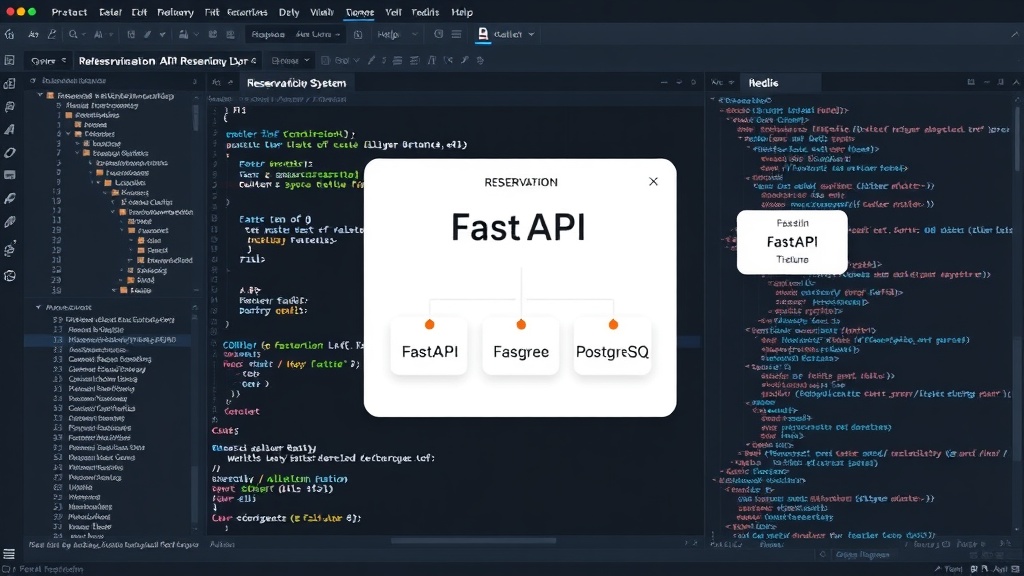
The chosen technology stack reflects a focus on performance, reliability, and developer productivity. The backend is built using FastAPI, a modern, fast (high-performance) web framework for building APIs with Python 3.7+ based on standard Python type hints. Its asynchronous capabilities are crucial for handling many concurrent requests efficiently.
For data persistence, PostgreSQL was selected. Its transactional integrity features, particularly its support for locking mechanisms and ACID compliance, are essential for managing shared resources like seats reliably. SQLAlchemy, a popular SQL toolkit and Object-Relational Mapper (ORM) for Python, provides an abstraction layer over PostgreSQL, simplifying database interactions while still allowing fine-grained control over transactions and locking.
Redis, an in-memory data structure store, is employed for caching and potentially for implementing distributed locks. Its speed makes it ideal for frequently accessed data or for coordinating operations across multiple application instances, further enhancing concurrency control. Standard JWT Authentication and Role-Based Access Control (RBAC) are included to secure the system, ensuring only authorized users can make reservations and administrators can manage them.
Docker is used for containerization, ensuring the application and its dependencies can be deployed consistently across different environments. This simplifies setup and scaling.
Implementing Concurrency Control
The most critical aspect of building a concurrency-safe reservation system is implementing effective concurrency control mechanisms. Traditional approaches often involve database-level locking, but these can become bottlenecks under extreme load. The project explored several strategies:
Optimistic Locking
Optimistic locking assumes that conflicts are rare. When a user requests to book a seat, the system reads the current state of the seat (e.g., its version number or a timestamp). When the user attempts to finalize the booking, the system checks if the seat's version number has changed since it was initially read. If it has, it means another transaction modified the seat, and the current booking attempt is rejected, prompting the user to retry. This approach avoids holding locks for extended periods but requires careful handling of retries.
Pessimistic Locking
Pessimistic locking, in contrast, assumes conflicts are likely and prevents them by acquiring locks on resources before operating on them. In the context of a reservation system, this means acquiring an exclusive lock on a specific seat record in the database before proceeding with the booking. PostgreSQL offers robust locking mechanisms, such as SELECT ... FOR UPDATE, which can be used with SQLAlchemy to ensure that only one transaction can modify a particular seat record at any given time. This guarantees that no two users can book the same seat, but it can reduce throughput if many users contend for the same popular seats, as they will be forced to wait for locks to be released.
Redis-based Distributed Locks
For systems that scale beyond a single database instance or require finer-grained control, distributed locks using Redis are a powerful option. Libraries like python-redis-lock can be used to implement distributed locks. A client wanting to book a seat would attempt to acquire a lock for that specific seat in Redis. If successful, it proceeds with the database transaction. If not, it waits or informs the user that the seat is temporarily unavailable. This approach can be more performant than database-level pessimistic locks in highly distributed environments, but it introduces complexity in managing lock expiry and potential deadlocks.
Transaction Management with SQLAlchemy
SQLAlchemy's session management is key to ensuring atomicity. Each reservation attempt should occur within a database transaction. SQLAlchemy's Session.begin_nested() or Session.begin() can be used. When using SELECT ... FOR UPDATE, it's critical that the lock is acquired within the same transaction that modifies the seat status. This ensures that the check and the update happen as a single atomic operation. If the transaction fails (e.g., due to a lock conflict or another error), all changes within that transaction are rolled back, leaving the database in a consistent state. The application layer then handles the rollback by informing the user, often prompting them to select another seat or retry the booking.
The developer's implementation likely combines these strategies. For instance, Redis might be used for an initial, quick check or for very high-contention items, while PostgreSQL's FOR UPDATE handles the critical, atomic booking step. The choice between optimistic and pessimistic locking, or a hybrid approach, depends heavily on the expected load patterns and the acceptable latency for booking operations.
Beyond the Basics: RBAC and JWT
While concurrency control is the heart of the problem, a production-ready system requires more. JWT (JSON Web Tokens) provide a stateless way to authenticate users, allowing the backend to verify the identity of the requester without needing to maintain session state on the server. This is particularly useful in distributed or microservices architectures. Role-Based Access Control (RBAC) complements authentication by defining permissions. For example, only authenticated users can book seats, while administrators might have permissions to manage movie schedules or view all bookings. Implementing RBAC ensures that the system adheres to the principle of least privilege, enhancing security.
The Unanswered Question: Scalability Bottlenecks
While this project demonstrates effective concurrency control, a critical question remains for any real-world deployment: at what scale do these solutions begin to show performance bottlenecks? How does the latency of SELECT ... FOR UPDATE or Redis lock acquisition scale with thousands of concurrent requests for the *same* popular seats versus more evenly distributed requests? Understanding the break-even point between different locking strategies and the infrastructure required to support extreme load remains an ongoing engineering challenge.