
Why Composition Outshines Inheritance
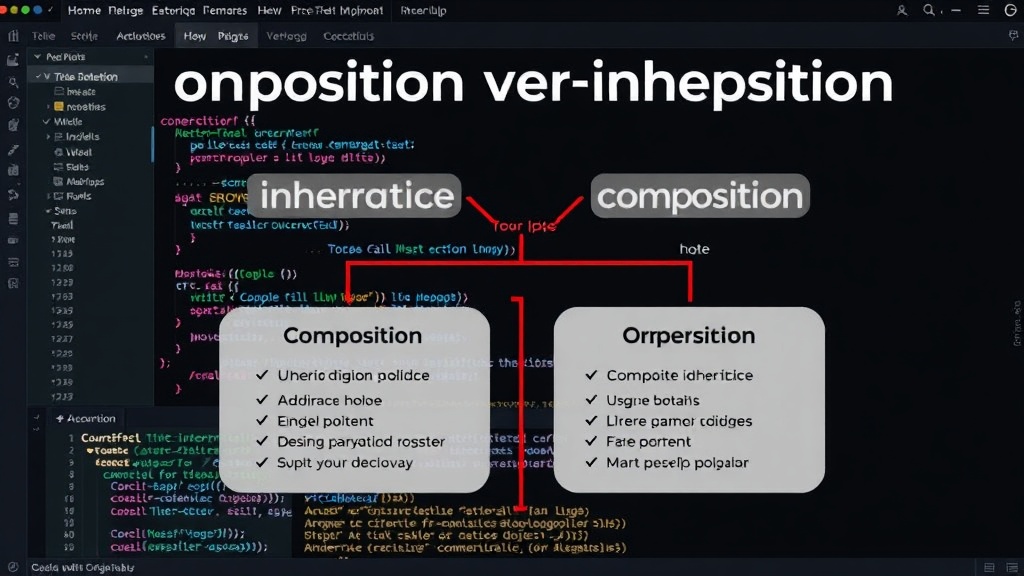
In software development, the choice between composition and inheritance is a fundamental design decision. While inheritance offers a clear way to model 'is-a' relationships and reuse code, it often leads to tightly coupled systems that are brittle and difficult to extend. Composition, on the other hand, models 'has-a' relationships, allowing objects to achieve functionality by combining simpler objects. This approach promotes flexibility, reduces coupling, and makes code more adaptable to changing requirements.
Consider a common scenario: a `Car` class inheriting from an `Engine` class. This implies a car 'is an' engine, which is semantically incorrect and creates design problems. A `Car` 'has an' `Engine`. By using composition, we can create a `Car` class that holds an instance of an `Engine` class. This `Car` object can then delegate engine-related tasks to its `Engine` component. This separation of concerns is powerful. It means the `Car` doesn't need to know the internal workings of the `Engine`; it only needs to know how to interact with its interface. This is akin to how a driver operates a car: they use the steering wheel, pedals, and gear shift without needing to understand the combustion process or the transmission's intricate gears. They interact with the car's components through well-defined interfaces.
The primary advantage of composition is its inherent flexibility. When requirements change, you can often swap out components without altering the core object. For example, if a `Car` needs to support different types of engines (electric, gasoline, hybrid), you can simply assign a different `Engine` object to the `Car` instance at runtime or during initialization. With inheritance, changing the engine type would likely require creating new subclasses, potentially leading to a combinatorial explosion of classes and a deep, fragile inheritance hierarchy.
When to Favor Composition
Composition is generally the preferred approach in modern software design for several key reasons:
- Flexibility and Reusability: Components created for composition can be reused across many different types of objects. A logging component, for instance, can be added to a `User` object, a `Product` object, or a `Payment` object without any shared inheritance. This makes it easy to add or remove functionality dynamically.
- Reduced Coupling: Objects that rely on composition are less coupled than those using inheritance. The parent object only depends on the interfaces of its component objects, not their concrete implementations. This isolation makes it easier to change or replace components without affecting other parts of the system.
- Easier Testing: Because components are independent, they can be tested in isolation. Mocking dependencies becomes simpler, allowing for more robust unit testing. If a `User` object relies on a `Database` component, you can easily provide a mock `Database` during testing to simulate different scenarios without needing a live database connection.
- Avoiding the Diamond Problem: Multiple inheritance, while supported in some languages, can lead to complex issues like the 'diamond problem' where ambiguity arises from inheriting from two classes with a common ancestor. Composition sidesteps this entirely by aggregating objects rather than inheriting their behavior.
- Runtime Flexibility: In many cases, you can change the behavior of an object at runtime by assigning different component objects. This is impossible with inheritance, where behavior is fixed at compile time.
When Inheritance Might Still Make Sense
While composition is often the superior choice, inheritance is not without its valid use cases. It remains a powerful tool for:
- Modeling Strict 'Is-A' Relationships: When there is a clear, unambiguous, and stable 'is-a' relationship, inheritance can be appropriate. For example, if you have a base `Shape` class and specific subclasses like `Circle`, `Square`, and `Triangle`, inheritance makes sense because a circle *is a* shape.
- Polymorphism: Inheritance is a cornerstone of polymorphism. If you need to treat objects of different subclasses uniformly through a common base class interface, inheritance is a direct way to achieve this.
- Frameworks and Libraries: Sometimes, when working with certain frameworks or libraries, you are required to extend specific base classes. In such cases, you might use inheritance out of necessity.
- Code Sharing for Related Concepts: When two or more classes share a significant amount of common behavior and state that is unlikely to change independently, inheritance can be a concise way to avoid code duplication.
Practical Implementation: The Decorator Pattern
The Decorator pattern is a classic example of composition in action. It allows behavior to be added to an individual object dynamically and transparently, without affecting other objects. Imagine a `Coffee` object. You might want to add milk, sugar, or whipped cream. Instead of creating subclasses for `CoffeeWithMilk`, `CoffeeWithSugar`, `CoffeeWithMilkAndSugar`, etc., you can 'decorate' the base `Coffee` object with `MilkDecorator`, `SugarDecorator`, and `WhippedCreamDecorator` objects. Each decorator wraps the original object and adds its specific functionality. This is composition: the `Coffee` object 'has a' `MilkDecorator`, which 'has a' `Coffee` (or another decorator), and so on. This is far more flexible than trying to manage a deep inheritance tree for every possible coffee combination.
The key takeaway is that composition offers a more robust and adaptable way to build software. It encourages modularity, makes systems easier to understand and maintain, and prevents the rigid coupling that often plagues inheritance-heavy designs. While inheritance has its place, a developer's default approach should lean towards composition for building flexible and scalable applications.