
The Problem: Contextual Bloat in AI Coding Agents
AI coding assistants, often called coding agents, are designed to streamline development workflows. However, a critical flaw is emerging: these agents are being fed an overwhelming amount of context, leading to significant inefficiencies. When tasked with a specific coding problem, agents typically perform a broad search across the entire codebase. This involves operations like grepping repositories and executing wide-ranging vector searches. The result is the loading of dozens, sometimes hundreds, of files and code chunks into the agent's context window, many of which bear only a superficial resemblance to the actual request.
This deluge of information comes at a dual cost. First, there's the direct financial expense: every token fed into the model, whether used or not, incurs a cost. Agents consuming vast, irrelevant datasets are burning through tokens at an alarming rate, often for context the model never actually utilizes. Second, and perhaps more insidious, is the erosion of precision. When the crucial pieces of information are buried under mountains of lookalike text, the model struggles to pinpoint the exact facts needed. This noise degrades the agent's reasoning capabilities, leading to less accurate and less effective code generation.
The intuitive response to this problem is to simply increase the context window size. However, this is a false economy. A larger window doesn't solve the underlying issue; it merely provides more space for noise. Imagine trying to find a specific book in a library where every shelf is crammed with random flyers and junk mail alongside the actual books. A bigger library doesn't help if it's just as disorganized. The agent gets lost in the clutter, and its performance suffers.
The core issue isn't the quantity of information but its quality and structure. The fix lies not in more retrieval mechanisms or larger context windows, but in meticulously structuring the retrieved information so the agent receives precisely what the task demands. This approach is both more cost-effective and yields sharper, more accurate results.
The Solution: Structured Knowledge Layers
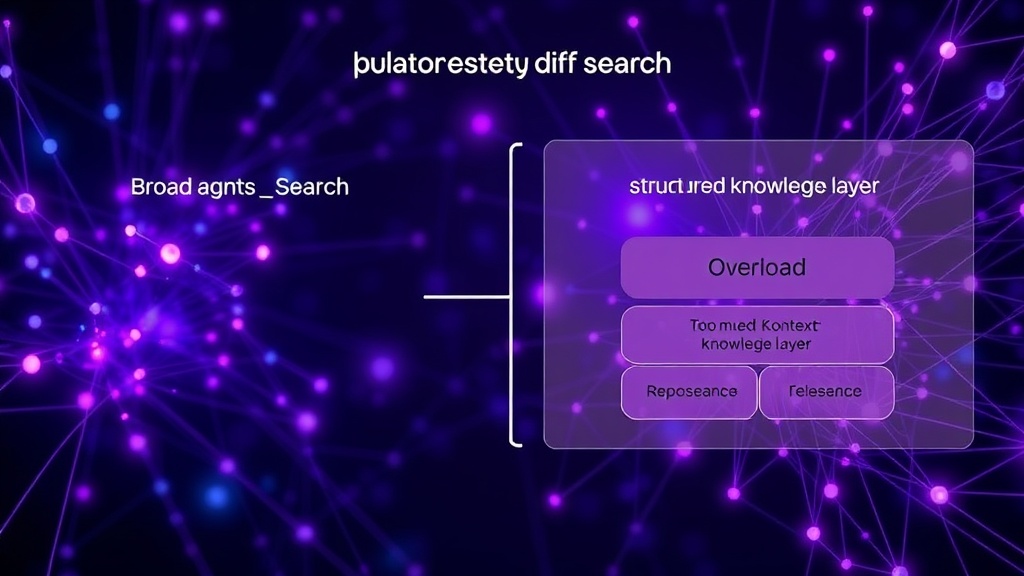
At Betsson, the development of the AI-DLC harness provided a clear demonstration of this principle. The team found that replacing the generic command to "search the codebase" with a dedicated knowledge layer that agents query is the optimal strategy. This knowledge layer acts as a curated, intelligent intermediary, providing only the most relevant information to the AI.
Building such a layer can be approached in several ways. One method involves reverse-engineering the codebase to create a semantic understanding of its components and their relationships. This can involve analyzing function calls, data structures, and dependencies to build a graph or knowledge base. Another, more comprehensive approach, is to build a full knowledge graph that maps out the entire system, including its architectural patterns, business logic, and historical evolution. This graph serves as a structured representation of the codebase's intelligence, allowing agents to query specific pieces of knowledge rather than sifting through raw text.
Consider the difference between asking a librarian for "all books on physics" versus asking for "all introductory quantum mechanics textbooks published after 2020." The latter query, with its specific filters and scope, will yield far more relevant results with less wasted effort. The knowledge layer functions similarly, transforming a broad, noisy search into a precise, targeted query.
Benefits of Structured Context
The advantages of this structured approach are manifold. Firstly, it drastically reduces token consumption. By providing only relevant information, agents operate with a much leaner context, leading to significant cost savings. This is not just about saving money; it's about making AI coding tools economically viable for broader adoption and more frequent use.
Secondly, precision and accuracy improve dramatically. When an agent receives distilled, relevant information, its ability to understand the problem and generate correct, efficient code is enhanced. The signal-to-noise ratio improves, allowing the model to focus on the critical details. This leads to fewer errors, better code quality, and a more reliable AI assistant. Developers can trust the output more, reducing the need for extensive manual review and correction.
Thirdly, it speeds up agent performance. Processing less data means faster retrieval and analysis. This translates to quicker responses from the AI, making the development process feel more fluid and less interrupted. The agent becomes a more responsive partner rather than a bottleneck.
Implications for AI Development and Deployment
The shift towards structured knowledge layers has profound implications for the future of AI development tools. It suggests that the next generation of AI coding agents will not just be about larger models or more data, but about smarter data management and retrieval. Companies building these tools will need to invest in sophisticated indexing, knowledge graph construction, and semantic search technologies.
For developers, this means that the effectiveness of their AI assistants will depend not only on the agent's core intelligence but also on the quality and structure of the information it can access. This could lead to new roles or skill sets focused on curating and structuring codebases for AI consumption. It also prompts a re-evaluation of how we organize and document code, emphasizing clarity and semantic richness.
The current approach, where agents are given a firehose of code and expected to find the needle, is unsustainable. The future lies in building intelligent systems that can intelligently curate and deliver the needle. This requires a move from brute-force retrieval to a more nuanced understanding of code and context. The companies and developers who embrace this shift will be the ones to truly unlock the potential of AI in software development, creating agents that are not just fast, but also precise and cost-effective.