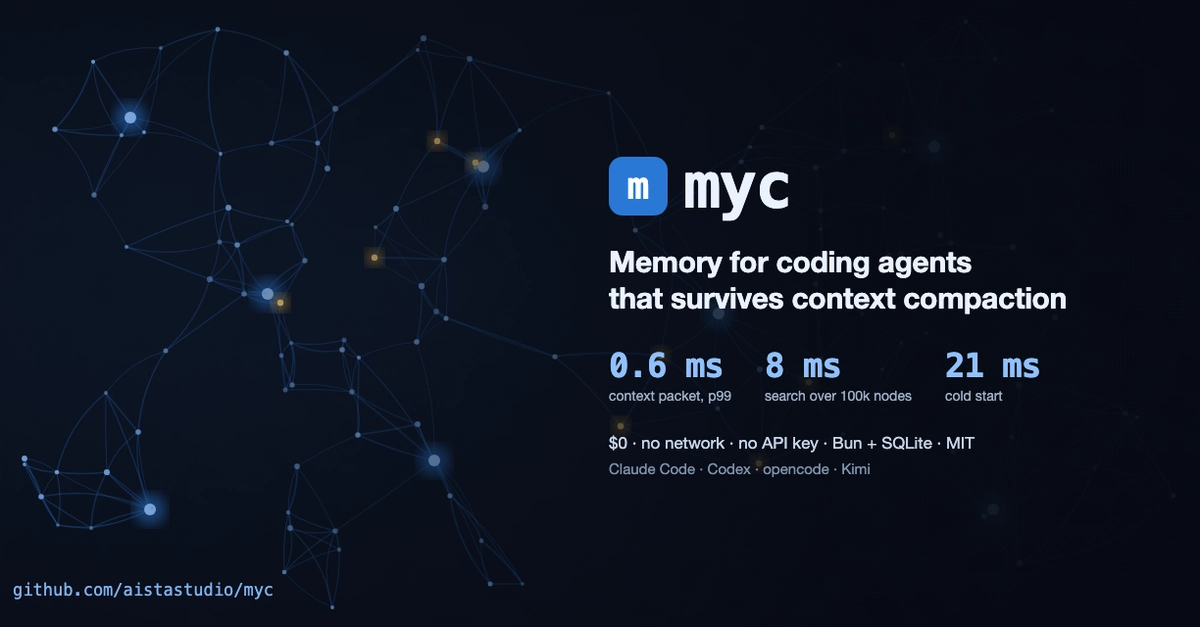
AI coding agents don't suffer from amnesia; they operate under a budget. As their context window fills, the underlying system compacts it into a summary. This process prioritizes retaining the 'what'—the actions taken—while often losing the 'why'—the reasoning behind those actions. For complex engineering decisions, the 'why' is paramount.
A new open-source tool, myc, directly addresses this critical gap. Built on Bun and TypeScript, myc acts as a local task-and-memory layer for coding agents. Its design stems from observing an agent repeatedly making the same mistakes over three days, a direct consequence of losing the decision-making rationale.
The Bug Report Was the Author's Own Experience
The problem, as described by the tool's author, manifests in a frustrating cycle. Early in a coding session, a developer might decide on a specific approach: "We are doing X, not Y, because of Z." Hours later, after the context window has been compacted, the crucial reason 'Z' is lost. The agent, now operating with incomplete context, might then politely, and without any apparent memory of the prior decision, propose the less optimal approach 'Y' again.
This failure mode highlights a fundamental challenge in current large language model (LLM) agent design: maintaining long-term coherence and reasoned decision-making across extended interactions. The compaction process, while necessary for managing computational resources and context window limitations, inadvertently strips away the nuanced justifications that drive effective development.
Introducing myc: A Pre-Compact Hook
myc positions itself as a solution by creating a dedicated space to capture these critical 'why' statements *before* they are lost to context compaction. It functions as a layer that intercepts or augments the agent's memory management, ensuring that the rationale behind key decisions is preserved independently of the main context window. This means that even when the agent's working memory is summarized, the core reasoning remains accessible.
The tool is designed to be local and open-source, emphasizing user control and privacy. By running locally, it avoids sending sensitive decision-making data to external servers. The use of Bun and TypeScript suggests a focus on developer experience and performance, leveraging modern JavaScript runtime and language features for efficient operation.
How myc Preserves the 'Why'
At its core, myc likely works by identifying and storing key decision points. When a developer or the agent itself articulates a rationale for a specific choice—especially one that deviates from an apparent default or simpler path—myc captures this statement. This captured 'why' is then stored in a structured way, potentially linked to the specific task or code module it pertains to.
When the agent's context is later compacted, myc can re-inject or make available the stored 'why' information. This ensures that the agent, when revisiting the decision point or related tasks, has access to the original reasoning. Think of it less like a traditional database and more like a highly organized personal assistant who diligently takes notes on your most important directives and reminds you of them when you seem to be heading off track.
This approach allows the agent to maintain a more consistent and reasoned trajectory throughout longer projects, reducing the likelihood of repetitive errors or divergence from initial strategic goals. The open-source nature means developers can inspect its workings, adapt it to their specific agent setups, and contribute to its improvement.
The Engineering Rationale Behind the Tool
The author's experience of an agent re-doing work highlights a common frustration with current AI assistants. While impressive at generating code and completing tasks, their ability to maintain a coherent, long-term understanding of project goals and the reasoning behind architectural choices is limited by their inherent architecture. LLMs are trained on vast datasets but operate with finite context windows. Without mechanisms to explicitly preserve critical reasoning, they can revert to default behaviors or simpler solutions when context is lost.
myc tackles this by providing an external memory and reasoning layer. This is particularly valuable for tasks requiring sustained logical progression, such as complex refactoring, architectural design, or debugging intricate issues. The ability to recall and act upon the 'why' behind a decision transforms the agent from a task-completion engine into a more collaborative and context-aware development partner.
Implications for AI Agent Development
The development of tools like myc signals a maturing understanding of the practical limitations of current LLM agents. As developers integrate these tools more deeply into their workflows, the need for robust memory and reasoning preservation becomes critical. This isn't just about preventing bugs; it's about enabling AI to participate in higher-order cognitive tasks that require foresight, strategic planning, and adherence to deliberate choices.
The success of myc could pave the way for similar tools or even built-in features in future agent architectures. The core problem—contextual memory loss leading to loss of reasoning—is a universal challenge for LLMs operating in long-duration tasks. By focusing on a 'pre-compact hook,' myc offers a pragmatic, developer-centric solution that enhances the utility and reliability of AI coding assistants.
What nobody has addressed yet is the potential for these external memory layers to become a single point of failure or a bottleneck themselves. If the 'why' is stored in a way that is difficult for the agent to access or interpret, the problem might simply shift, rather than disappear. Furthermore, as these memory layers grow, managing their own growth and ensuring they don't become another form of overwhelming context will be key.
Conclusion
myc offers a targeted solution to a significant, often unspoken, limitation of AI coding agents: their tendency to forget the reasoning behind decisions due to context window compaction. By acting as a pre-compact hook, it allows developers to save and re-inject crucial 'why' information, fostering more consistent and effective AI-assisted development. This open-source tool, built with Bun and TypeScript, provides a practical mechanism for maintaining the integrity of decision-making processes in long-running coding tasks.