The Benchmark Illusion
Last year, my team needed to select an AI coding agent. I volunteered to lead the evaluation, feeling confident. I reviewed public benchmark scores, lined up the top contenders, picked the highest-ranked one, and declared it our winner. The problem began when we actually pointed it at our own repository.
It didn't fail spectacularly. Instead, it consistently produced minor errors that consumed our time. Diffs recommended by the agent were rejected by our reviewers. It would rename a function, breaking three unrelated files it had never touched. Crucially, the tests it ran passed, yet the repository remained broken. My confident recommendation was based on a metric that offered almost no insight into our specific situation. This embarrassing experience motivated me to understand the disconnect. After weeks of research and a couple more misguided choices, I found a solution. This is my plain-language explanation, intended to save you the awkward meeting where you have to retract your recommendation.
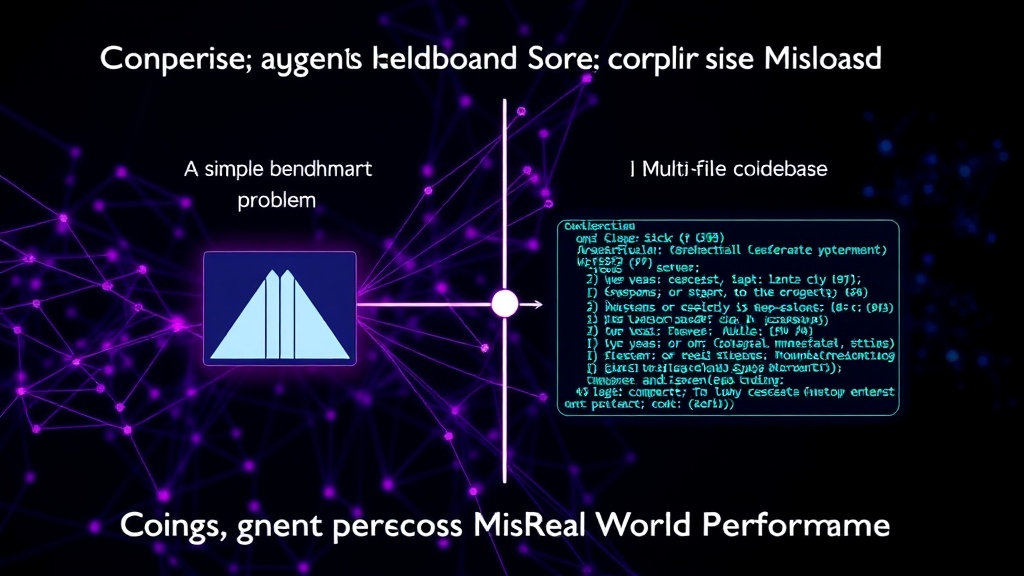
The core issue is that public benchmarks for coding agents are fundamentally flawed. They typically evaluate agents on standardized datasets like HumanEval or MBPP. These benchmarks consist of small, self-contained code snippets designed to test algorithmic problem-solving and basic code generation. While useful for measuring an agent's ability to solve textbook problems, they bear little resemblance to the complexity and nuances of real-world, production-level codebases.
Why Benchmarks Fail Real Codebases
Real-world codebases are vastly different from benchmark datasets. They are often large, intricate, and span multiple files and modules. They contain custom libraries, internal frameworks, legacy code, and specific architectural patterns. The relationships between different parts of the code are complex and implicit, relying on context that a benchmark dataset cannot replicate.
Consider the difference between solving a single math problem in isolation versus managing the financial records for a sprawling enterprise. The math problem tests a specific skill. Managing enterprise finances requires understanding interdependencies, regulatory compliance, historical data, and custom accounting rules. An AI agent trained solely on isolated math problems will struggle with the latter, even if it scores perfectly on the former.
When a coding agent encounters a real codebase, it faces challenges far beyond simple function completion. It must understand:
- Project-specific conventions: Naming conventions, coding styles, and idiomatic patterns unique to the project.
- Inter-file dependencies: How changes in one file affect others, often through indirect relationships like dependency injection or shared configurations.
- Contextual understanding: The purpose and interaction of different modules and components within the larger system.
- Legacy code integration: Working with older code that may not adhere to modern practices or have comprehensive documentation.
- Subtle bugs: Errors that don't break tests immediately but lead to incorrect behavior or security vulnerabilities later.
A benchmark score, often derived from passing a set of predefined unit tests on isolated problems, cannot capture these critical aspects. The agent might correctly implement a requested feature but fail to integrate it seamlessly, leading to regressions or maintenance headaches. The fact that tests passed is a red herring; tests are designed to catch specific, known failure modes, not the subtle, context-dependent errors an agent might introduce.
The Search for a Better Evaluation Method
My team's initial mistake was relying solely on leaderboard metrics. To find an agent that actually worked, we had to develop a more rigorous, context-aware evaluation process. This involved several steps:
1. Define Realistic Tasks
Instead of generic code generation, we crafted tasks that mirrored our actual development workflows. This included:
- Refactoring a complex module.
- Adding a new feature that required modifying multiple files and interacting with existing APIs.
- Debugging a known, subtle bug.
- Generating documentation for an existing component.
2. Use a Representative Subset of Our Codebase
We created a sandbox environment using a significant, representative portion of our actual codebase. This subset included various modules, dependencies, and coding styles to simulate real-world complexity.
3. Evaluate Beyond Passing Tests
We expanded our evaluation criteria beyond automated test results. Key metrics included:
- Code Review Acceptance: Would human reviewers approve the generated code? This is the ultimate test of quality and maintainability.
- Contextual Accuracy: Did the agent understand the purpose of the code it was modifying and generating?
- Dependency Management: Did the agent correctly handle imports, exports, and inter-module communication?
- Performance Impact: Did the changes negatively affect runtime performance or memory usage?
- Time to Integration: How much human effort was required to review, correct, and integrate the agent's output?
4. Iterative Testing and Refinement
We treated the evaluation as an iterative process. We tested several agents against our defined tasks and criteria, analyzed their failures, and refined our tasks and criteria based on the insights gained. This allowed us to identify agents that showed promise in handling real-world complexity, rather than just theoretical problem-solving.
What This Means for AI Agent Adoption
The disconnect between benchmark scores and real-world performance is a critical hurdle for the widespread adoption of AI coding agents. Developers and teams are understandably looking for reliable ways to assess these tools. Relying on public leaderboards is akin to choosing a chef based solely on their ability to solve a single recipe's ingredients list, without ever tasting their actual dishes or considering the complexity of a full banquet.
The surprising detail here is not that benchmarks are imperfect, but how profoundly they can mislead when applied to complex, proprietary systems. A high score on HumanEval might indicate a strong theoretical capability, but it doesn't guarantee an agent can navigate the intricate web of dependencies, conventions, and implicit knowledge that defines a production codebase. The agent that fails on your repo might be perfectly capable on simpler, isolated tasks, but that capability doesn't translate directly.
If you are evaluating AI coding agents, resist the urge to simply pick the top-ranked option. Instead, invest time in creating a custom evaluation framework that mirrors your team's specific development environment, codebase, and workflows. This hands-on approach, while more time-consuming upfront, is essential for selecting tools that will genuinely augment your development process rather than becoming a costly distraction.