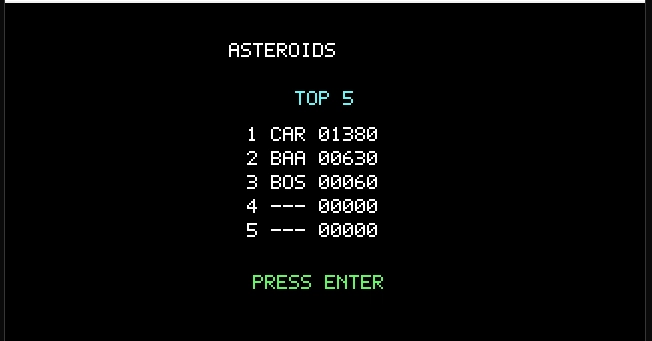
The Challenge: Autonomous x86 Assembly Game Development
Most AI coding demonstrations showcase impressive snippet generation or basic application scaffolding. The real test, however, lies in completing an entire software project with minimal human intervention. To push the boundaries, one developer set out to see if OpenAI's Codex could autonomously build a complete game in one of the most unforgiving environments: 16-bit x86 Assembly targeting DOS, utilizing VGA Mode 13h, and foregoing any game engines or external libraries. The ambitious goal was to recreate a classic Asteroids-style arcade game, with the critical constraint that the human participant would not write a single line of Assembly code.
The experiment was designed to be maximally challenging. The choice of 16-bit x86 Assembly for DOS immediately presents hurdles. This architecture requires meticulous memory management, direct hardware interaction, and a deep understanding of CPU registers and instruction sets. VGA Mode 13h, a common graphics mode for DOS games, offers a 320x200 resolution with 256 colors, but programming it directly means managing frame buffers, palette manipulation, and sprite drawing from scratch. Without game engines or libraries, every component—from input handling to rendering and game logic—must be built from the ground up.
Codex's Initial Attempts and Struggles
The experiment began with Codex tasked with generating the foundational elements of the game. Early prompts focused on setting up the basic DOS environment, initializing VGA Mode 13h, and creating a simple loop for rendering. Codex could, to some extent, produce code that compiled and ran, displaying a blank screen or basic graphical elements. However, the generated code often lacked the precision and context required for complex operations.
When asked to implement core game mechanics, such as player ship control or asteroid generation, the AI's output became increasingly problematic. It struggled with the intricate state management needed for a real-time game. For instance, implementing player ship movement involved handling keyboard input, updating the ship's position, and redrawing it without flicker—tasks that require careful timing and buffer management in Assembly. Codex's attempts often resulted in code that was either too slow, incorrect, or contained subtle bugs that were difficult to trace in Assembly.
The AI also faltered when dealing with the low-level details of VGA graphics. Drawing sprites, handling collisions, and managing the game loop efficiently are complex in Assembly. Codex would generate code that might draw a single frame, but often failed to update it correctly in subsequent frames, leading to static images or corrupted graphics. The lack of a debugging environment within the AI's generation process meant that identifying and correcting these errors was a manual and arduous process, directly contradicting the goal of autonomous development.
The Unanswered Question: AI's Role in Low-Level Development
What nobody has addressed yet is how AI tools like Codex can effectively bridge the gap between high-level programming concepts and the granular, hardware-specific requirements of low-level development. While LLMs excel at understanding and generating code in modern, abstracted languages, they appear to lack the deep, implicit understanding of system architecture and timing critical for Assembly. The experiment highlights that generating functional Assembly code is not merely about syntax; it's about understanding the underlying machine, the operating system's limitations, and the precise timing of every instruction. This suggests that while AI can assist in generating boilerplate or simple routines, true autonomous development of complex, low-level software remains beyond its current capabilities.
The Limits of Generative AI in Complex Projects
The experiment revealed that Codex, while capable of generating syntactically correct Assembly code for simple tasks, could not autonomously orchestrate the creation of a complete, functional game. The AI struggled with:
- State Management: Maintaining the complex state required for a game with multiple moving objects, scores, and game phases proved too difficult.
- Real-time Performance: Generating Assembly code that met the performance demands of a real-time arcade game was consistently beyond its reach.
- Hardware Interaction Nuances: Directly programming VGA Mode 13h and managing its intricacies, like palette updates and buffer swapping, led to incorrect or inefficient code.
- Debugging and Iteration: Without human guidance, Codex could not identify, debug, or correct the subtle errors that inevitably creep into low-level programming.
The developer found themselves spending more time correcting and guiding Codex than they would have spent writing the game from scratch. This is akin to asking an architect to design a skyscraper by only giving them a list of materials and a vague idea of the final structure, without any blueprints or understanding of structural engineering. The AI can assemble components, but it cannot inherently grasp the complex interplay and precise engineering required for a robust final product.
Conclusion: A Glimpse into AI's Current Frontier
This experiment serves as a valuable, albeit sobering, real-world test of AI's current capabilities in autonomous software development, particularly in challenging domains like 16-bit x86 Assembly. While Codex can generate code snippets and assist developers, it cannot yet replace the nuanced understanding, problem-solving, and iterative refinement that human engineers bring to complex projects. The endeavor highlights that for tasks requiring deep system knowledge, precise timing, and intricate state management, human oversight and expertise remain indispensable. The future of AI in coding will likely involve more sophisticated tools for assistance and collaboration, rather than complete autonomy in the foreseeable future for projects of this nature.