Customizing Codex CLI with Ace Data Cloud
The ability to integrate custom AI model providers into local development tools is crucial for maintaining a seamless workflow. Codex CLI, a terminal-based programming agent, now supports this flexibility. By configuring a custom provider, developers can direct their Codex CLI requests to alternative AI model endpoints, such as Ace Data Cloud, without altering their fundamental command-line experience.
This integration allows Codex CLI to leverage models compatible with OpenAI’s API structure, but routed through a different infrastructure. The primary benefit is the ability to use preferred or more cost-effective AI providers while retaining the powerful features of Codex CLI. These features include reading project code, modifying files, executing terminal commands, and explaining errors, all within the familiar terminal environment.
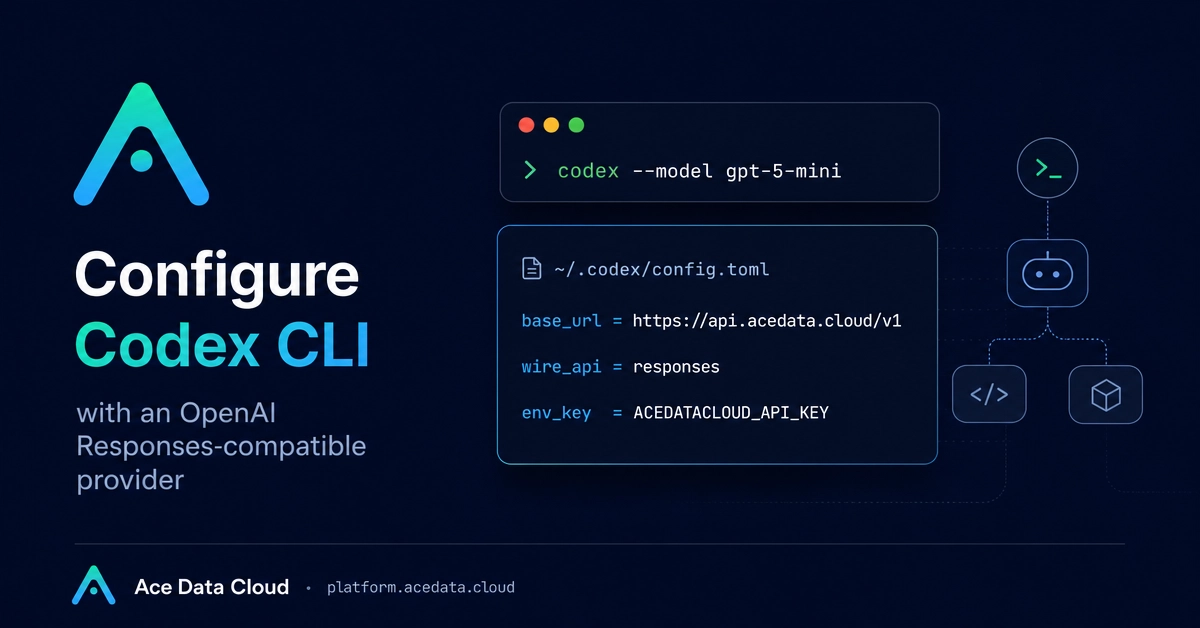
The setup process involves defining a custom provider block within the Codex CLI configuration. The key parameters for this integration are the provider’s base URL and the specific API endpoint for responses. For Ace Data Cloud, the documented base URL is https://api.acedata.cloud/v1. This allows Codex CLI to send requests to this endpoint, effectively using Ace Data Cloud’s AI models as a backend for its agentic capabilities.
Configuring the Custom Provider
To enable this custom provider functionality, developers need to modify their Codex CLI configuration. The configuration typically allows for specifying a named provider, its base URL, and potentially authentication credentials. For Ace Data Cloud, the configuration would point to https://api.acedata.cloud/v1. This means that when Codex CLI needs to generate code, explain a problem, or perform any other AI-driven task, it will send the request to this Ace Data Cloud endpoint instead of the default OpenAI endpoint.
The underlying principle is that the custom provider must adhere to an OpenAI Responses-compatible format. This compatibility ensures that Codex CLI can correctly parse the AI’s output and integrate it into its operational flow. Without this compatibility, the CLI would not understand the responses it receives. The guide highlights that this approach maintains the native codex terminal experience. Users continue to interact with codex commands as usual, but the AI processing happens on the custom provider’s infrastructure.
Benefits for Developers and Workflow Integration
The ability to switch AI providers offers significant advantages. Developers can choose providers based on factors like cost, performance, data privacy policies, or specific model capabilities. For instance, if a company has specific data residency requirements or prefers to avoid sending proprietary code to public AI services, a private or self-hosted compatible endpoint becomes essential. Ace Data Cloud, by offering an OpenAI-compatible API, simplifies this transition.
This flexibility directly addresses a core concern for developers: maintaining control over their tools and workflows. Instead of being locked into a single vendor, developers can adapt their AI backend to suit evolving project needs or budgetary constraints. This is particularly relevant for teams working on large codebases or engaging in frequent AI-assisted development tasks, where API costs can accumulate rapidly.
The integration emphasizes that the core functionality of Codex CLI remains intact. It can still analyze project structures, suggest code changes, and execute commands. The change is purely in where the AI processing occurs. This means that developers do not need to learn new commands or adapt their existing shell scripting that incorporates Codex CLI. The power of an AI coding assistant is now more portable and configurable than ever before.
The Future of Local AI Development Tools
This development signals a broader trend towards more open and configurable AI development tools. As AI models become increasingly integrated into software development lifecycles, the demand for tools that allow for provider agnostic usage will grow. Codex CLI’s support for custom providers positions it as a forward-thinking solution in this space.
The question for developers is no longer just about the capability of the AI model, but about how easily that capability can be integrated into existing, often complex, local development environments. The success of integrations like this one with Ace Data Cloud suggests a path forward where developers can mix and match AI backends with their preferred local tools, creating a more personalized and efficient development stack. This approach empowers developers to tailor their AI assistance without compromising their established workflows or incurring unexpected costs.
What nobody has addressed yet is what happens to the thousands of developers who built on the old API, or how this custom provider model will scale with an increasing number of diverse AI model providers entering the market. The potential for fragmentation is real, but so is the potential for a more robust and competitive AI tooling ecosystem.