
Introducing Coasty: An API for Computer-Use Agents
Coasty, a Y Combinator S26 startup, has launched its API designed to enable developers to build and deploy computer-use agents. These agents are designed to interact with applications and perform tasks autonomously, much like a human user would, but at machine speed and scale.
The core innovation behind Coasty lies in its ability to abstract the complexities of agent development. Traditionally, creating agents that can navigate graphical user interfaces (GUIs), interpret visual information, and execute actions across various applications requires deep expertise in areas like computer vision, natural language processing, and UI automation. Coasty aims to democratize this capability by providing a unified API that handles these underlying challenges.
Think of it less like a traditional API that fetches data or triggers a single function, and more like a digital assistant you can program. You tell Coasty what you want the agent to achieve – for example, 'sign up for this service,' 'fill out this form,' or 'scrape product information from this website' – and Coasty's backend orchestrates the process. This involves understanding the target application's interface, planning a sequence of actions, executing those actions, and handling any unexpected outcomes.
How Coasty Works
The Coasty API provides developers with the tools to define agent behaviors and integrate them into their own applications. The process typically involves the following steps:
- Task Definition: Developers specify the high-level goal for the agent using natural language or structured commands.
- Environment Setup: Coasty interacts with the target application, which can be a web application, desktop software, or even a mobile app, depending on the integration.
- Action Execution: The agent, powered by Coasty's engine, performs a series of atomic actions such as clicking buttons, typing text, selecting dropdowns, and navigating between screens.
- State Management and Decision Making: Coasty's agents can interpret visual feedback from the application, make decisions based on the current state, and adapt their execution plan if necessary. This includes handling dynamic content, CAPTCHAs (with appropriate user consent and handling mechanisms), and error conditions.
- Output and Integration: The results of the agent's task, such as captured data, completed forms, or status updates, are returned to the developer's application via the API.
The underlying technology leverages a combination of advanced AI models, including large language models (LLMs) for understanding instructions and planning, and computer vision models for interpreting the user interface. This allows agents to be flexible and adapt to changes in application UIs without requiring constant reprogramming, a common pain point with older automation tools.
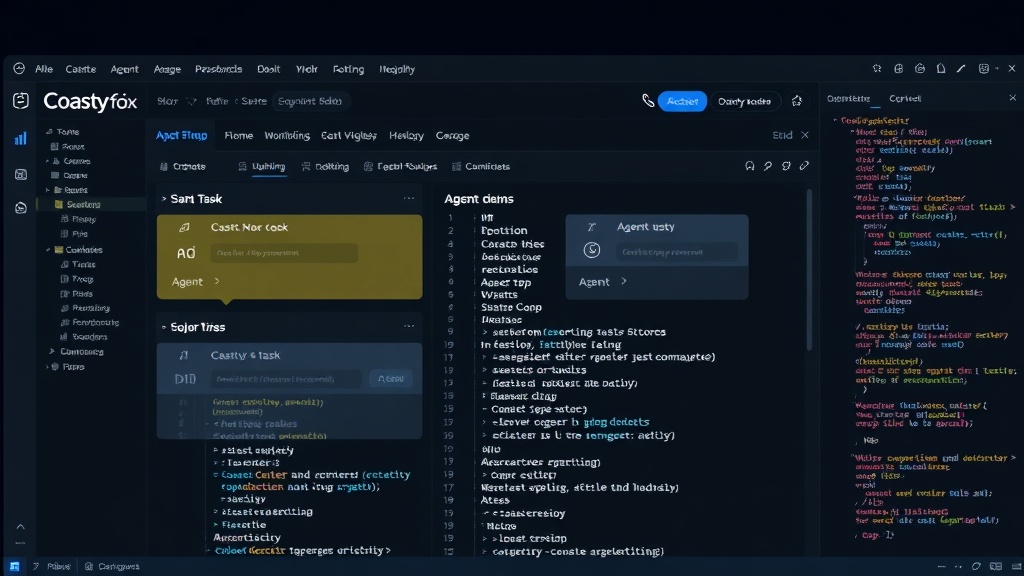
Use Cases and Developer Benefits
The potential applications for Coasty's API are vast. For businesses, it opens doors to automating a wide range of operational tasks that currently require human intervention. Examples include:
- Onboarding and Account Creation: Automating the process of signing up for new services or creating user accounts across multiple platforms.
- Data Entry and Processing: Populating forms, migrating data between applications, and extracting information from unstructured documents.
- Customer Support Automation: Handling routine customer queries, guiding users through troubleshooting steps, or processing simple support requests.
- E-commerce Operations: Automating product listing, price monitoring, and order processing.
- Software Testing: Performing UI testing by simulating user interactions across different scenarios.
For developers, Coasty significantly lowers the barrier to entry for building sophisticated automation solutions. Instead of managing the intricate details of UI interaction, vision processing, and state management, developers can focus on defining the business logic and the desired outcomes. This accelerates development cycles and allows for the creation of more intelligent and responsive automated workflows.
The Future of Agent Automation
Coasty's approach represents a significant step forward in the field of AI-powered automation. By providing a developer-friendly API, the company is empowering a broader range of creators to leverage the power of autonomous agents. This could lead to a new wave of applications that are more efficient, more personalized, and capable of handling tasks previously thought to be exclusively within the human domain.
What remains to be seen is how effectively Coasty's agents can handle highly dynamic or complex user interfaces, and the ethical considerations surrounding autonomous actions on behalf of users. Ensuring clear consent, robust error handling, and transparent operation will be critical as these agents become more integrated into daily workflows.