The Problem Closures Solve
When learning Python, one might encounter nested functions and question their utility, especially when grappling with the concept of closures. The initial confusion often stems from not understanding the problem closures are designed to solve. Without them, managing state and context in nested functions becomes cumbersome, limiting code elegance and functionality.
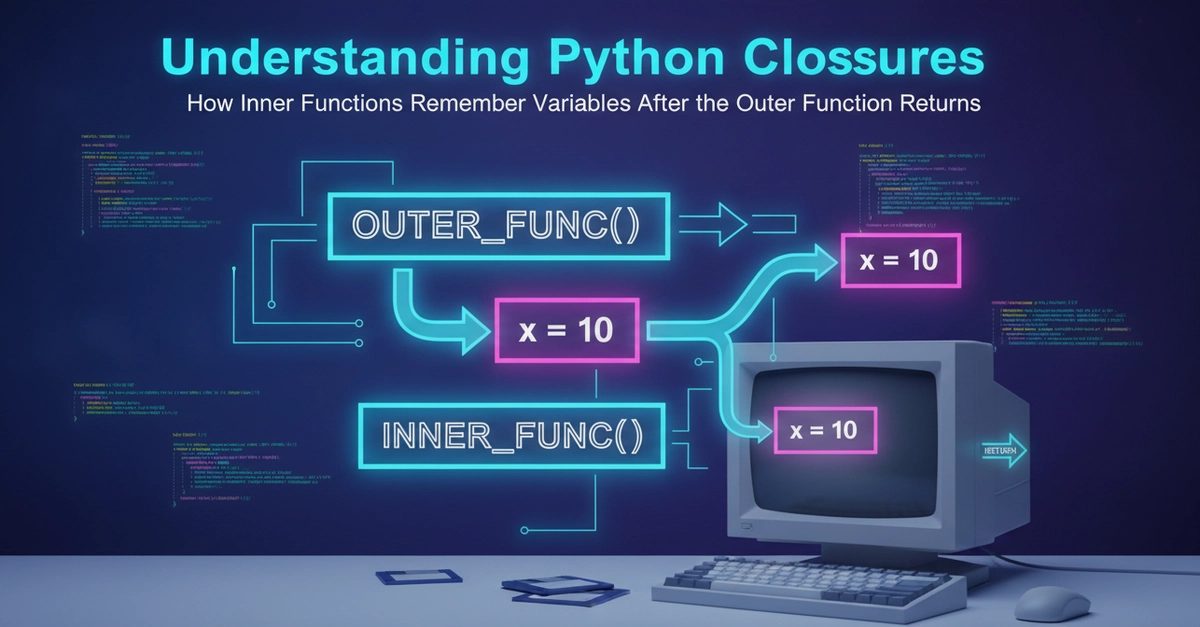
Consider a scenario where an outer function defines a variable and an inner function needs to access or modify that variable. In many languages, once the outer function finishes executing and its local scope is theoretically gone, the inner function would lose access to that variable. This is where closures become indispensable. A closure allows an inner function to 'remember' and retain access to the variables of its enclosing scope, even after the outer function has completed its execution.
Without closures, achieving certain programming patterns would require more complex workarounds. For instance, creating functions that maintain their own persistent state or functions that are configured with specific parameters at creation time would be significantly harder. This limitation hinders the development of modular, reusable, and expressive code.
How Closures Work Internally
At its core, a closure is a function object that remembers values in enclosing scopes in which it was created. This is possible due to Python's handling of functions as first-class citizens. First-class functions mean that functions can be treated like any other variable: they can be assigned to other variables, passed as arguments to other functions, and returned as values from other functions.
When an outer function is called, it creates its own local scope. If this outer function defines a nested function and returns it, Python doesn't just return the inner function's code. It bundles the inner function along with a reference to the enclosing scope's variables that the inner function depends on. This bundle is what we call a closure.
The key is that the inner function retains a link to its enclosing scope's variables. This link persists even after the outer function has finished executing. This means the inner function can still access, and in some cases modify, those variables. This behavior is often managed through a special attribute, often referred to as `__closure__` in Python, which holds the cell objects containing the referenced variables.
To illustrate, let's consider a simple example. Suppose we have an outer function `outer_func` that takes an argument `msg`. Inside `outer_func`, we define an inner function `inner_func` that prints `msg`. If `outer_func` returns `inner_func`, the returned function is a closure. When this closure is called later, it can still access the `msg` that was passed to `outer_func` when the closure was created.
def outer_func(msg):
    def inner_func():
        print(msg)
    return inner_func

my_closure = outer_func("Hello, Closure!")
my_closure() # Output: Hello, Closure!
In this example, `my_closure` is an instance of `inner_func`. It 'remembers' that `msg` was "Hello, Closure!". Even though `outer_func` has long since finished executing, `my_closure` can still access and use that specific `msg` value.
Real-World Use Cases and Decorators
Closures are not just an academic concept; they are fundamental to building elegant and efficient Python code. One of the most prominent applications of closures is in the implementation of decorators.
Decorators are a powerful feature in Python that allow you to modify or enhance functions or methods in a clean and readable way. A decorator is essentially a function that takes another function as an argument, adds some functionality, and then returns another function, all without altering the source code of the original function being decorated.
Let's look at a simple decorator example using closures:
def repeat(num_times):
    def decorator_repeat(func):
        def wrapper(*args, **kwargs):
            for _ in range(num_times):
                result = func(*args, **kwargs)
            return result
        return wrapper
    return decorator_repeat

@repeat(num_times=3)
def greet(name):
    print(f"Hello {name}")

greet("Alice")
In this code:
repeatis an outer function that takes `num_times` as an argument.decorator_repeatis a nested function that takes the function to be decorated (`greet` in this case) as an argument.wrapperis a nested function within `decorator_repeat`. It's the function that actually adds the repeated execution logic.
When we use the @repeat(num_times=3) syntax, Python is effectively doing this:
greet = repeat(num_times=3)(greet)
Here, repeat(num_times=3) returns decorator_repeat. Then, decorator_repeat(greet) is called, which returns the wrapper function. The wrapper function is a closure. It remembers the value of `num_times` from its enclosing scope (the repeat function) and the original function `greet` passed to decorator_repeat. When greet("Alice") is called, it's actually calling the wrapper, which then executes the original greet function three times.
This pattern is incredibly useful for tasks like logging function calls, measuring execution time, access control, and caching. Without closures, implementing such reusable and configurable enhancements would be far more convoluted.
Other Use Cases
Beyond decorators, closures find application in various programming paradigms:
- Data Hiding and Encapsulation: Closures can be used to create private variables. By returning an inner function that operates on variables defined in the outer scope, you can effectively hide those variables from direct external access, mimicking private members in object-oriented programming.
- Function Factories: As seen with the decorator example, closures allow you to create functions that generate other functions tailored to specific configurations. This is useful for creating specialized versions of a general-purpose function.
- Callback Functions: In asynchronous programming or event-driven systems, closures can be used to pass context to callback functions that will be executed later. The closure ensures the callback has access to the necessary data from the scope in which it was defined.
Understanding closures unlocks a deeper appreciation for how functions can carry state and context, leading to more sophisticated and Pythonic code. They are a testament to the power of first-class functions and dynamic scope handling.