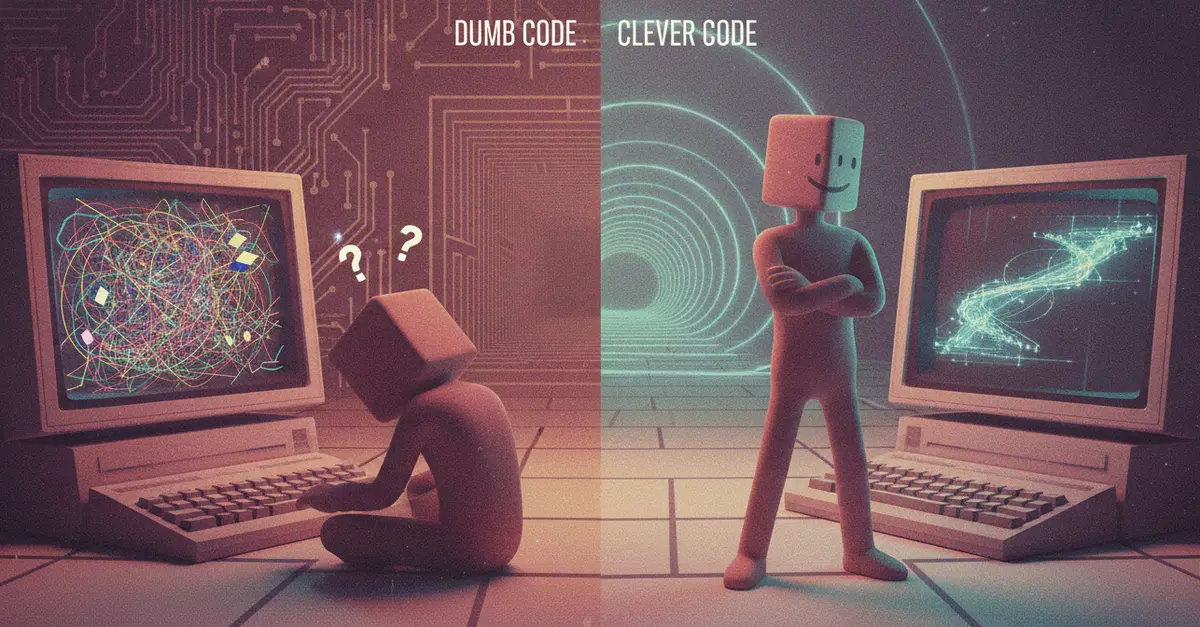
The Siren Song of Clever Code
The tech industry has a persistent, often celebrated, affliction: the pursuit of "clever" code. We equate complexity with capability, mistaking intricate, performant solutions for true engineering prowess. This mindset, deeply ingrained from early coding education, leads developers down a perilous path. They start by writing simple for loops, only to graduate to architecting five-layer generic abstract factory patterns for a mere boolean flag. This isn't seniority; it's a recipe for disaster.
Brian Kernighan’s famous quote rings truer than ever: “Debugging is twice as hard as writing the code in the first place. Therefore, if you write the code as cleverly as possible, you are, by definition, not smart enough to debug it.” This statement cuts to the heart of the problem. Many developers, fueled by caffeine and a desire to impress, craft elegant-seeming, four-line nested ternary operations wrapped in reduce functions. These solutions might execute in milliseconds and pass initial tests, appearing like black magic. But three months later, during a critical incident response at 3:00 AM, the same developers stare blankly at their own creation, utterly lost.
The truth is, clever code is a technical debt factory. It’s a seductive trap that promises efficiency but delivers unmaintainability, increased debugging time, and ultimately, slower development cycles. The industry needs to collectively confess and pivot from celebrating 'smart' code to prioritizing clarity and maintainability.
The "Genius" Complex and Its Cost
This obsession with cleverness stems from a flawed understanding of expertise. Early in a developer's career, mastering complex syntax and algorithms feels like a significant achievement. This can lead to an inflated sense of self-worth tied to the perceived difficulty of one's code. Seniority becomes associated with the ability to write code that is dense, opaque, and difficult for others to decipher, rather than code that is robust, understandable, and easily maintainable by a team.
Consider the common scenario of a pull request containing a highly optimized, yet convoluted, piece of logic. While it might pass code review due to its apparent technical sophistication, it introduces significant long-term costs. The next developer to touch that code, or even the original author months later, faces an uphill battle. Understanding the intent, tracing the execution flow, and identifying potential edge cases becomes an arduous task. This is compounded when the original author has moved on or forgotten the intricate details.
The cost isn't just developer frustration. It translates directly into slower feature development, increased bug rates, and higher operational overhead. Every hour spent deciphering 'smart' code is an hour not spent building new value. The pursuit of micro-optimizations in code that doesn't require it is a classic example of premature optimization, a well-known anti-pattern. It's a trade-off that rarely pays off in the long run.
Embracing "Dumb" Code: The Path to Clarity
The antidote to the clever code epidemic is a conscious shift towards writing what can be termed "dumb" code. This doesn't mean writing inefficient or poorly performing code, but rather code that is explicit, readable, and straightforward. It prioritizes clarity over conciseness, and understandability over intricate algorithmic gymnastics.
This involves several key practices:
- Favor Readability: Use clear variable names, break down complex logic into smaller functions with single responsibilities, and avoid deep nesting of conditional statements or loops.
- Prioritize Explicit Over Implicit: Instead of relying on side effects or implicit behaviors, make the code's intent obvious. For example, a simple `if` statement is often preferable to a complex ternary operator.
- Document Intent, Not Just Logic: While self-documenting code is ideal, complex sections benefit from comments explaining *why* a certain approach was taken, especially if it deviates from the norm or involves a specific optimization.
- Embrace Standard Patterns: Stick to well-understood design patterns and language idioms. While custom solutions can be powerful, they also increase the learning curve for new team members.
- Test Thoroughly and Strategically: "Dumb" code is often easier to test. Focus on writing comprehensive unit tests that verify the intended behavior and catch regressions, especially when refactoring or modifying existing logic.
Think of it like building a house. You could use exotic, difficult-to-work-with materials for structural elements, potentially saving a few inches of space or shaving off a few pounds. Or, you could use standard, well-understood materials that are easy to source, work with, and repair. The latter approach leads to a more stable, maintainable, and ultimately, more valuable structure.
The Future: Maintainability Over Magic
The trend towards more complex applications, distributed systems, and AI-driven features only exacerbates the problem of unmaintainable code. As systems grow, the ability to understand and modify them becomes paramount. Developers who can write clear, simple, and testable code will be invaluable. They are the architects of sustainable systems, not the creators of unmanageable technical debt.
If you're a developer, challenge your own habits. Before writing that overly clever one-liner, ask yourself: will I, or someone else, understand this in six months? If the answer is uncertain, opt for the simpler, dumber approach. For engineering leaders, foster a culture that rewards clarity, maintainability, and collaborative understanding over individual brilliance expressed through complex code. The long-term health of any software project depends on it.