The Silent Degradation of AI Code Sessions
Large language models (LLMs) like Anthropic's Claude are increasingly used as coding assistants. Developers feed them codebases, ask for refactors, bug fixes, and feature implementations. The expectation is a seamless, intelligent pair programmer. However, many users observe a subtle but significant degradation in the quality of Claude's output over extended coding sessions. This phenomenon, often termed 'context rot,' occurs well before the model hits its stated token limits, suggesting a more complex interaction between the model, its context window, and the task at hand.
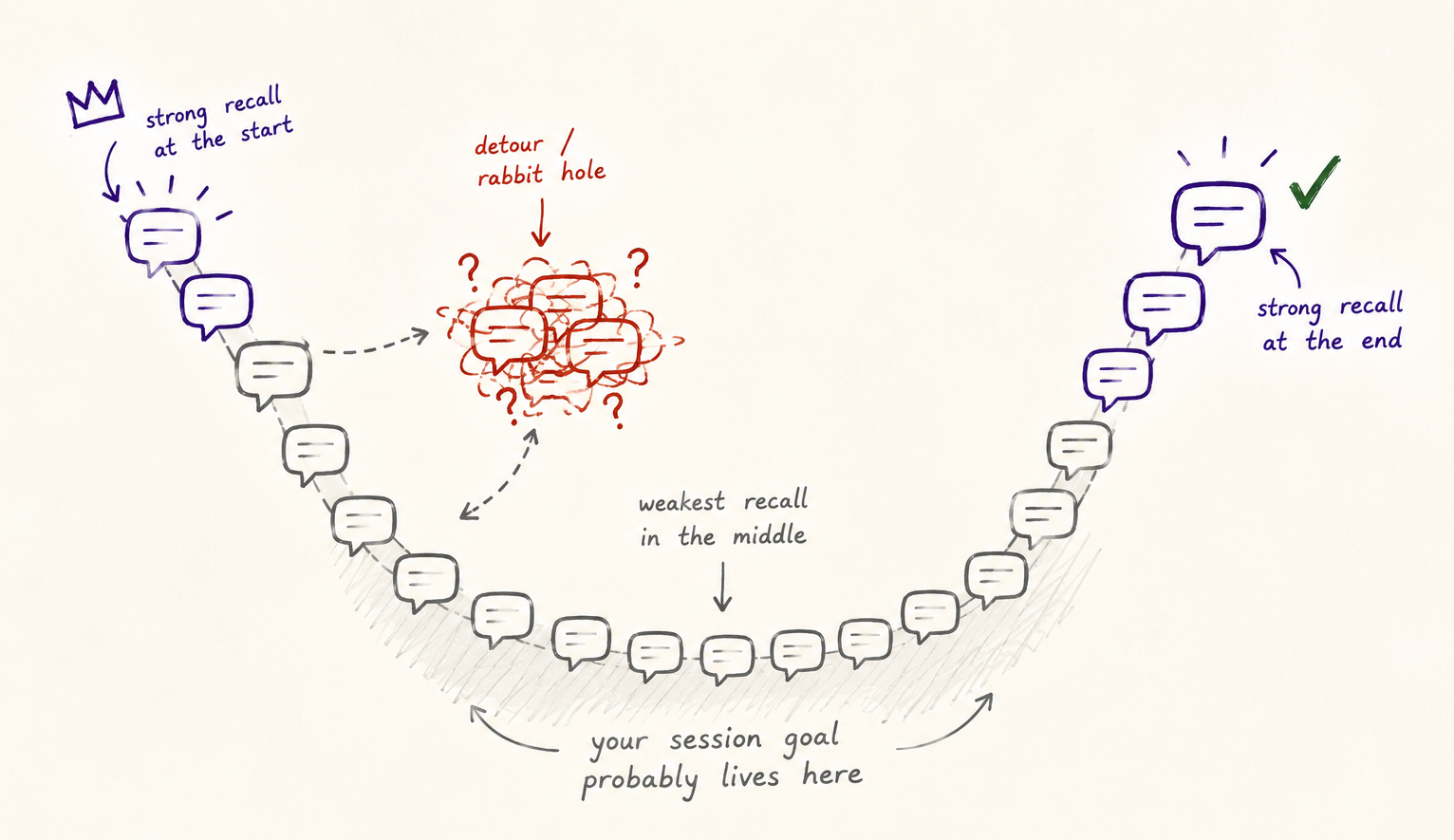
Context rot isn't about the sheer volume of text exceeding a hard limit. Instead, it's a qualitative decay. Imagine a conversation where a participant starts to forget earlier details, misinterpret nuances, or become less relevant to the ongoing discussion, even if they haven't been explicitly told to stop listening. This is analogous to context rot in LLMs. As the session progresses, the model's ability to accurately recall, synthesize, and act upon the information provided earlier in the context window diminishes. This leads to outputs that might be syntactically correct but semantically flawed, miss critical dependencies, or propose solutions that conflict with established logic elsewhere in the provided code.

Why Context Rot Happens in LLMs
The core of the issue lies in how LLMs process and prioritize information within their attention mechanisms. While LLMs have a theoretical context window – the maximum amount of text they can consider at once – the effective 'memory' or 'focus' of the model is not uniform across this window. Newer information often has a disproportionately higher influence than older information. This is partly due to the self-attention mechanism, which calculates the relevance of each token to every other token. As the context grows, the computational burden increases, and the model may struggle to maintain strong attention weights for information introduced early in the session.
Furthermore, the sequential nature of processing means that new prompts and responses are appended to the existing context. If the model is asked to perform a task that requires understanding the entire project's architecture, but the initial context only contained a small subset of files, subsequent additions might not fully compensate for the missing foundational knowledge. The model might 'forget' or deprioritize crucial early instructions or code snippets, leading to outputs that are locally coherent but globally inconsistent. This is akin to a human programmer trying to fix a bug without looking at the original design documents – they might fix the immediate issue but introduce new architectural problems.
Another contributing factor can be the iterative nature of coding with an AI. Developers often refine their prompts, ask follow-up questions, and provide corrected code. Each of these interactions adds to the context. If not managed carefully, the context can become cluttered with outdated code versions, redundant explanations, and slightly contradictory instructions. The LLM then has to sift through this noise to find the most relevant signals, increasing the chance of errors. This is not a failure of the LLM's architecture per se, but a consequence of how we interact with it in complex, evolving tasks.
Governing Your Claude Code Sessions
Managing context rot requires a proactive strategy. Simply extending the session or adding more information without structure will likely exacerbate the problem. The goal is to ensure the most critical information remains salient to the model throughout the session.
Structured Prompting and Re-summarization
One effective technique is to periodically re-summarize the project's state, key decisions, and architectural constraints. Instead of just appending new requests, frame them within a concise summary of the current understanding. For instance, before asking for a complex refactor, preface the request with a summary like: "We are working on feature X, which involves modifying modules A and B. Module A's primary function is Y, and it interacts with Module B via API Z. The goal is to improve performance by refactoring function F within Module A." This explicit re-grounding helps the model re-focus on essential elements.
Context Pruning and Re-initialization
For very long or complex sessions, developers may need to consciously prune the context. This can involve starting a new chat session with a carefully curated, high-level summary of the project and the specific task. Alternatively, developers can manually edit the conversation history, removing redundant or outdated exchanges before sending the next prompt. This is akin to cleaning up your workspace before starting a critical task. While tedious, it can significantly improve the AI's performance.
Leveraging Claude's Specific Features
Claude models, particularly those with larger context windows, are designed to handle more information. However, the 'context rot' phenomenon suggests that even these models benefit from governance. Developers should experiment with different session lengths and prompt structuring to understand how their specific workflow interacts with Claude's capabilities. It's also crucial to test the AI's outputs rigorously. Don't blindly accept code suggestions; always review them for consistency, correctness, and adherence to project standards. Treat the AI as a highly capable, but sometimes forgetful, junior developer who needs clear direction and oversight.
The Unanswered Question of Effective Context Management
While techniques like re-summarization and context pruning offer partial solutions, what remains unclear is the optimal strategy for different project types and LLM architectures. A small script modification session might tolerate longer contexts than a full-stack application refactor. The ideal balance between session length, context density, and prompt engineering for maximum AI coding efficiency is still an open area of research and practical exploration. Developers will need to develop their own heuristics based on their experiences and the specific LLM they are using.
Conclusion: Proactive Governance for Better AI Coding
Context rot is an inherent challenge in using LLMs for complex coding tasks. It's not a binary failure at a token limit but a gradual decay in performance. By understanding the underlying mechanisms and employing proactive governance strategies—structured prompting, periodic re-summarization, and mindful context management—developers can mitigate its effects. The key is to treat AI coding sessions not as passive interactions, but as active collaborations requiring careful guidance and validation to ensure the AI remains a productive and reliable partner.