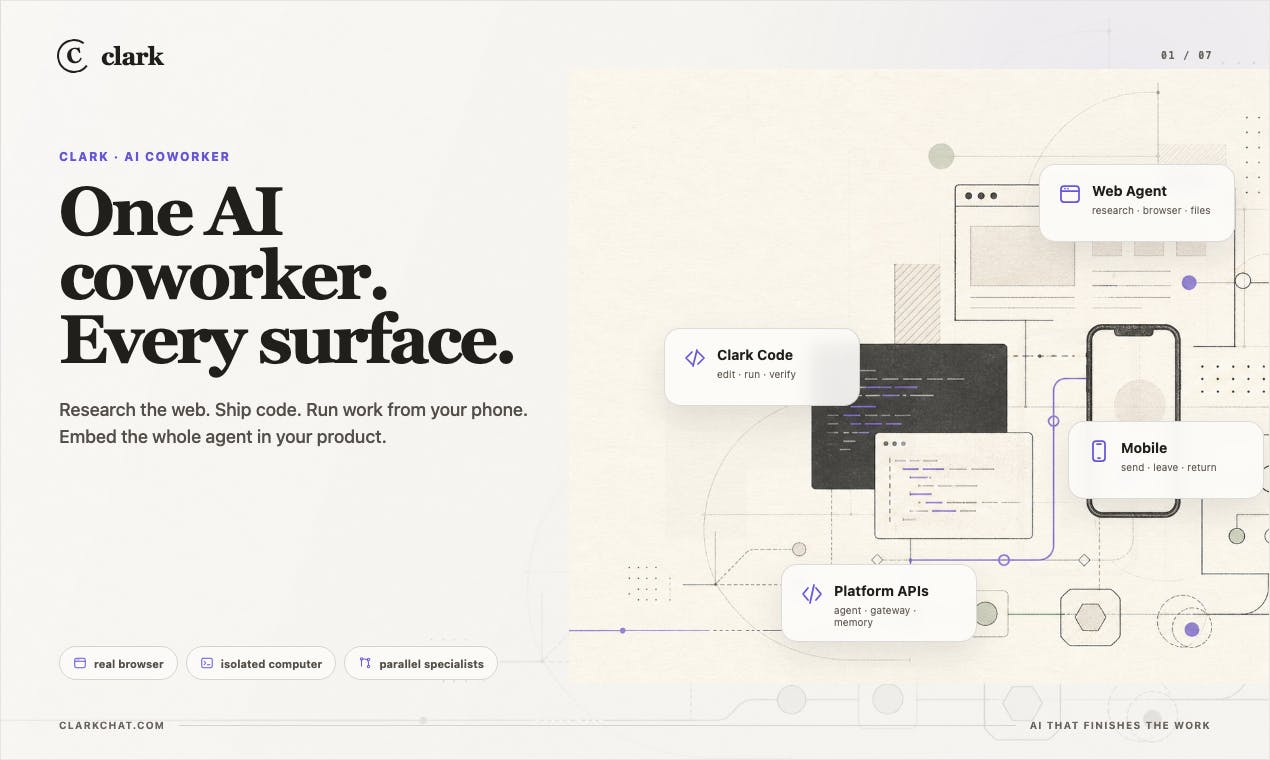
Introducing Clark: Your AI Coworker
Clark emerges as a novel AI tool positioning itself as a "coworker" with a significant differentiator: its own dedicated cloud computer. This isn't just another chatbot or productivity assistant; Clark is designed to operate with a degree of autonomy, leveraging its own computational resources to perform tasks. The concept aims to offload work that typically requires a human to initiate and manage, freeing up users for higher-level strategic thinking or creative endeavors.
The core promise of Clark is to act as a digital entity capable of executing tasks independently. Unlike AI assistants that primarily respond to direct commands and queries, Clark is envisioned to proactively manage and complete work streams. This implies a sophisticated understanding of task dependencies, resource management, and potentially even problem-solving within its operational domain. By providing Clark with its own cloud computer, the developers ensure that the AI has the dedicated processing power and memory it needs to function efficiently without directly competing with the user's local machine or other cloud-based applications.
How Clark Operates
At its heart, Clark is an AI agent designed to function as a remote employee. Users can delegate tasks to Clark, which then utilizes its dedicated cloud environment to execute them. This could range from data analysis and report generation to software development tasks and complex research. The AI coworker model suggests a system that can be onboarded, assigned projects, and monitored, much like a human team member. The AI's ability to possess its own cloud computer is a critical architectural choice. It means Clark isn't a shared resource or a plugin for existing services; it's a self-contained unit with its own operational environment. This isolation can lead to enhanced security, predictable performance, and the ability to run resource-intensive processes without impacting the user's primary workflow.
The underlying technology likely involves a combination of advanced natural language processing for understanding task requests, sophisticated planning algorithms for task execution, and robust infrastructure management for its cloud computer. The goal is to create an AI that doesn't just answer questions but actively *does* things. Imagine asking Clark to "analyze the Q3 sales data and prepare a presentation summary," and instead of just providing a text summary, Clark spins up the necessary tools, processes the data, generates charts, and compiles a draft presentation – all within its own cloud instance. This level of autonomy is what sets Clark apart from many existing AI productivity tools.
Potential Use Cases and Implications
The implications of an AI coworker with its own cloud computer are far-reaching. For developers, Clark could assist with coding, debugging, and testing, running simulations or compiling large codebases in its dedicated environment. For data scientists, it might handle large-scale data cleaning, model training, and inference tasks. For entrepreneurs and founders, Clark could manage market research, competitive analysis, or even draft initial business plans. The "coworker" metaphor suggests that Clark is intended to be an integrated part of a workflow, not just a standalone tool. This could lead to new paradigms in how teams collaborate, with AI agents taking on specific roles and responsibilities.
One of the most intriguing aspects is the potential for Clark to manage complex, multi-step projects. Instead of requiring granular instructions for each sub-task, a user might define a high-level objective, and Clark would break it down, execute each step, and report on progress. This shifts the user's role from task manager to project overseer. The dedicated cloud computer aspect also hints at potential for specialization. Different instances of Clark could be configured with specific software stacks or trained on particular datasets, allowing them to excel at niche tasks. This is less like a general-purpose AI assistant and more akin to hiring a specialist for a specific job, but with the scalability and cost-effectiveness of AI.
Challenges and Future Development
While the concept is powerful, several challenges lie ahead. Ensuring the security and privacy of data processed by Clark's dedicated cloud computer will be paramount. Users need to trust that their sensitive information is handled securely. Furthermore, the complexity of task delegation and AI autonomy requires robust error handling and transparent reporting. Users must be able to understand *why* Clark made certain decisions or encountered issues. The sophistication required to manage a cloud computer and execute diverse tasks means Clark will likely be a premium offering, raising questions about accessibility and pricing models.
The long-term vision for Clark could involve seamless integration with existing work environments, allowing for fluid handoffs between human and AI coworkers. It also opens up questions about the future of work itself. If AI can reliably perform tasks that previously required human intervention, what new roles will emerge? How will companies structure teams when AI agents can fill specific functional gaps? Clark represents a step towards a future where AI is not just a tool but a collaborator, capable of independent action within a defined digital workspace.