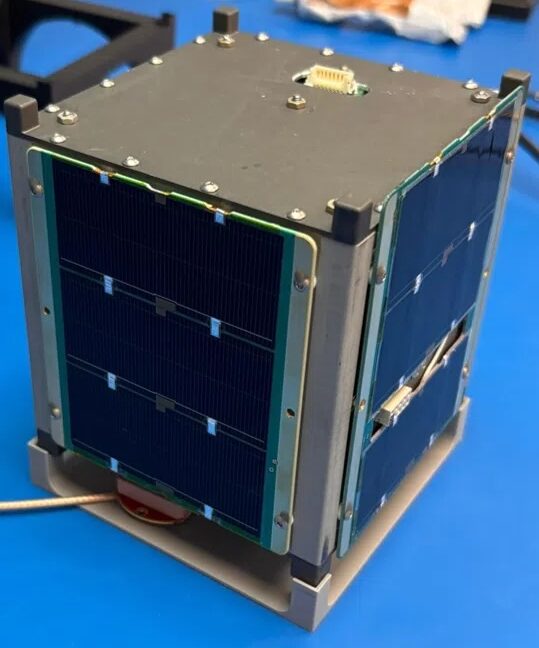
City Labs Ignites Space Nuclear Power Milestone

Miami-based City Labs has achieved a significant milestone in space exploration: the successful activation and operation of the first commercial nuclear fission power system in orbit. The BOHR (Boron-10) mission, launched discreetly, represents a critical step toward enabling long-duration, high-power missions beyond Earth's immediate vicinity. This achievement marks a departure from government-led nuclear space programs, introducing a commercial pathway for this vital technology. For decades, the concept of nuclear power in space has been confined to government agencies, primarily for scientific probes and military applications. The technical hurdles, regulatory complexities, and public perception have historically kept commercial entities at bay. City Labs' success with BOHR demonstrates a viable model for private development and deployment of space-based nuclear reactors. This opens the door for a new era of commercial space infrastructure, where sustained power is not a limiting factor. The BOHR mission's primary objective was to validate the performance and safety of a compact, solid-state fission system designed for space environments. Unlike previous designs that relied on liquid-fueled or more complex reactor types, City Labs focused on a robust, inherently safe design. The system utilizes a unique fuel assembly and a passive cooling mechanism, which are crucial for reliability in the harsh vacuum of space. The successful activation means the reactor is now generating electricity, providing power for the spacecraft's onboard systems and for future experimental payloads. This achievement is not merely about powering a single spacecraft; it's about establishing a blueprint for future applications. Think of it less like a temporary boost from solar panels and more like a compact, self-sustaining power plant that can operate for years, regardless of sunlight or planetary alignment. This sustained power capability is essential for ambitious endeavors such as lunar bases, Mars outposts, and deep-space resource extraction.

Technical Innovations and Safety Protocols

City Labs has not disclosed the exact technical specifications of the BOHR reactor, citing proprietary concerns. However, sources familiar with the project indicate a strong emphasis on inherent safety features. The reactor is designed to remain subcritical until it reaches its operational orbit, a critical safety measure to prevent accidental criticality during launch or ascent. Furthermore, the solid-state design minimizes the risk of leaks or component failures that could compromise the reactor's integrity. The mission's success hinges on its ability to generate a consistent and reliable power output. While the exact wattage is not public, it is understood to be significantly higher than what could be achieved by current solar-electric propulsion systems for comparable spacecraft mass. This increased power density is what enables more ambitious mission profiles, such as faster transit times to outer planets or the operation of high-energy scientific instruments. The BOHR mission serves as a pathfinder for future nuclear-powered spacecraft. Its success provides invaluable data on reactor performance, thermal management, and radiation shielding in a real space environment. This data will be crucial for the design and development of larger, more powerful reactors for subsequent missions. City Labs' approach to safety and regulatory compliance is also a key takeaway, setting a precedent for other commercial ventures in this nascent field.

Implications for the Future of Space Exploration

The implications of this breakthrough are profound. For commercial entities, it means the possibility of building and operating orbital infrastructure that requires substantial and continuous power. This could include advanced manufacturing facilities, large-scale communication relays, or even propulsion systems for interplanetary cargo transport. The ability to generate power locally, rather than relying on energy-intensive propulsion systems or limited solar arrays, dramatically expands the operational envelope for commercial space activities. For scientific exploration, BOHR-derived technology could enable new classes of missions. Imagine probes capable of sustained operation in the frigid outer solar system, or orbital observatories with power budgets that allow for unprecedented data collection. The long lifespan of a nuclear reactor also means that missions can be designed with longer operational periods, reducing the per-year cost of exploration. However, the use of nuclear power in space is not without its challenges. The specter of accidents, however remote, remains a concern. City Labs' success will undoubtedly intensify discussions around international regulations, safety standards, and the responsible deployment of nuclear technology beyond Earth. What nobody has addressed yet is what happens to the thousands of developers who built applications and services around the current limitations of space power, and how they will adapt to a future where power is no longer a bottleneck. The BOHR mission's success positions City Labs as a key player in the future of space power. By demonstrating a commercially viable nuclear fission system, they have not only achieved a technical first but have also opened a new chapter in humanity's quest to explore and utilize the solar system. The era of sustained, powerful, and commercially driven space operations may have just begun.