Manifest V3: The End of Persistent Background Pages
Developing Chrome extensions that operate reliably across arbitrary, third-party websites presents unique challenges. These sites are inherently unstable environments from an extension's perspective. With the advent of Manifest V3, the fundamental architecture for background processes has shifted dramatically. The persistent background page, a stable anchor for many older extensions, is gone. It has been replaced by service workers, which are designed to terminate aggressively after periods of inactivity, typically around 30 seconds. This means any state held in memory within the service worker is lost when it shuts down.
This aggressive termination model necessitates a complete rethink of how extensions manage data and state. Anything that needs to persist beyond the lifespan of a single service worker invocation must be explicitly saved to chrome.storage. This API provides asynchronous storage that survives across service worker restarts and browser sessions.
// ❌ This data dies with the worker
let cache = {}

// ✅ This data survives across worker lifetimes
await chrome.storage.local.set({ key: 'value' });
This shift impacts how developers handle everything from user preferences and session data to complex state required for interacting with web page elements. Developers must now design their extensions with a stateless background and rely on persistent storage for any crucial information.
Content Scripts: The Primary Interface
Given the limitations of service workers, content scripts become the primary, and often only, reliable interface for interacting with web pages. Content scripts are injected directly into the page's context, allowing them to access and manipulate the DOM. However, they too are subject to page reloads and navigation events, meaning their own in-memory state is ephemeral.
The challenge lies in coordinating between the service worker and content scripts. When a service worker needs to perform an action on a page (e.g., extract data, modify an element), it must send a message to the relevant content script. This message-passing mechanism is asynchronous and requires careful handling of responses and potential errors. The service worker initiates an action, the content script executes it, and then reports back.
Consider a scenario where an extension aims to save product details from an e-commerce site. The user clicks a button in the extension's popup. This action triggers a message from the popup to the service worker. The service worker then identifies the active tab and sends a message to the content script running on that tab. The content script, upon receiving the message, executes JavaScript to find the product title, price, and image URL within the page's DOM. It then sends this extracted data back to the service worker. Finally, the service worker receives the data and saves it to chrome.storage.
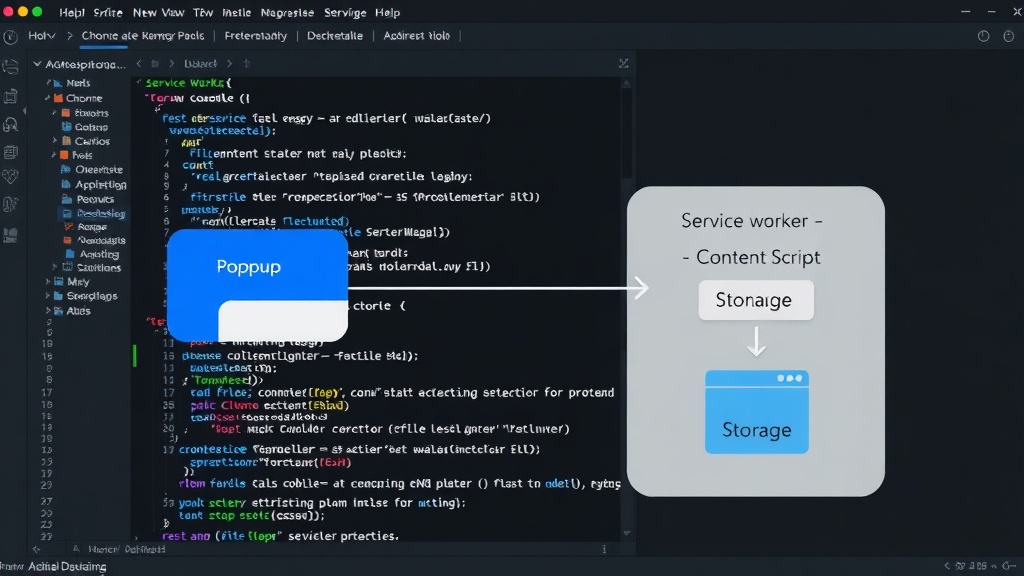
Each step in this chain is asynchronous. The service worker must be active (or be woken up) to receive messages, and it must be able to send messages to content scripts. If the service worker has been terminated due to inactivity, Chrome will attempt to wake it up when a message is received from the popup or a content script. However, this wake-up process adds latency and introduces a potential point of failure if the wake-up mechanism itself is delayed or fails.
Managing State Across Tab Reloads
The most significant hurdle for extensions interacting with arbitrary sites is handling tab reloads and navigations. When a user navigates to a new page or reloads the current one, the existing content script is destroyed, and a new one is injected. Any in-memory state held by the content script is lost.
To maintain context, extensions must rely on the service worker and persistent storage. When a content script is injected into a new page, it can immediately check if it has been run before by querying chrome.storage. If it finds previous state or an identifier indicating it's part of an ongoing user session, it can attempt to re-establish its context. For example, it might inform the service worker that it has loaded on a specific page, and the service worker can then send instructions based on that context.
This approach is analogous to how single-page applications manage state. The client-side (content script) is largely stateless, relying on API calls to a server (the service worker, which acts as a local server for the extension) to fetch and update persistent data (chrome.storage). The service worker’s role is to act as the durable brain of the operation, coordinating actions and ensuring data integrity.
The Unanswered Question: Performance and User Experience
What nobody has adequately addressed yet is the performance impact of Manifest V3's service worker model on extensions that need to be highly responsive. While chrome.storage is efficient, the overhead of waking up a service worker, passing messages, and re-establishing content script context can introduce noticeable delays. For extensions that perform real-time analysis or provide instant feedback, this latency could degrade the user experience significantly. Developers are left to meticulously optimize message passing and storage access, a task that becomes increasingly complex as the extension's functionality grows.
The aggressive termination policy, while designed to conserve resources, creates a tightrope walk for developers. They must ensure critical operations complete before the worker is killed, or that state is saved and retrievable immediately upon its restart. This requires a deep understanding of Chrome's lifecycle events and careful error handling. Designing an extension that feels seamless and instantaneous under these constraints is a significant engineering feat.
Alternative Strategies and Future Considerations
While chrome.storage is the primary mechanism for persistence, other strategies can be employed. For instance, using chrome.runtime.connect for long-lived connections between the service worker and content scripts can help maintain communication channels, although the service worker itself can still be terminated. These connections are re-established when the service worker restarts.
Developers are also exploring techniques like debouncing and throttling user interactions to reduce the frequency of messages and storage operations, thereby minimizing the chance of hitting service worker inactivity timeouts. For complex state, breaking it down into smaller, manageable chunks that can be saved and loaded incrementally can also improve perceived performance.
Ultimately, shipping a Chrome extension that reliably interacts with arbitrary third-party websites under Manifest V3 demands a shift towards a more distributed, event-driven architecture. The service worker is no longer a background constant but a transient process that must be managed with the same care as any ephemeral component. Developers who master this new paradigm will be able to build powerful, efficient extensions that can still operate effectively in the wild, unpredictable landscape of the web.