Chiron: A New Paradigm for AI Verification
The burgeoning field of artificial intelligence often grapples with a fundamental challenge: trust. Large language models and other AI systems generate outputs with varying degrees of confidence, but rarely provide a mechanism for absolute certainty or verifiable provenance. Most AI systems operate on a generate-and-hope model, where users must implicitly trust the output. Chiron, a new open-source project, aims to fundamentally invert this paradigm by prioritizing certainty over mere confidence.
Chiron introduces a novel verification system designed to provide absolute assurance in AI-generated outputs. Instead of simply producing an answer, Chiron focuses on recovering the exact underlying rule that led to that answer. This is achieved through a process inspired by Minimum Description Length (MDL) principles, aiming to find the simplest possible explanation for the observed data. Once a rule is recovered, Chiron rigorously tests it on data it has never encountered before. Crucially, Chiron is engineered to refuse to stamp anything it cannot verify exactly. This means that every output is accompanied by a signed, falsifiable certificate, offering a level of transparency and accountability previously unseen in many AI applications.
The implications of such a system are profound. For applications where even minor errors can have significant consequences—such as medical diagnostics, financial analysis, or critical infrastructure control—Chiron offers a path toward greater reliability. The ability to not only generate an output but to prove its validity through independent, held-out verification is a significant step towards building more robust and trustworthy AI systems.
Core Mechanics: Exact Recovery and Held-Out Verification
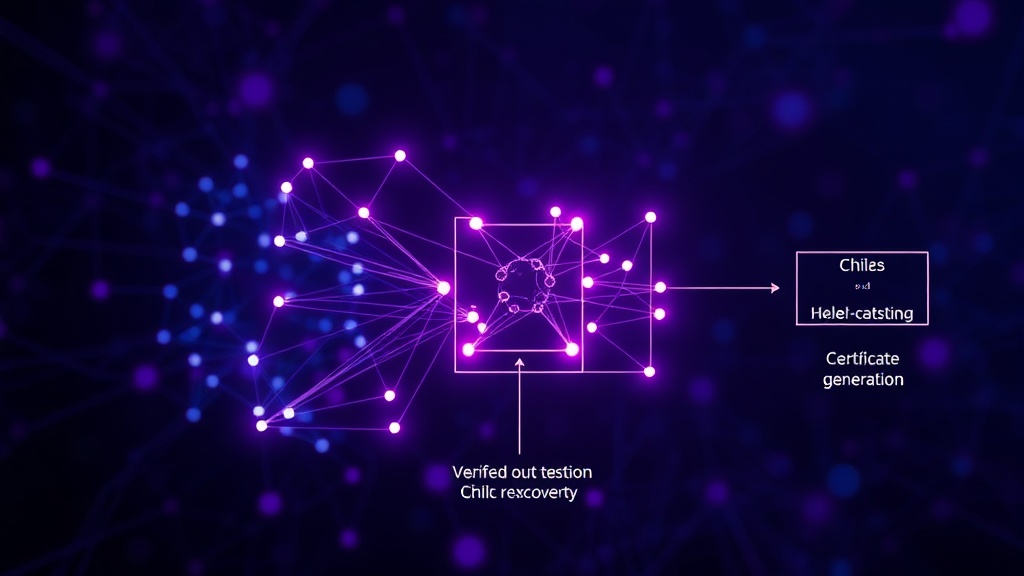
At the heart of Chiron lies its innovative approach to rule discovery and validation. The system employs techniques that seek the Minimum Description Length (MDL) for the observed data. In essence, MDL aims to find the simplest model or rule that explains a given set of observations. For AI, this means striving to uncover the most parsimonious explanation for the patterns learned during training, rather than relying on complex, opaque models that are difficult to interpret.
Once a candidate rule is identified, Chiron subjects it to a stringent held-out verification process. This is not a mere confidence check; it's an empirical test on unseen data. The system takes the recovered rule and applies it to a dataset that was explicitly excluded from the rule discovery phase. If the rule accurately predicts or explains the outcomes in this held-out data, its validity is significantly strengthened. This process is analogous to a scientist formulating a hypothesis and then testing it with new experimental results, a cornerstone of scientific rigor.
The critical differentiator here is the emphasis on *exact* recovery and verification. Many current AI systems provide confidence scores, which are probabilistic and can be misleading. Chiron, conversely, demands a deterministic match. If the recovered rule does not perfectly align with the outcomes in the held-out data, Chiron flags the output as unverified. This binary approach—verified or not verified—eliminates the ambiguity associated with confidence scores and provides a clear, unambiguous signal about the reliability of the AI's output.
The Refusal Engine and Verifiable Certificates
The 'refusal engine' is the gatekeeper of Chiron's verification process. It is programmed to be uncompromising: if the recovered rule fails the held-out verification, the system refuses to provide a definitive output. This proactive refusal is key to preventing the propagation of potentially erroneous or misleading information. It ensures that only outputs that have passed Chiron's rigorous validation checks are presented to the user.
Accompanying every verified output is a signed, falsifiable certificate. This certificate is more than just a metadata tag; it's a cryptographically signed attestation that the output was generated according to a specific, recovered rule that was validated against held-out data. The 'falsifiable' aspect is crucial: it means that the certificate itself can be independently audited and verified. Anyone can take the certificate, the original data, and the recovered rule, and re-run the verification process to confirm its authenticity. This cryptographic proof of validity transforms AI outputs from opaque pronouncements into transparent, auditable assertions.
This mechanism offers a tangible benefit: users can trust that an output bearing a Chiron certificate has undergone a robust, repeatable, and independently verifiable validation process. It’s like receiving a product with a UL certification for electrical safety—you know it’s been tested to specific standards. Chiron provides a similar, albeit more technically detailed, assurance for AI-generated information.
Broader Implications and Future Directions
Chiron’s approach has far-reaching implications for the responsible development and deployment of AI. In fields where accuracy is paramount, such as scientific research, engineering, and autonomous systems, the ability to guarantee the integrity of AI outputs could accelerate adoption and unlock new capabilities. Developers building applications requiring high levels of assurance can now leverage Chiron as a foundational component, rather than attempting to build bespoke verification systems from scratch.
The open-source nature of the project, including its public repository, invites collaboration and scrutiny from the broader AI community. This transparency is vital for building trust in AI systems. As Chiron evolves, it could set a new standard for how AI outputs are validated and communicated, moving the industry away from a reliance on fuzzy confidence metrics towards a more robust system of verifiable certainty.
What remains to be seen is how effectively Chiron scales to the complexity and sheer volume of data handled by state-of-the-art large language models. While the principles of MDL and held-out verification are sound, their practical implementation in massive, multi-modal AI systems will be the true test of Chiron's utility. The success of this endeavor could pave the way for AI that not only generates answers but also demonstrably proves their correctness.