The Illusion of Conversational Memory
Many users approach large language models (LLMs) like ChatGPT with the expectation of a seamless, evolving conversation. We ask follow-up questions, reference previous statements, and assume the AI remembers our dialogue history just as a human would. However, this assumption leads to frustration when ChatGPT delivers answers that feel off-topic, generic, or disconnected from the ongoing discussion. The root cause isn't a lack of intelligence or a bug in the model; it's a fundamental limitation in how these models process and retain conversational context.
Consider a typical interaction: you're researching a topic, asking casual questions. After a few exchanges, you pose a question that relies heavily on the context established in prior messages. You don't restate the subject, assuming the AI will naturally follow. Instead, the model might latch onto an incorrect noun, misunderstand a pronoun, or simply generate an answer that is entirely irrelevant to the immediate thread. This isn't the AI being lazy or forgetful in a human sense; it's a direct consequence of its architectural constraints. The AI doesn't possess persistent memory of past interactions beyond a defined 'context window'.
Understanding the Context Window
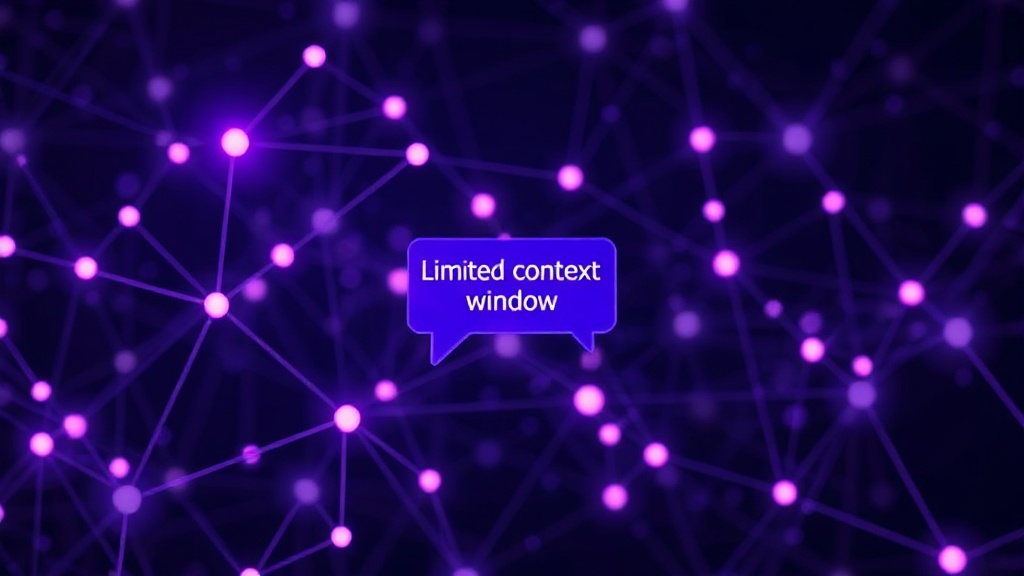
At its core, an LLM processes text by looking at a specific, finite sequence of tokens – words or sub-word units – that precede the current input. This sequence is known as the 'context window'. Think of it less like a human's long-term memory and more like a small notepad on which the AI can jot down notes from the immediate past. When you send a new prompt, the model considers the prompt itself and a limited portion of the preceding conversation history that fits within this window. Anything outside this window is effectively forgotten.
The size of this context window varies significantly between models and even different versions of the same model. Early LLMs had very small context windows, capable of remembering only a few sentences. More advanced models, like GPT-4, boast much larger context windows, often measured in thousands or tens of thousands of tokens. However, even these larger windows are finite. A lengthy, complex conversation can easily exceed this limit, causing the model to lose track of earlier nuances, specific details, or the precise subject matter being discussed. When this happens, the AI must make its best guess based on the *currently visible* text, which can lead to off-topic responses.
The Impact on Answer Quality
This limitation directly impacts the perceived quality and relevance of ChatGPT's answers. Users who expect human-like conversational recall will inevitably be disappointed. If a user asks, "What about its impact on the economy?" without explicitly restating the subject (e.g., "the new policy's impact on the economy"), the model might struggle if the previous turns of conversation have scrolled out of its context window. It might incorrectly infer "its" refers to a different noun mentioned earlier, or simply default to a generic response about economic impacts in general, lacking the specific nuance derived from the prior discussion.
This phenomenon explains why answers can feel generic. Without explicit re-grounding, the AI defaults to its most probable answer based on the limited information it has access to. It's not that the model lacks the knowledge; it's that it cannot access the specific conversational history required to tailor the answer precisely. This is particularly problematic for tasks requiring deep contextual understanding, such as debugging code, refining complex arguments, or developing intricate narratives. In such scenarios, users must actively manage the conversation by summarizing key points or rephrasing questions to ensure crucial context remains within the model's active memory.
Managing Expectations and Improving Interactions
To get the most out of LLMs like ChatGPT, users must adapt their interaction strategies. Instead of treating it as a conversational partner with perfect recall, view it as a highly capable tool that requires precise input. This means:
- Explicitly Restate Context: When asking follow-up questions, especially after a few turns or if the topic has shifted subtly, reintroduce the core subject. For example, instead of "What about that?", try "Regarding the new software update, what about its security implications?".
- Keep Prompts Concise: While LLMs can handle lengthy prompts, very long conversational threads can quickly exhaust the context window. Breaking down complex requests into smaller, sequential prompts can be more effective.
- Summarize Key Information: Periodically, or before asking a critical question, provide a brief summary of the essential points discussed so far. This ensures the most important context is present within the window.
- Understand Model Limitations: Be aware that even models with large context windows have limits. For extremely long or complex interactions, external note-taking or a structured approach might be necessary.
The perceived 'genericity' of ChatGPT's answers is not a failure of the AI's underlying intelligence but a direct reflection of its architectural constraints. By understanding the concept of the context window and adjusting our interaction methods, we can mitigate these limitations and achieve more relevant, nuanced, and useful responses. The fault lies not with the model's mind, but with our assumptions about its memory.