Beyond Simple API Calls: The True Nature of Chainlink Functions
The common understanding of Chainlink Functions as merely a tool for smart contracts to call APIs is a gross oversimplification. While technically true, this view misses the core innovation: it's a decentralized serverless compute platform. Arbitrary JavaScript code executes across a Decentralized Oracle Network (DON), with each node running the code independently. The results are then aggregated using the Oracle's Proven Results (OCR) protocol and delivered back to the consumer smart contract via a verified callback. The ability to call an API is just one capability of the JavaScript environment. The true differentiator lies in the DON's consensus mechanism and the security provided by its threshold-encrypted secrets model, setting it apart from centralized API proxy solutions.
This deep dive explores the complete request lifecycle of Chainlink Functions, detailing every contract involved and the intricate flow of data and execution. This process ensures that off-chain computation performed on behalf of smart contracts is both secure and verifiable.
The Request Lifecycle: From Consumer Contract to Oracle Execution
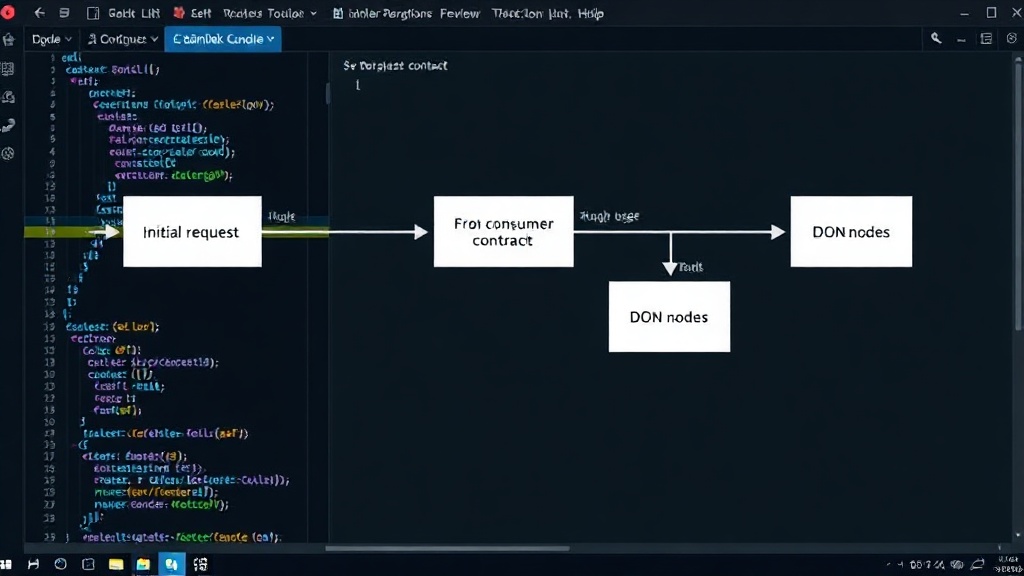
The journey of a Chainlink Functions request begins with a consumer smart contract. This contract initiates a request by calling the requestData function on the FunctionsConsumer contract. This function takes several parameters, including the user's subscription ID, the specific request ID, the user's encrypted private key, the JavaScript code to be executed, and any necessary configuration. The FunctionsConsumer contract then forwards this request to the Chainlink DON, specifically to the Oracle contract responsible for fulfilling the request.
The Oracle contract acts as the gateway to the DON. It receives the request and, crucially, initiates the process of distributing the task to the individual DON nodes. Each node in the DON is responsible for executing the provided JavaScript code independently. This distributed execution is a cornerstone of Chainlink's security model, ensuring that no single point of failure can compromise the integrity of the computation.
Before the JavaScript code is executed, it must be securely delivered to the DON nodes. Sensitive information, such as API keys or private keys required for the computation, are handled through Chainlink's threshold encryption. The user's private key is encrypted using a public key derived from the DON's aggregate public key. This encrypted payload is then distributed to each DON node. Only when a sufficient threshold of nodes agree can the decryption key be reconstructed, ensuring that no single node has access to the sensitive data.
Decentralized Execution and Result Aggregation
Once the JavaScript code and any encrypted secrets are received by a DON node, the node executes the code within a secure sandbox environment. This environment isolates the execution, preventing any malicious code from affecting the node's underlying system. The JavaScript code itself is responsible for performing the desired off-chain computation, which could involve fetching data from external APIs, performing complex calculations, or interacting with other services.
The results of these independent executions are then sent back to the Oracle contract. This is where the Oracle's Proven Results (OCR) protocol comes into play. OCR is a sophisticated consensus mechanism designed to aggregate off-chain data from multiple independent nodes into a single, cryptographically secured report. Each node submits its computed result along with a cryptographic signature.
OCR ensures that a supermajority of nodes must agree on the final result. This threshold mechanism prevents a minority of malicious or faulty nodes from corrupting the outcome. The aggregation process is not merely a simple average; it involves complex cryptographic proofs and verification steps to ensure the integrity and authenticity of the aggregated data. This aggregated and verified result is what ultimately gets delivered back to the consumer smart contract.
Callback Mechanism and Final Delivery
The final step in the Chainlink Functions request lifecycle is the delivery of the aggregated, verified result back to the originating consumer smart contract. The Oracle contract, having successfully aggregated the results via OCR, prepares a callback transaction. This transaction invokes a specific function (often `fulfillData`) on the FunctionsConsumer contract, passing the computed result as a parameter.
The FunctionsConsumer contract receives this result and can then use it within its own logic. This could involve updating its state, triggering further actions, or making decisions based on the off-chain computation. The entire process is designed to be auditable and tamper-proof. The use of cryptographic signatures at each stage, from node execution to result aggregation, provides a strong guarantee that the data received by the smart contract is accurate and has not been manipulated.
The security benefits of this architecture are significant. By distributing computation across multiple independent nodes and using a robust consensus mechanism like OCR, Chainlink Functions mitigates the risks associated with centralized compute solutions. The threshold encryption of secrets further enhances security by ensuring that sensitive credentials are not exposed to any single entity. This robust design allows smart contracts to securely access and process a wide range of off-chain data and computational capabilities, opening up new possibilities for decentralized applications.